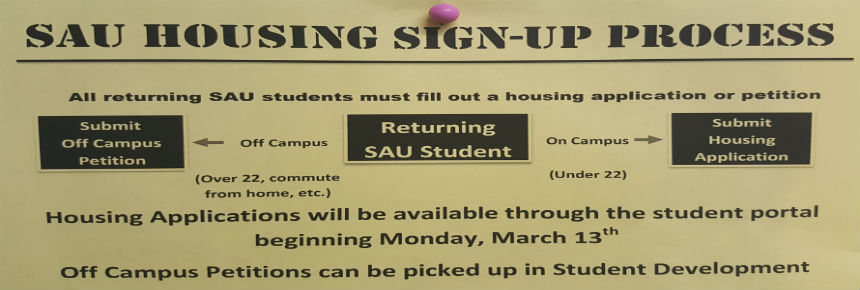
Applying for Community: the reason behind those yellow sheets

By Alex Anhalt
It is time for housing applications again at Spring Arbor University (SAU)

By Alex Anhalt

It is time for housing applications again at Spring Arbor University (SAU).


The bright yellow sheets popping up all across campus prompted roommates-to-be to make last-minute plans, and on March 13, the first applications for K-Houses were available. For the next few weeks, students will be matching up with friends and filling out one form that will help determine their living quarters for the 2017-2018 academic year.


When it comes to housing signups, there are many dates to remember, options to consider and intricacies to iron out. However, Associate Dean of Students Bobby Pratt, head of the housing application system, said the complex workings of the application system actually work to the student’s benefit.


Pratt said most schools will leave it “to the luck of the draw.” This lottery system “lets them assign living options in one fell swoop,” Pratt said, but student requests are granted at random.


Pratt believes there are better alternatives that give students more say in where they want to go, even if those methods are “a little bit more work on our end.”


Applications are given priority based on three main categories: seniority, roommate plans and squatter’s rights.


“We start with what we consider upperclassman housing,” Pratt said. He said the K-Houses and villages are designed to give seniors the chance to live more independently, and since they tend to be the most sought-after options, those applications are available first. Priority is also given to students staying in the same place because Pratt thinks they should be rewarded for “what they’ve invested in that community.”


Applicants who suggest a correct number of roommates will also receive priority, Pratt said, since it saves the administration the challenge of partnering students into well-matched groups.


Every time applicants learn whether or not their application was approved, they are given twenty-four hours before the next applications open. That gives students a chance to shuffle roommates and formulate a new housing plan before the next option is available.
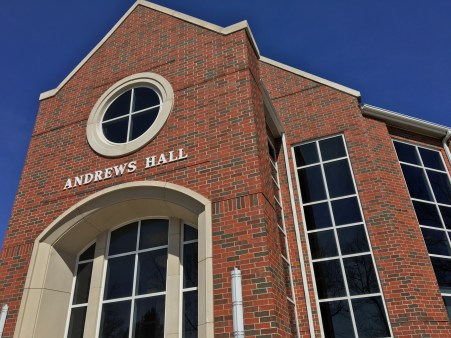
IMG_1621
Photo by Alex Anhalt


Pratt said SAU’s housing system is not just designed to cater to the student; it also maximizes community.


Andrews Hall, a residence hall added to SAU in 2010, is one example of this philosophy. According to Pratt, most universities would avoid building new residence halls with communal bathrooms, but SAU wanted to establish a brand-new community.


Community is also the reason freshmen can’t live in the K-Houses or Villages.


“We want our underclassmen to make a lot of connections and feel like part of the campus,” Pratt said. “We understand that as students get older, they’ve done that, they’ve identified the group that’s going to be their support.”
Village applications close on April 6, and students can opt for any of the residence halls starting April 13.

Mix and Match: the process of building an individualized major

By Collin Caroland
“If you were to throw a rock at a group of 10 college students, the odds are good you would hit one of the eight students who has changed or will change their major, according to the National Center for Education Statistics.”

By Collin Caroland | Online Writer

If you were to throw a rock at a group of 10 college students in the United States, the odds are good you would hit one of the eight students who has changed or will change their major, according to the National Center for Education Statistics. Of that same group of students, most are more than likely to have a major that is a course-load advertised by their school. There are, however, some students who have taken it upon themselves to create their own special courses of study- these courses are often referred to as individualized majors.

Each student has their own reason for choosing s specialized study, Alec Cross cited his primary reason as marketability and practicality.

“I’m studying adolescent spirituality,” Cross said. “It’s basically a youth ministry major, I just pulled out a couple of classes that are more administration and other classes that conflict with my spiritual formation minor and just added them to my major.” Cross’ main concern with making a major was nobody would understand what it meant, but professors and advisors told him the major was fine and would make him more marketable.

Nick Lemerand has a similar story about his own personalized major. Lemerand decided one week before his sixth semester at Oklahoma University he would rather be studying ministry, with a focus on helping adolescents and young adults, than meteorology, so he checked with Spring Arbor, who worked with him so he could combine urban ministry and youth ministry to make college ministry major, and transferred here.

The individual major is unique for each student, and therefore not for everyone. While it may make the student more marketable, it can be difficult to set up.

“I had to look at the semester offerings of each course in all of the related departments myself,” Cross said when asked if the individualized major was a program that had no down sides. “I had to sit down by myself one day and decide which courses could work best, and then get them approved by the overseeing faculty and when they were finally approved, I had to get a form from the registrar and I needed to get six or so signatures from a lot of different people.” From the logistical standpoint, according to Cross, it can be a nightmare to set up. Lemerand advised those looking into it to be wary of the practicality of the individual major.

“You definitely have to have some idea of what you want to do with it,” Lemerand said.

Courses were pulled from a variety of different programs for both Cross and Lemerand, with special thought put into each course so as to make their majors truly their own. Cross and Lemerand both would encourage any student who is looking at an individualized major to talk with their advisors and faculty to determine if an individualized major would be suited for the student’s goals and aspirations.

Focused on Food

By Makana Geppert
“Chartwells, the meal service provider at Spring Arbor University (SAU) recently invited all students to participate in a focus group to survey students’ feelings about their food.”

Chartwells, the meal service provider  at Spring Arbor University (SAU) recently invited all students to participate in a focus group to survey students’ feelings about their food. Chartwells held several group sessions on Jan. 25.

Elijah Drake, a freshman who participated in one focus group, described the session as an extensive meeting to discover his opinions regarding the various stations within the SAU Dining Commons (DC). The focus group gave feedback on four categories: quality, variety, value and staff.

Drake said the best reviews were in regard to the staff, but when it came to the other topics, he said his group had mixed views. Some thought the meals had adequate variety, while others wanted more options. Drake said the lower quality of food on the weekends was brought to Chartwells’ attention during his group’s session.

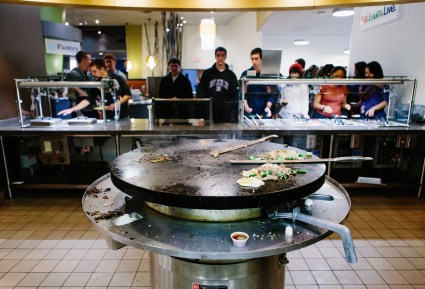
Drake said value, another category, was more important to consumers without a meal plan. Another concern presented by Chartwells was which stations in the DC were most popular and which were declared the least. According to Drake, his group chose The Grill and Create! stations as their favorites.


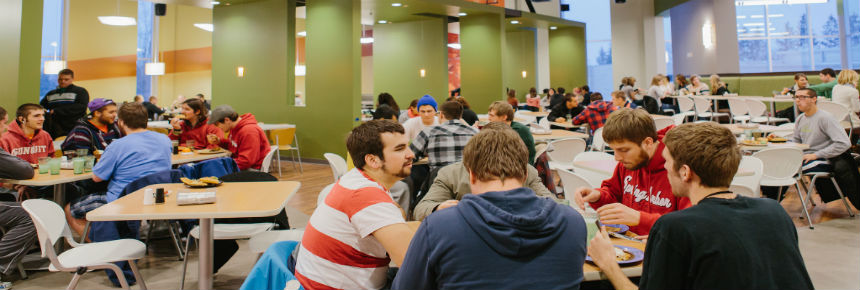
8445442774_519d58958b_k
Photo provided by Spring Arbor University


I found these choices to be interesting and set out to see if I could replicate his results by polling a larger group than his focus group of seven. On a Monday night, I stationed myself in the lobby of Andrews Hall and asked 25 guys who came through which Chartwells food station was their favorite, and for a little more insight, I also asked which was their least favorite. Overwhelmingly the two favorite stations were Create! and The Grill which shared nearly 60 percent of the votes.  On the flip side, the Yo Bowl, Chef’s Corner, and Oven Baked Pizza stations were tied for the least favorite of the survey participants, with a combined total of 72 percent.

Overall, Drake said the employees seemed receptive, and that he is eager to see if any changes come from the survey. DC student worker Grace Comstock was able to bring some insight to the complaints made during the focus group sessions.

“As a student myself,” Comstock said, “I can relate to them. However, I also know what goes on behind the scenes and how much work goes into each meal.” Comstock said the Chartwells employees took the comments made into consideration, and that they wish to improve the meal quality in any ways they can. The whiteboard near the dish return is another important source for feedback, Comstock said.

Not all the feedback is negative, either.

“I hear a lot of complaints indirectly on and off the job,” Comstock said, “but also a lot of compliments.” Comstock said that although complaints remain valid, she still hopes students understand the hard work that is put into “making each meal a pleasant experience for the student body.”


8445434420_028f156883_k
Photo provided by Spring Arbor University


Pirates on Playgrounds

By L.J Richardson
Spring Arbor University brings Gilbert and Sullivan to the stage

After a sabbatical semester Jen Letherer, associate professor of communications, returned to the stage to direct W.S. Gilbert and Arthur Sullivan’s comic operetta “The Pirates of Penzance” which showed in White Auditorium on Feb. 9-11 at 7:00 p.m. and on Feb. 12 at 3:00 p.m.

The decision to produce “Pirates” was a collaborative choice agreed upon by Dr. Mark Douglas and Dr. Natalie Emptage-Downs along with Letherer.

“[Natalie] said we had the voices to do a Gilbert and Sullivan Show,” Letherer said. “”Pirates” seemed the most accessible, and I came up with the idea of setting it on a playground.”

16665842_266256777128443_5822772375350692208_o
Photo by Kimmee Kiefer 

“The Pirates of Penzance” is historically set on the shores of England.

Letherer said, “The story is ridiculous, most opera stories are, and that’s why I think it’s funny we’re setting it on a playground. It strikes me as the kind of story people would just make up.”

According to Letherer, “Gilbert and Sullivan were the Shakespeares of musical theatre. The appeal of Gilbert and Sullivan is the music is incredible, the way it is scored is very memorable, clever, witty, wordy and beautiful. The integrity of the story and the integrity of the music carry it above and beyond.”


16665578_266258577128263_3431978393413812596_o
Photo by Kimmee Kiefer


In a show fraught with pirates, maidens and major generals, Letherer said truth and how it effects the characters was the overall message of the show: “Sometimes truth causes us to leave the ones we love and distance ourselves from those we care about when they are dishonest.” Letherer’s vison is that those who watch the play will examine the truth in their own lives.

Letherer said the one emotion that she wanted audiences to experience at the end of the show was joy. “As the finale states, ‘Poor wandering ones, though thee hast surely strayed, take heart of grace, thy steps retrace, poor wandering ones. Take heart.’”


Cougar Bowling

By Olivia Landis
SAU leads the trend by starting the first ever Crossroads League Bowling team

Bowling is a sport on the rise, and Spring Arbor University (SAU) is the first school in the Crossroads League to have a bowling team. Both are comprised entirely of freshmen, with six students on the womens team and seven on the mens.
The Cougars will be competing in the Wolverine Hoosier Athletic Conference (WHAC) this winter because none of the schools in the Crossroads League have bowling teams. When asked which team will be the biggest competition, Coach Michael Hall is quick to mention
Concordia.
“They have a really good program that has been there for a while now, but all our bowlers have a 220 or better average, so I am confident we will be able to compete well with them
[Concordia],” Hall said.
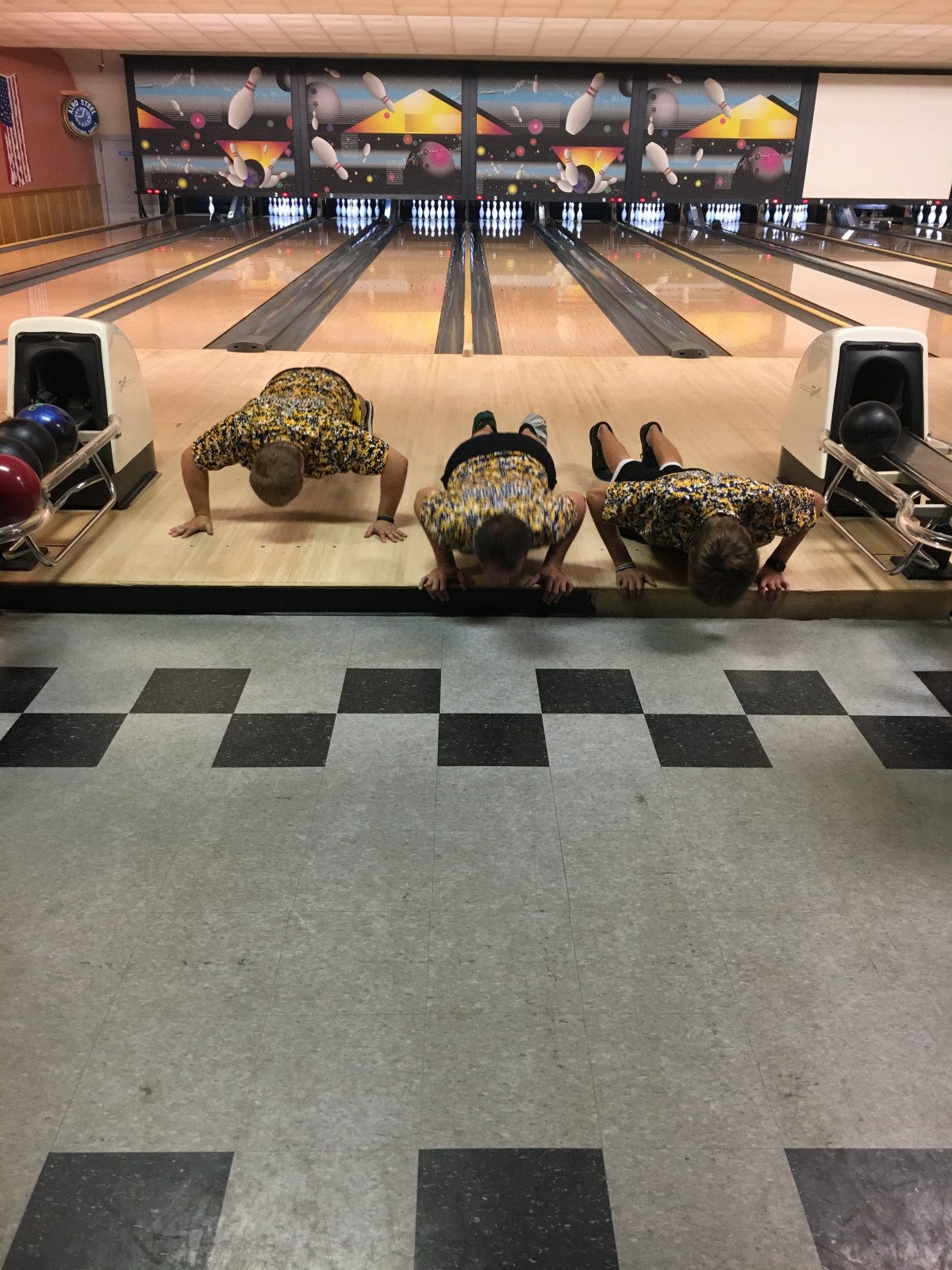
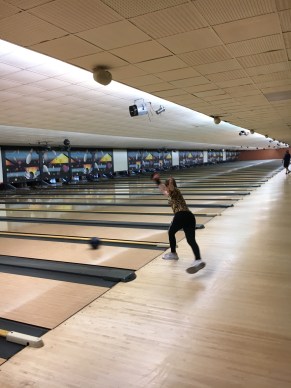
The Cougar bowling teams practice three times a week at Airport Lanes in addition to 6:30 a.m. conditioning twice a week. The conditioning the teams are doing includes lots of sprints, lifting and burpees. The muscle groups Hall wants to target are the forearms and wrists, which are the primary ones used when bowling.
“They are doing sprints because they have to get used to seven or eight hour long tournaments,” Hall said. “In high school they only went for three or four hours.”
In tournaments, the top five bowlers from the mens and the womens teams are chosen to bowl for the Cougars on the tournament day, and each player begins by bowling six individual games. After the individual games, the players get into teams to play a Baker Game, where five of the bowlers get together and bowl as a group, combining their skills for an even higher score. The first bowler bowls the first frame, second bowler the second frame, third bowler the third frame and so on until they have finished the game.
In the tournaments, players use different types of bowling balls to achieve different purposes. One ball is covered in resin and curves more. The players bowl with it first, because they can curve it and knock down more pins. The next ball is plastic and is better for spares because it rolls straight. And the heavier the ball, the harder it will hit the pins because it has more momentum behind it. The average weight of a ball used, for both men and women, is 15 pounds.
img_0234
Photo by Olivia Landis
A challenge for the players lies in the oil patterns on the lanes. All lanes have a layer of oil, but it is smooth and uniform when people bowl for fun. For the more experienced bowlers,
there are oil patterns put down on the lanes to make it harder to get a strike on nearly every opportunity. The oil is laid down so there will be hooks, curves and smooth parts in the lane. This forces the bowlers to be creative with their releases.
The Spring Arbor bowling teams are sponsored by Ebonite International, which provides all the bags and bowling balls for the team. The teams also have an advantage over other schools because they have access to a machine called a Strike Seeker. This records the athlete as they bowl and breaks down their form.
Practice begins with some stretches to warm up, and then a warm up game for the bowlers. During the warm up game, the coaches are able to go around and talk to them about footwork, approach and the best angles to take. After warm ups, they will do more specific drills to work on endurance, form and the precision of hitting a single pin. Almost all of the athletes have been bowling since they were toddlers. Hall found his recruits through YouTube videos and tournaments such as the Junior Gold Tournament.
Hall started the bowling program at Cornerstone, and he heard about Spring Arbor when SAU contacted him asking for information on how he got the program started there.
“After the initial call, I was kind of intrigued. I was working part time and looking for a full time position, which Spring Arbor had. I asked if I could throw my name in the hat, and my family and I visited here four times before I took the offer,” Hall said.
Assisting Hall this winter is Coach Rich Bradley, who is currently coaching at Western High School.
“Their practices go 2:30-5:30, and we go 7-9, so I’ll be pretty busy this winter… but I love it.” Bradley said.
You can truly see the passion the coaches and players have for the sport. Practices are focused and intense, and Hall said the fans and teams get competitive and crazy at
tournaments. They have their own cheers, trash talk and dress in crazy
attire to support their team.
Hall is working to make the adjustment as smooth and comfortable as possible.
“I always tell them I live close to campus, and if you need a break and want to come hang out, the doors are always open.” He laughs and adds, “They definitely take advantage of that, but I love them.”

SAU welcomes new nursing center

By Heather Clark
Oct. 1 marked the opening of Spring Arbor University’s (SAU) new undergraduate nursing lab.

Oct. 1 marked the opening of Spring Arbor University’s (SAU) new undergraduate nursing lab. On Homecoming Day, President Brent Ellis dedicated the Jaworski Clinical Simulation Center and Physical Therapy & Sports Medicine Service clinic on the other side of M-60.

“We’ve had nursing for a long time, but this is a unique element,” Al Kauffman, chair of the department of nursing, said. “[our previous] nursing program we had was for people who were nurses already. Now you can enter as a non-nurse.”
megan-himebook_9197
Photo by Megan Himebook
According to Kauffman, SAU has offered bachelor’s degree completion programs for those holding associate’s degrees since 2001. A master’s program followed in 2009, but both required a student to have at least an associate’s degree to enter the program.
Kauffman said the process to create the undergraduate program began in 2014. After creating a business plan, deciding on curriculum offerings and planning a budget, the program was required to seek approval from the Michigan Board of Nursing. The program also required approval from the academic and administrative committees at SAU, which it received last year.
Several other departments, especially in the science department, had to redesign their curriculum to be qualified to offer the necessary support knowledge for nursing majors, according to Raymond Jones, director of campus nursing. The increased rigor of the courses is meant to prepare nurses to pass the required certification exams with better scores and more knowledge.
The Michigan Board of Nursing approved the new program on May 5, allowing the university to select classes of 30 students to enter the program until two classes have
been graduated. Those two classes will then be evaluated based on a standardized test, the National Council Licensure Examination.
Jones has been involved in planning not only the educational aspects, but also new facilities that will open for the department. A portion of SAU’s Physical Plant building
has been converted to a simulation center containing lifelike practice mannequins. The center shares space with a physical therapy clinic that will be open to the public and used jointly by SAU’s physical therapy courses and the nursing department for training in therapy and safety practices.
Sophomore Jaydn Fuerst will be one of the department’s entering undergraduates for the class of 2020. She said she is most enthusiastic about the availability of the new programs and the ability to take all of her required classes at one school.
Another student entering the program is Jonathan Matwiejczyk, a 2015 graduate biology major. He said he had been searching for a job when he found out about the available
nursing program.
“I loved the idea of being able to return to Spring Arbor, not only for the community and it already being my home for the last five years, but also I already had great relationships I had cultivated with the professors over the years,” Matwiejczyk said.
megan-himebook_9202
Photo by Megan Himebook
Jessica Khoury, a sophomore transfer from Michigan State University, said she is looking forward to the hands-on clinic.
“It will be a place where mistakes will be made, but better to made in the lab than in the hospital,” Khoury said.
Fuerst also expressed excitement for the clinics. She was able to participate in simulation equipment tests last year when the program was being set up, and practiced with a specially designed mannequin.
“I helped deliver a fake baby,” Fuerst said. “It was pretty awesome.”

Save

Where the money for the five dedications comes from

Ever wondered why there’s a 30,000 lbs rock at the front front of the school? Or how these donors discovered Spring Arbor when some of them are not alumni? President Brent Ellis explains the stories behind each facility.

Kayla Williamson | Editor-in-Chief

The new tennis complex, renovated locker rooms, upstairs Sayre-Decan mural, rock entrance and nursing lab officially opened on Homecoming Day, Oct. 1.

Almost 100 percent of these five dedicated facilities were paid by donors, people who want to show their love and appreciation towards the school. None of the money to build these came from tuition.

Ever wondered why there’s a 30,000 lbs rock at the front front of the school? Or how these donors discovered Spring Arbor when some of them are not alumni? President Brent Ellis explains the stories behind each facility.

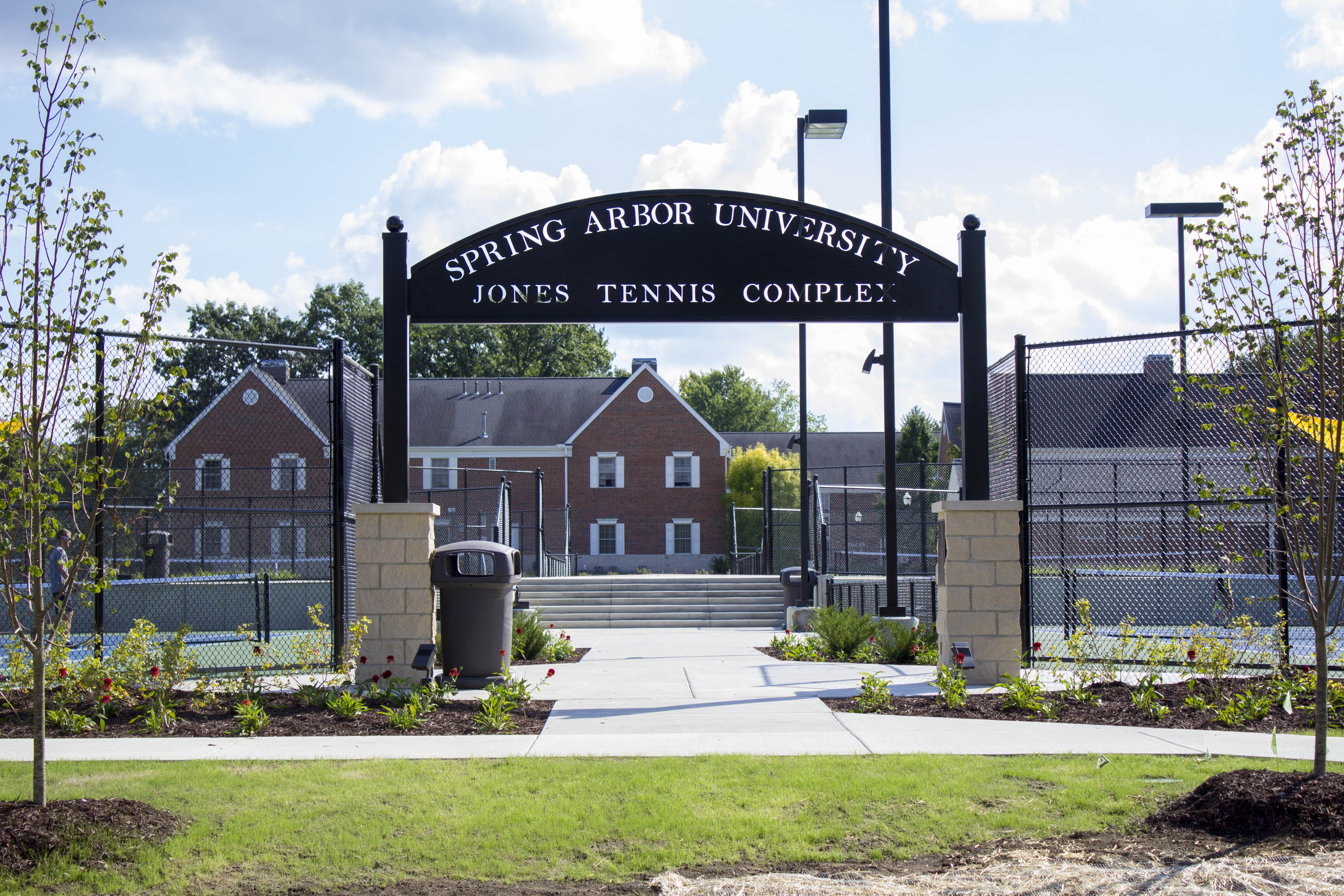
The Jones Tennis Complex

Jones Tennis Complex

Who: Ron & Marvelle Jones and other donors

What: $1.3 million tennis courts and $250,000 in scholarships

Where: North of Ogle Villages

The Story: “Ron Jones, a new board member for SAU, and his wife love tennis and  have a long history with SAU tennis alumni. That began to influence their interest in Spring Arbor. It was a real natural gift.” – President Brent Ellis

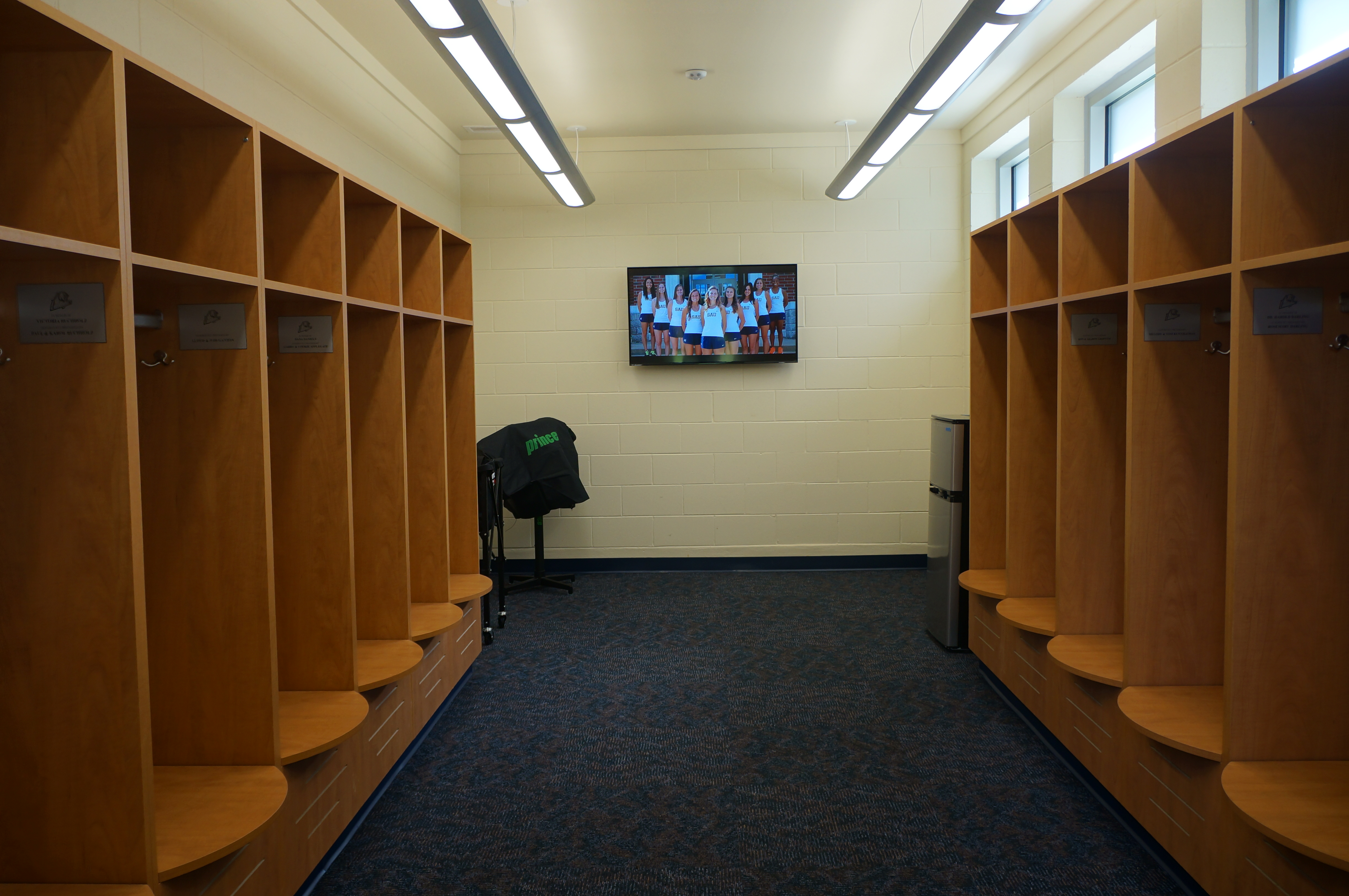
Varsity Locker Rooms for Basketball and Volleyball

Locker Rooms

Who: Faith Small (women’s locker rooms) and anonymous donors (men’s locker rooms)

What: $185,000 to renovate locker rooms

Where: Fieldhouse

The Story: “Trent Allen, who the men’s locker rooms are named for, had a relationship with the donor couple, and he passed away, which is why it is named for him. The women’s locker rooms were funded by Faith Small who was a board member who just passed away. It was eight or 10 months before she died that she had given the funds to renovate the women’s locker rooms.” – President Brent Ellis

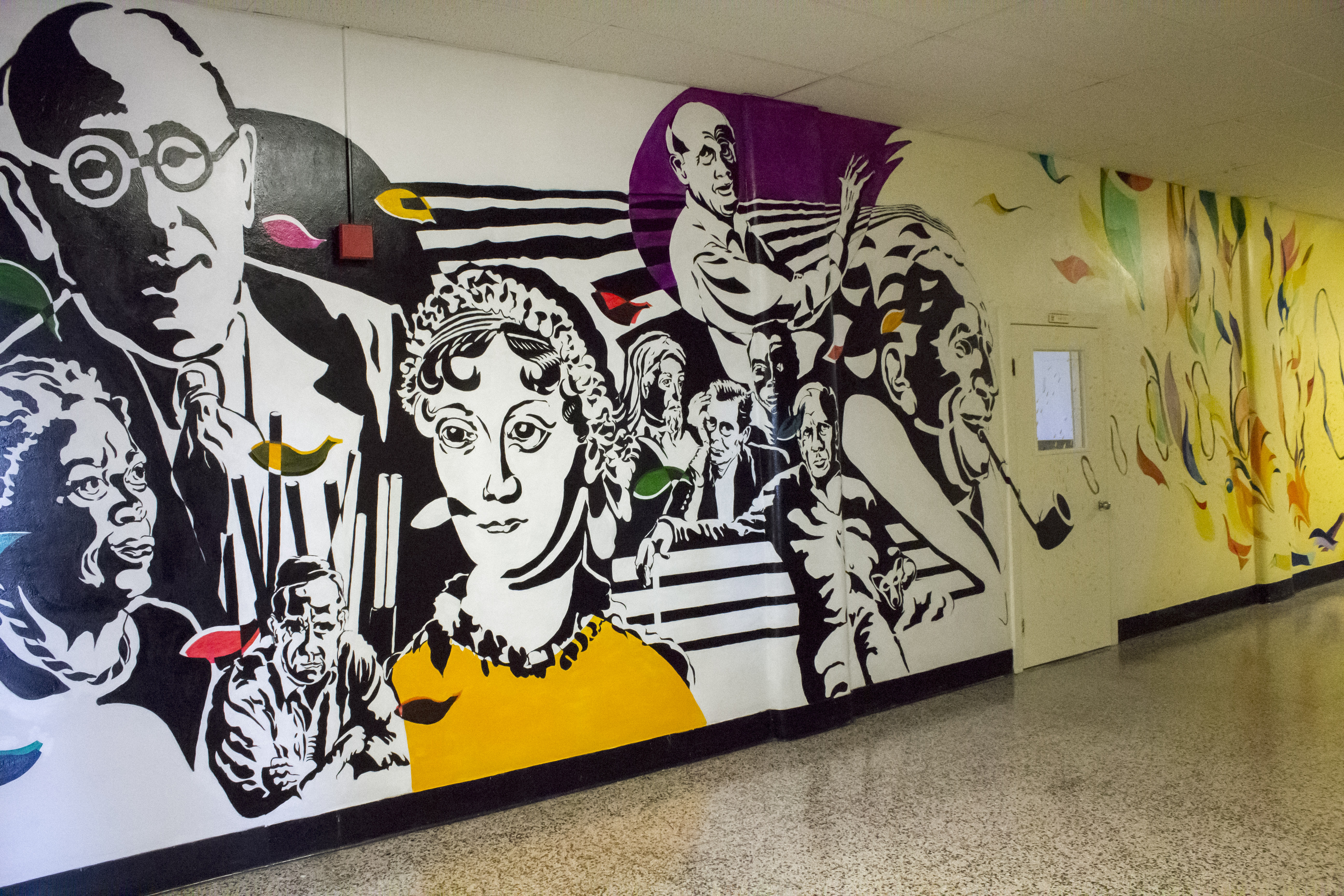
“Word & Image” Mural

Mural

Who: Joel Varland, Roger Varland’s brother

What: Donated labor to paint a mural highlighting some of the influential authors of the Christian faith

Where: Upstairs Sayre-Decan Hall

The Story: “Joel heard that we were doing [the DC] mural a couple years back. He worked with Kimberly Moore-Jumonville and the faculty in the department of English and came up with who would make the wall and who wouldn’t make the wall.” – President Brent Ellis

E.P. Hart Circle

EP Hart Circle Rock

Who: Hal Munn, board of trustees, and anonymous donors

What: $40,000 memorial for EP Hart, the founder of SAU

Where: EP Hart Circle

The Story: “Hal Munn was one of the catalysts for the memorial when it was first raised in 2003. Two weeks prior to Hal’s death, I went to go see him just to pay my respects and he said, Brent I need you to promise me two things: first thing have a tenure of more than 20 years, be the president for more than 20 years. I said well that’s going to be up to our board. And he was like yes—you be committed. I said I am committed to this place. I’m glad I’m here and I believe in what this place is and he said the second thing is I want to give a legacy gift to complete the construction of the EP Hart circle. I said Hal, we’ll find a way to get it done. He made a very generous gift from his family. That gave us almost what we needed to get it done. We’ve gone out and raised and additional 15-20k to fund that circle as well. It’s not just going to be a memorial, but also an entrance, and that’s why you see the brick façade that says Spring Arbor University, lights, when you come into that entrance, you’ll now where you are. It also will serve as a nice welcome, entrance into the university, which I don’t think we have a entrance, where’s the front gate, where the front door. Now that will be the front door to the university.” – President Brent Ellis

Jaworski Clinical Simulation Center and Physical Therapy & Sports Medicine Service Clinic

Nursing Lab

Who: Joe Jaworski, retired professor of biology

What: Clinical space (labs) to kickstart a residential nursing program

Where: Across M-60 in the old Physical Plant

The Story: “As we’ve been doing market research and where we’re losing students, nursing continued to be a place where we continued to lose students because people wanted a nursing degree from a Christian university, so we were losing students to Indiana Wesleyan, Huntington, etc. I could name 10 people that I know that did not go here because of the nursing program. One of our professors, Joe Jaworski, a 30+ year faculty member in Biology, left a significant portion of his estate to the university with the caveat that it would go towards benefiting the sciences. Through conversations with our science faculty arrived at the idea if we started a nursing program that would provide a consistent stream of students into biology and into chemistry and allow us to recruit some students that we’d been losing.” – President Brent Ellis

Save

SAU Hosts Alumni Graphic Design Exhibition

By Emily Spencer
Ganton Art Gallery is hosting Spring Arbor University’s (SAU) first Alumni Graphic Design Show.

Ganton Art Gallery is hosting Spring Arbor University’s (SAU) first Alumni Graphic Design Show. Though Spring Arbor has held alumni shows before this is the first centered on graphic design. The show is up from Sept. 18 to Oct. 9.

In order to organize the alumni show, Associate Professor of Art, Brian Shaw had to contact the alumni and send out a call for entries. The art faculty then set up the show using the pieces sent in by the alumni.

Spring Arbor alumni, Kari Shimmel, class of 2003, spoke for the opening of the show. Shimmel worked for Daniel Brian Advertising in Rochester, Mich. for 11 years before going to work for another advertising agency, Campbell Ewald. Shimmel is now the chief marketing officer at Campbell Ewald where she oversees new business development. Along with a team of coworkers, she works to come up with a vision for the brand and pitch their ideas to the company. She has worked with many large brands, most recently, Travelocity and Harley-Davidson. Shimmel also oversees external as well as internal communications. This includes working on Campbell Ewald’s website, stationary and communicating the values of the company.

At the end of her talk, Shimmel gives four pieces of advice to the students. Her first advice was always try harder, stressing the importance of going above and beyond the work assigned. Secondly, said every class counts. General education classes Shimmel never thought she would need have proved to be essential to her job. Her third piece of advice was to impact culture. Her job in advertising gives Shimmel a great opportunity to make a difference in the culture around her. Finally, she said to be faithful. Throughout the course of her work, Shimmel has had to request not to work on certain projects because they did not coincide with her beliefs.

Shimmel is not the only alumni whose art pieces have made their way into the gallery. The other alumni participating in the show are, Lauren Nadrowski, class of 2011, Josh Smiertka, class of 2014, Beau Ulrey, class of 2013, Derrick Robbins, class of 2010, Emily Reed, class of 2011, Jake Fletcher, class of 2015, Kaitlin Lutz, class of 2015, Kevin Sharp, class of 2015, Kwade Joslin, 2013, Mackenzie Varnagatas, class of 2015, and Mark Adkins, class of 2013.

Shaw, class of 1990, also has a few pieces in the show. As an alumni of SAU, Shaw felt that it was important that he participate in the show.

“I felt like I should be represented,” Shaw said “I wanted to join my colleagues in showing work.”

Shaw said of his students, “I’m only going to feel successful if you’re successful.” Shaw feels it is important to showcase alumni as artists who have succeeded in SAU’s art program.

“I’m so proud of what they’re accomplishing out there,” Shaw said. This sense of pride and joy, Shaw said, is one of the main reasons that alumni shows are so important.

According to Lecturer of Art, Brianne Witt, another reason for holding alumni shows is it gives current students the opportunity to see what they could accomplish once they graduate from SAU.

“It’s great information for the students to just see the different ways they can take their skills that they’re learning within the art department,” Witt said. According to Witt, seeing the work of SAU alumni can provide direction for current students.

She said, “It’s good for them to see the different ways they can reach their ultimate goal.”

The show will run in the Ganton Art Gallery until Oct. 9 and a second reception was held on Oct. 1 at 3:30 p.m.

Our Ocean Conference 2016

By Amber Cekander
The Pulse had an opportunity to participate in a national conference call about the annual Our Ocean conference.

The Pulse recently had an opportunity to participate in a national conference call with other student publications from campuses across the country. The call was hosted by Judith Garber,  who works in Washington D.C. as the assistant secretary of state for oceans, international environmental and scientific affairs. The focus of the call was to bring attention to the annual Our Ocean conference which gathers nations across the globe to discuss ocean conservation. Our Ocean was held Sept. 15 and 16 in Washing D.C. and included keynote talks from Secretary of State John Kerry, President Barack Obama and actor Leonardo DiCaprio.

“Secretary Kerry is fond of saying that nothing connects all of us but the ocean,” Garber said in the call.

After a brief introduction about the purpose of the event, the call was opened up to the students to ask questions about the conference and its goals.

Sarah Antozzi from the Marlin Chronicle at Virginia Wesleyan College asked Garber to communicate the one main takeaway she would like students to have from the call.

“That our ocean is under threat, that solutions are possible, and it’s all of our responsibility to take action to help our ocean,” Garber said.

oceans_factsv5_page_11a
Graphic from ourocean2016.org

The main focus areas of the conference were centered around marine protected areas, climate, sustainable fisheries and marine pollution. Different solutions and ideas were proposed at the conference along with monetary donations and commitments to aid in those solutions.

Since the international conference was focused on what countries as a whole can do for ocean conservation, Katie Gagliano from the Daily Reveille at Louisiana State University asked what role the national administration was encouraging states to play.

Garber responded by confirming that some states were actually participating at the conference. “This is an issue that can’t just be solved by governments or international organizations. It is something that needs state and local communities. We are trying to do outreach at every level,” she said.

But what about states like Michigan that aren’t bordering an ocean? Spring Arbor University’s Professor of Biology Chris Newhouse said that, in terms of effects from ocean pollution, there would be “relatively few negative impacts” on the Michigan and the Great Lakes.

5-ouroceanplastic
Graphic from ourocean2016.org

Both Garber and Newhouse mentioned the role plastic plays in ocean pollution. According to Garber, the “ocean is suffering from massive quantities of plastic waste.”

Newhouse said, “We can make plastics bio-degradable. Or we can do a better job of recycling plastics. If we can figure out how to remove them in the ocean most of the those [solutions] could be applied to the Great Lakes.”

More information from the conference can be found on the website ourocean2016.org

Save

The Dangers of Desire

By Heather Clark
Radio host Al Kresta visited SAU to discuss the dangers of loving a material world.

“What do you want?”

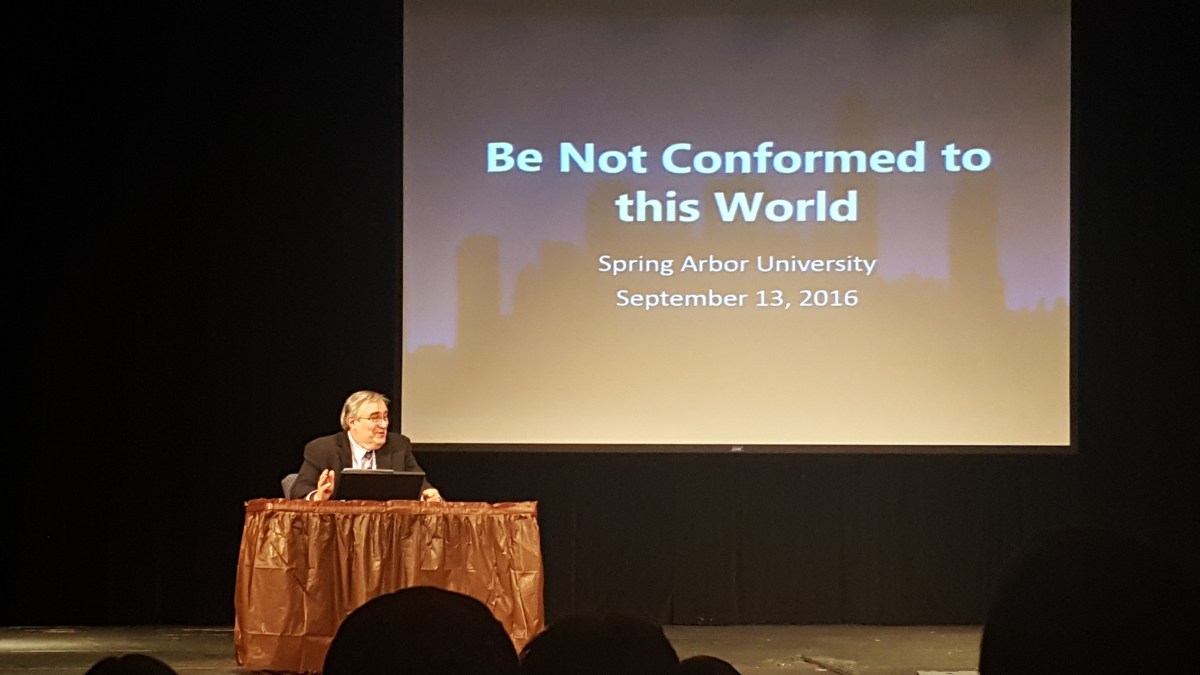
This was the foundational question Catholic radio program host and apologist Al Kresta asked at his lecture Sept. 13 at Spring Arbor University (SAU).

Kresta, whose daily program has an audience of nearly three-hundred radio stations, including the local Catholic station “Good Shepherd Radio,” has been a colleague and friend of SAU’s Professor of Communication Paul Patton for almost 40 years. The two have worked on theatrical productions and radio broadcasts together. Kresta was invited by the department of communication to speak and participate in a post-lecture reception.

For his audience of nearly one-hundred-fifty people, Kresta expounded on the dilemma Christians face in modern society. He cited seemingly conflicting Biblical messages that advise against loving the “world” but then tell us that God loves the world he created.

“Pleasure becomes hedonism, and enjoying food becomes gluttony. Kresta made me realize that one can worship through these things without worshiping the things themselves,” sophomore Trevor Tarantowski said.

Cameron Moore, assistant professor in English, said he hoped his literature students who attended the lecture would see parts of their own studies reflected.

“Loving rightly, ordering our desires, it’s very much like Dante [‘s Divine Comedy],” Moore said.

Many modern Christians, according to Kresta, rationalize their involvement and consumption of the world’s value system.

“They say, ‘God loves the world,’ so shouldn’t we imitate him?'” Kresta said.

This, Kresta said, indicates a failure to realize that the “world” spoken of in scripture has the dual meaning of the created order and also of the secular value system. There is an important distinction there that renders the seemingly conflicted passages understandable.

Kresta went on to illustrate his topic of remaining un-conformed through examples of three “illusion generators” that he said cause people to desire “the contradictory and the impossible,”. The illusion generators Kresta cited were the unattainable beauty standards set for women, media manipulation of “news” and ubiquitous advertising and marketing competing for attention.

Leah Rose, a junior advertising and public relations major, found Kresta’s talk very applicable to her own studies.

“I enjoyed Kresta’s talk because it was thought provoking; his statement about Jesus’ earthly “competition” being brands and materialistic objects changed my perspective on what and how I consume,” Rose said.

kresta2

Kresta said for the church to remain ‘relevant’ in society, it must not succumb to the devices of modern culture but rise above them by remaining distinctive.

Junior pre-engineering major Abigail Owens remembered the following quote from Kresta’s lecture: “What you lure them with is what you lure them to.”

“As he pointed out,” Owens said, “the church was not meant to be just another economical good.”

“Brands need to make us feel good. They exist to distract people,” Kresta said. His vision of the church is a place that does not dismiss the uncomfortable and painful realities of life, but rather “Bear[s] witness in the midst of suffering to joy that goes beyond.” The community and belonging offered by the church, he said, is real, not an advertising gimmick to lure consumers, and should be the reason people decide to attend a church.

Phil Webster, senior Biblical Studies major, said the advice Kresta gave will change how he reacts to the information he finds in popular media.

“Advertisers focus on our wants of happiness, fulfillment and pleasure, but that’s only because we’re so carnally minded. I’m going to keep better inventory of my wants and see to it that they are both God pleasing and beneficial for the kingdom,” Webster said.

“His question, ‘what do you want’, is really key to your soul,” Charles White ,prrofessor of Christian thought and history, said.

Kresta, in a reworking of 1 John 4:4, summed up his statements of the church’s relevance in society:  “Greater is He that is in us…than he who is over there at Starbucks or Nike or Google.”