Extended SGA President and VP Q&A

By Elise Emmert
This is an extended version of our interview with Richard Harris and Catherine Galloway, the newly-elected SGA President and Vice President.

By Elise Emmert

This is an extended version of our interview with Richard Harris and Catherine Galloway, the newly-elected SGA President and Vice President. To read the rest of the interview, check out page five of The Pulse.

The Pulse (TP): How do you think your involvements in activities on campus, like Enactus and in the Office of Intercultural Relations (OIR), have prepared you for this leadership role?

Catherine Galloway (CG): I feel like being an Intercultural Advisor (IA) has given me a look into what leadership looks like on campus, around events, what weekly meetings look like, and what the structure on campus looks like.

Richard Harris (RH): In Enactus we do a lot of stuff in the Jackson community, so I have that relationship outside of Spring Arbor. That helped me build relationships within the school because not everybody in Enactus is a business major. So that branches me out beyond what I’m studying, and helps me develop more friendships.

TP: What skills do you think you bring to the table, other than what you have learned in Enactus and as an IA?

RH: Personally, I believe our social skills. If you can’t really tell we’re people’s people, and we’re very outgoing. That could actually be a big factor when it comes to standing in advocacy for certain things that the student body wants.

CG: I feel like working for OIR here and doing three and a half years of missions in high school in another country has taught me about what diversity looks like, even on a campus like this, and how to pull it together. (It taught me how to) be able to listen to students and be able to hear what they want and where they’re coming from.

RH: That amplification of diversity is something that we really enjoy, obviously, in ourselves. I’m an African-American male, if nobody knew that (laughs). That’s part of who I am, but that’s literally just one part of who I am. The other sides of who I am, I am a spiritual believer, I have a solid foundation in Christ, I love God with all my heart, mind, and soul, and I plan to radiate that love in this position.

TP: How do you plan to show Christ through your administration?

RH: I would really love to amplify the knowledge of Christian ministries that are here on a Christian university. There’s so many, and I believe the only thing that’s lacking is on the student’s part. There’s a lot of phenomenal ministries, they just need student participation.
 

Applying for Community: the reason behind those yellow sheets

By Alex Anhalt
It is time for housing applications again at Spring Arbor University (SAU)

By Alex Anhalt

It is time for housing applications again at Spring Arbor University (SAU).


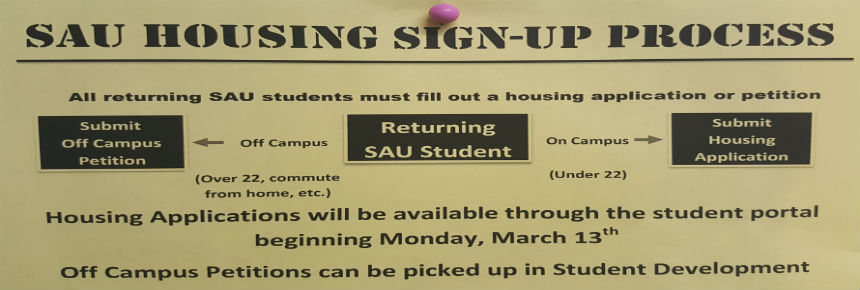
The bright yellow sheets popping up all across campus prompted roommates-to-be to make last-minute plans, and on March 13, the first applications for K-Houses were available. For the next few weeks, students will be matching up with friends and filling out one form that will help determine their living quarters for the 2017-2018 academic year.


When it comes to housing signups, there are many dates to remember, options to consider and intricacies to iron out. However, Associate Dean of Students Bobby Pratt, head of the housing application system, said the complex workings of the application system actually work to the student’s benefit.


Pratt said most schools will leave it “to the luck of the draw.” This lottery system “lets them assign living options in one fell swoop,” Pratt said, but student requests are granted at random.


Pratt believes there are better alternatives that give students more say in where they want to go, even if those methods are “a little bit more work on our end.”


Applications are given priority based on three main categories: seniority, roommate plans and squatter’s rights.


“We start with what we consider upperclassman housing,” Pratt said. He said the K-Houses and villages are designed to give seniors the chance to live more independently, and since they tend to be the most sought-after options, those applications are available first. Priority is also given to students staying in the same place because Pratt thinks they should be rewarded for “what they’ve invested in that community.”


Applicants who suggest a correct number of roommates will also receive priority, Pratt said, since it saves the administration the challenge of partnering students into well-matched groups.


Every time applicants learn whether or not their application was approved, they are given twenty-four hours before the next applications open. That gives students a chance to shuffle roommates and formulate a new housing plan before the next option is available.

IMG_1621
Photo by Alex Anhalt


Pratt said SAU’s housing system is not just designed to cater to the student; it also maximizes community.


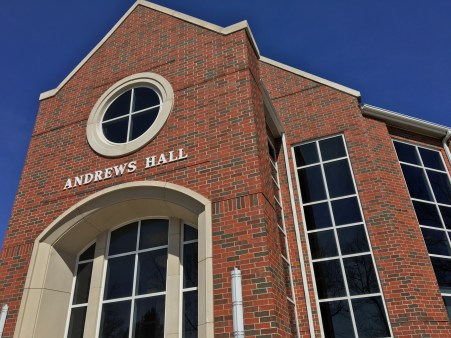
Andrews Hall, a residence hall added to SAU in 2010, is one example of this philosophy. According to Pratt, most universities would avoid building new residence halls with communal bathrooms, but SAU wanted to establish a brand-new community.


Community is also the reason freshmen can’t live in the K-Houses or Villages.


“We want our underclassmen to make a lot of connections and feel like part of the campus,” Pratt said. “We understand that as students get older, they’ve done that, they’ve identified the group that’s going to be their support.”
Village applications close on April 6, and students can opt for any of the residence halls starting April 13.

Mix and Match: the process of building an individualized major

By Collin Caroland
“If you were to throw a rock at a group of 10 college students, the odds are good you would hit one of the eight students who has changed or will change their major, according to the National Center for Education Statistics.”

By Collin Caroland | Online Writer

If you were to throw a rock at a group of 10 college students in the United States, the odds are good you would hit one of the eight students who has changed or will change their major, according to the National Center for Education Statistics. Of that same group of students, most are more than likely to have a major that is a course-load advertised by their school. There are, however, some students who have taken it upon themselves to create their own special courses of study- these courses are often referred to as individualized majors.

Each student has their own reason for choosing s specialized study, Alec Cross cited his primary reason as marketability and practicality.

“I’m studying adolescent spirituality,” Cross said. “It’s basically a youth ministry major, I just pulled out a couple of classes that are more administration and other classes that conflict with my spiritual formation minor and just added them to my major.” Cross’ main concern with making a major was nobody would understand what it meant, but professors and advisors told him the major was fine and would make him more marketable.

Nick Lemerand has a similar story about his own personalized major. Lemerand decided one week before his sixth semester at Oklahoma University he would rather be studying ministry, with a focus on helping adolescents and young adults, than meteorology, so he checked with Spring Arbor, who worked with him so he could combine urban ministry and youth ministry to make college ministry major, and transferred here.

The individual major is unique for each student, and therefore not for everyone. While it may make the student more marketable, it can be difficult to set up.

“I had to look at the semester offerings of each course in all of the related departments myself,” Cross said when asked if the individualized major was a program that had no down sides. “I had to sit down by myself one day and decide which courses could work best, and then get them approved by the overseeing faculty and when they were finally approved, I had to get a form from the registrar and I needed to get six or so signatures from a lot of different people.” From the logistical standpoint, according to Cross, it can be a nightmare to set up. Lemerand advised those looking into it to be wary of the practicality of the individual major.

“You definitely have to have some idea of what you want to do with it,” Lemerand said.

Courses were pulled from a variety of different programs for both Cross and Lemerand, with special thought put into each course so as to make their majors truly their own. Cross and Lemerand both would encourage any student who is looking at an individualized major to talk with their advisors and faculty to determine if an individualized major would be suited for the student’s goals and aspirations.

Focused on Food

By Makana Geppert
“Chartwells, the meal service provider at Spring Arbor University (SAU) recently invited all students to participate in a focus group to survey students’ feelings about their food.”

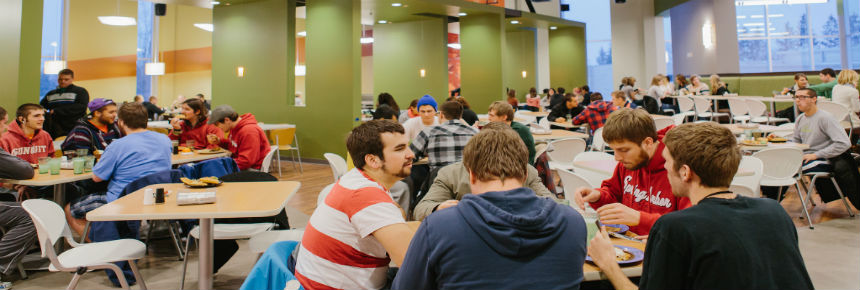
Chartwells, the meal service provider  at Spring Arbor University (SAU) recently invited all students to participate in a focus group to survey students’ feelings about their food. Chartwells held several group sessions on Jan. 25.

Elijah Drake, a freshman who participated in one focus group, described the session as an extensive meeting to discover his opinions regarding the various stations within the SAU Dining Commons (DC). The focus group gave feedback on four categories: quality, variety, value and staff.

Drake said the best reviews were in regard to the staff, but when it came to the other topics, he said his group had mixed views. Some thought the meals had adequate variety, while others wanted more options. Drake said the lower quality of food on the weekends was brought to Chartwells’ attention during his group’s session.

Drake said value, another category, was more important to consumers without a meal plan. Another concern presented by Chartwells was which stations in the DC were most popular and which were declared the least. According to Drake, his group chose The Grill and Create! stations as their favorites.


8445442774_519d58958b_k
Photo provided by Spring Arbor University


I found these choices to be interesting and set out to see if I could replicate his results by polling a larger group than his focus group of seven. On a Monday night, I stationed myself in the lobby of Andrews Hall and asked 25 guys who came through which Chartwells food station was their favorite, and for a little more insight, I also asked which was their least favorite. Overwhelmingly the two favorite stations were Create! and The Grill which shared nearly 60 percent of the votes.  On the flip side, the Yo Bowl, Chef’s Corner, and Oven Baked Pizza stations were tied for the least favorite of the survey participants, with a combined total of 72 percent.

Overall, Drake said the employees seemed receptive, and that he is eager to see if any changes come from the survey. DC student worker Grace Comstock was able to bring some insight to the complaints made during the focus group sessions.

“As a student myself,” Comstock said, “I can relate to them. However, I also know what goes on behind the scenes and how much work goes into each meal.” Comstock said the Chartwells employees took the comments made into consideration, and that they wish to improve the meal quality in any ways they can. The whiteboard near the dish return is another important source for feedback, Comstock said.

Not all the feedback is negative, either.

“I hear a lot of complaints indirectly on and off the job,” Comstock said, “but also a lot of compliments.” Comstock said that although complaints remain valid, she still hopes students understand the hard work that is put into “making each meal a pleasant experience for the student body.”


8445434420_028f156883_k
Photo provided by Spring Arbor University