New Microbiology Lab: Weatherwax Foundation Sponsors Upgrade

By Nathaniel Salsbury

The Department of Biology and Chemistry upgraded one of its labs in Whiteman-Gibbs over the summer to create a more modern environment thanks to donors and a grant. Spring Arbor University (SAU) decided a renovation was needed because Whiteman-Gibbs was built nearly 50 years ago.

“The facilities are older than I would like and so I’m rejoicing that we have a refurbishing right now,” Bruce Baldwin, chairperson of the department of biology and chemistry, said.

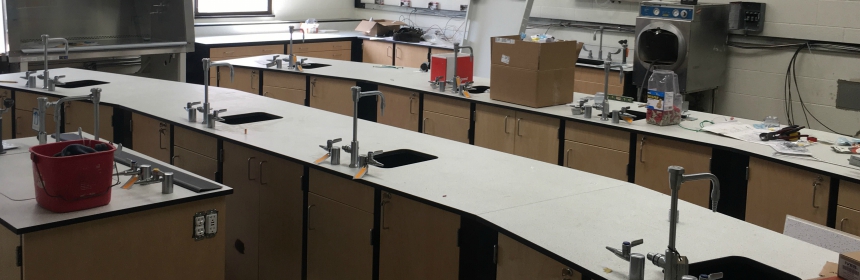
The renovated space, officially named the Weatherwax Microbiology Laboratory, features new equipment for students and new surfaces to work on. The new tables provide more open sightlines for the professors to supervise the students. They will also get to interact more with their instructors as the new tables provide more working and walking space. New lights were also installed and changed from fluorescent to LED. The lights will last longer and are easier and safer to dispose of once they do go out.

Shortly after students finished the school year and moved off campus, the project began. Baldwin said the goal is to finish the renovations before classes begin. However, a backup plan is set in place for the lab’s first classes in case construction is not completed in time for school.

“You can never guarantee when a project is going to finish,” Baldwin said. “It’s a good target and you do your best and then you react if things don’t work out.”

In the middle of the 2016-2017 school year, SAU applied for a grant from the Weatherwax Foundation, the namesake of the new lab, with the hopes of renovating one of the labs in the science department to create a more modern, high-tech microbiology lab.  The Weatherwax Foundation is a Jackson-based organization that provides funding to help strengthen various educational programs in the county.

Chief Financial Officer and Vice President for Finance and Administration Kevin Rose assured that the foundation funded 100 percent of the renovation.

Although the microbiology lab is currently the only space being funded by the Weatherwax Foundation, the plan is to eventually refurbish the other laboratory spaces in the building. Whether these plans will get the funding from the same foundation or elsewhere remains to be seen, but the hope is to receive additional donations after the school is able to demonstrate the functionality of the new lab.

Extended SGA President and VP Q&A

By Elise Emmert
This is an extended version of our interview with Richard Harris and Catherine Galloway, the newly-elected SGA President and Vice President.

By Elise Emmert

This is an extended version of our interview with Richard Harris and Catherine Galloway, the newly-elected SGA President and Vice President. To read the rest of the interview, check out page five of The Pulse.

The Pulse (TP): How do you think your involvements in activities on campus, like Enactus and in the Office of Intercultural Relations (OIR), have prepared you for this leadership role?

Catherine Galloway (CG): I feel like being an Intercultural Advisor (IA) has given me a look into what leadership looks like on campus, around events, what weekly meetings look like, and what the structure on campus looks like.

Richard Harris (RH): In Enactus we do a lot of stuff in the Jackson community, so I have that relationship outside of Spring Arbor. That helped me build relationships within the school because not everybody in Enactus is a business major. So that branches me out beyond what I’m studying, and helps me develop more friendships.

TP: What skills do you think you bring to the table, other than what you have learned in Enactus and as an IA?

RH: Personally, I believe our social skills. If you can’t really tell we’re people’s people, and we’re very outgoing. That could actually be a big factor when it comes to standing in advocacy for certain things that the student body wants.

CG: I feel like working for OIR here and doing three and a half years of missions in high school in another country has taught me about what diversity looks like, even on a campus like this, and how to pull it together. (It taught me how to) be able to listen to students and be able to hear what they want and where they’re coming from.

RH: That amplification of diversity is something that we really enjoy, obviously, in ourselves. I’m an African-American male, if nobody knew that (laughs). That’s part of who I am, but that’s literally just one part of who I am. The other sides of who I am, I am a spiritual believer, I have a solid foundation in Christ, I love God with all my heart, mind, and soul, and I plan to radiate that love in this position.

TP: How do you plan to show Christ through your administration?

RH: I would really love to amplify the knowledge of Christian ministries that are here on a Christian university. There’s so many, and I believe the only thing that’s lacking is on the student’s part. There’s a lot of phenomenal ministries, they just need student participation.


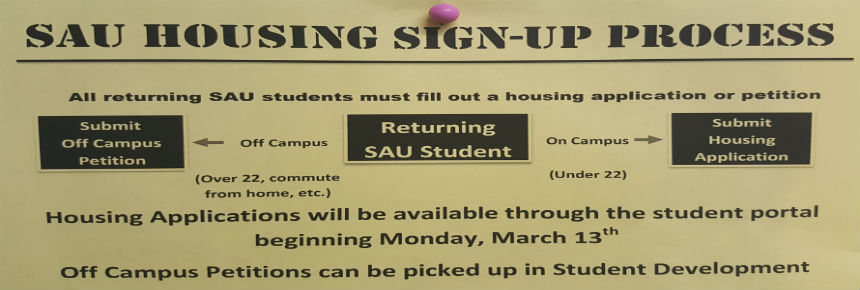
Applying for Community: the reason behind those yellow sheets

By Alex Anhalt
It is time for housing applications again at Spring Arbor University (SAU)

By Alex Anhalt

It is time for housing applications again at Spring Arbor University (SAU).


The bright yellow sheets popping up all across campus prompted roommates-to-be to make last-minute plans, and on March 13, the first applications for K-Houses were available. For the next few weeks, students will be matching up with friends and filling out one form that will help determine their living quarters for the 2017-2018 academic year.


When it comes to housing signups, there are many dates to remember, options to consider and intricacies to iron out. However, Associate Dean of Students Bobby Pratt, head of the housing application system, said the complex workings of the application system actually work to the student’s benefit.


Pratt said most schools will leave it “to the luck of the draw.” This lottery system “lets them assign living options in one fell swoop,” Pratt said, but student requests are granted at random.


Pratt believes there are better alternatives that give students more say in where they want to go, even if those methods are “a little bit more work on our end.”


Applications are given priority based on three main categories: seniority, roommate plans and squatter’s rights.


“We start with what we consider upperclassman housing,” Pratt said. He said the K-Houses and villages are designed to give seniors the chance to live more independently, and since they tend to be the most sought-after options, those applications are available first. Priority is also given to students staying in the same place because Pratt thinks they should be rewarded for “what they’ve invested in that community.”


Applicants who suggest a correct number of roommates will also receive priority, Pratt said, since it saves the administration the challenge of partnering students into well-matched groups.


Every time applicants learn whether or not their application was approved, they are given twenty-four hours before the next applications open. That gives students a chance to shuffle roommates and formulate a new housing plan before the next option is available.

IMG_1621
Photo by Alex Anhalt


Pratt said SAU’s housing system is not just designed to cater to the student; it also maximizes community.


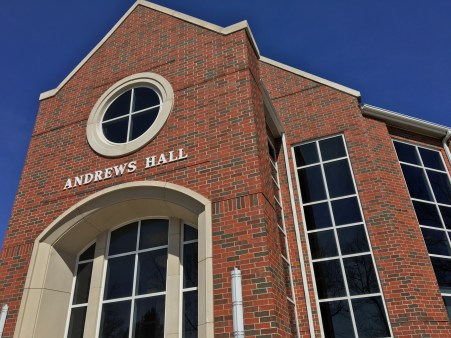
Andrews Hall, a residence hall added to SAU in 2010, is one example of this philosophy. According to Pratt, most universities would avoid building new residence halls with communal bathrooms, but SAU wanted to establish a brand-new community.


Community is also the reason freshmen can’t live in the K-Houses or Villages.


“We want our underclassmen to make a lot of connections and feel like part of the campus,” Pratt said. “We understand that as students get older, they’ve done that, they’ve identified the group that’s going to be their support.”
Village applications close on April 6, and students can opt for any of the residence halls starting April 13.

Focused on Food

By Makana Geppert
“Chartwells, the meal service provider at Spring Arbor University (SAU) recently invited all students to participate in a focus group to survey students’ feelings about their food.”

Chartwells, the meal service provider  at Spring Arbor University (SAU) recently invited all students to participate in a focus group to survey students’ feelings about their food. Chartwells held several group sessions on Jan. 25.

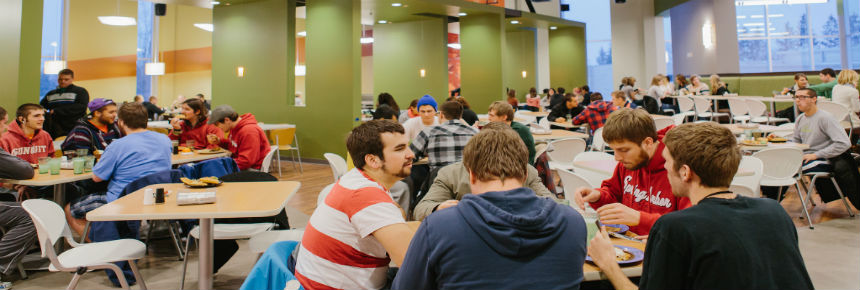
Elijah Drake, a freshman who participated in one focus group, described the session as an extensive meeting to discover his opinions regarding the various stations within the SAU Dining Commons (DC). The focus group gave feedback on four categories: quality, variety, value and staff.

Drake said the best reviews were in regard to the staff, but when it came to the other topics, he said his group had mixed views. Some thought the meals had adequate variety, while others wanted more options. Drake said the lower quality of food on the weekends was brought to Chartwells’ attention during his group’s session.

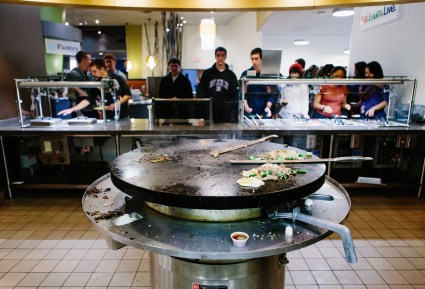
Drake said value, another category, was more important to consumers without a meal plan. Another concern presented by Chartwells was which stations in the DC were most popular and which were declared the least. According to Drake, his group chose The Grill and Create! stations as their favorites.


8445442774_519d58958b_k
Photo provided by Spring Arbor University


I found these choices to be interesting and set out to see if I could replicate his results by polling a larger group than his focus group of seven. On a Monday night, I stationed myself in the lobby of Andrews Hall and asked 25 guys who came through which Chartwells food station was their favorite, and for a little more insight, I also asked which was their least favorite. Overwhelmingly the two favorite stations were Create! and The Grill which shared nearly 60 percent of the votes.  On the flip side, the Yo Bowl, Chef’s Corner, and Oven Baked Pizza stations were tied for the least favorite of the survey participants, with a combined total of 72 percent.

Overall, Drake said the employees seemed receptive, and that he is eager to see if any changes come from the survey. DC student worker Grace Comstock was able to bring some insight to the complaints made during the focus group sessions.

“As a student myself,” Comstock said, “I can relate to them. However, I also know what goes on behind the scenes and how much work goes into each meal.” Comstock said the Chartwells employees took the comments made into consideration, and that they wish to improve the meal quality in any ways they can. The whiteboard near the dish return is another important source for feedback, Comstock said.

Not all the feedback is negative, either.

“I hear a lot of complaints indirectly on and off the job,” Comstock said, “but also a lot of compliments.” Comstock said that although complaints remain valid, she still hopes students understand the hard work that is put into “making each meal a pleasant experience for the student body.”


8445434420_028f156883_k
Photo provided by Spring Arbor University


How to Vote by Absentee Ballot

By Celeste Fendt
With the general election less than a month away, now is an important time for registered voters to consider how they plan on submitting their votes.

With the general election less than a month away, now is an important time for registered voters to consider how they plan on submitting their votes. The traditional method of voting involves meeting at a designated Polling Place between the hours of 7:00 a.m and 8:00 p.m. Thankfully, there is another way to vote for those who can’t make it to their Polling Place on election day. This other method is called Absentee Voting.

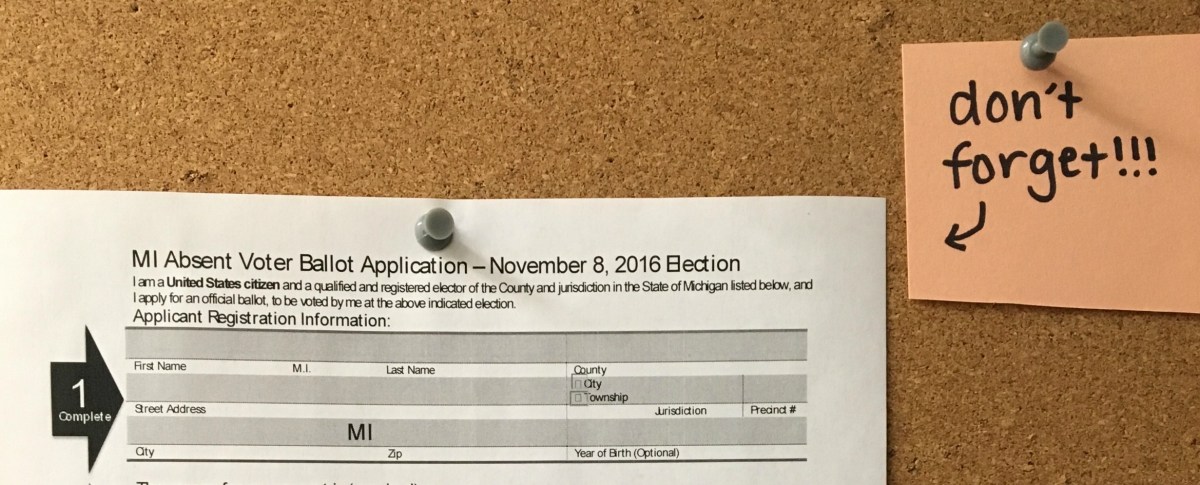
According to the Absentee Ballot application, Michigan residents must meet at least one of these requirements:

  • You are physically disabled and because of this you cannot vote on Election Day without another’s assistance
  • You can’t vote on Election Day because of the principles of your religion
  • You can’t vote on Election Day in the precinct where you are registered because you are an election precinct inspector in another precinct
  • You are 60 years of age or older
  • You are absent or expect to be absent from the township or city in which you reside during the entire time the polls are open for voting on Election Day
  • You are confined in jail awaiting arraignment for trial

If you meet one of the above requirements, the Michigan Secretary of State website says the next steps are as follows:

  1. You must be registered to vote (the deadline for registering to vote in Michigan has already passed for the general election)
  2. Get your Absentee Ballot application here
  3. Fill out the form, making sure to select the proper reason why you cannot vote on Election Day
  4. Find out who your local clerk is here
  5. Submit your Absentee Ballot application to your local clerk by one of the following methods:
  6. Print and mail the application in an envelope
  7. Personally deliver the application to the clerk’s office
  8. Have an immediate family member (or other person residing in your household) mail or personally deliver the application for you

Your application must be submitted to the clerk’s office no later than 2:00 p.m. on November 5.

For out-of-state residents, the Absentee Voting process is almost exactly the same. The biggest difference is in step two – each state has a slightly different application. It is also important to pay attention to deadlines, as they may differ by state.

Indiana Absentee Voting Application

Ohio Absentee Voting Application

That’s it! You will receive your Absentee Ballot in the mail shortly after your application is submitted. For Michigan residents, your final Absentee Ballot must be submitted to your clerk no later than 8:00 p.m. on November 8.

SAU welcomes new nursing center

By Heather Clark
Oct. 1 marked the opening of Spring Arbor University’s (SAU) new undergraduate nursing lab.

Oct. 1 marked the opening of Spring Arbor University’s (SAU) new undergraduate nursing lab. On Homecoming Day, President Brent Ellis dedicated the Jaworski Clinical Simulation Center and Physical Therapy & Sports Medicine Service clinic on the other side of M-60.

“We’ve had nursing for a long time, but this is a unique element,” Al Kauffman, chair of the department of nursing, said. “[our previous] nursing program we had was for people who were nurses already. Now you can enter as a non-nurse.”
megan-himebook_9197
Photo by Megan Himebook
According to Kauffman, SAU has offered bachelor’s degree completion programs for those holding associate’s degrees since 2001. A master’s program followed in 2009, but both required a student to have at least an associate’s degree to enter the program.
Kauffman said the process to create the undergraduate program began in 2014. After creating a business plan, deciding on curriculum offerings and planning a budget, the program was required to seek approval from the Michigan Board of Nursing. The program also required approval from the academic and administrative committees at SAU, which it received last year.
Several other departments, especially in the science department, had to redesign their curriculum to be qualified to offer the necessary support knowledge for nursing majors, according to Raymond Jones, director of campus nursing. The increased rigor of the courses is meant to prepare nurses to pass the required certification exams with better scores and more knowledge.
The Michigan Board of Nursing approved the new program on May 5, allowing the university to select classes of 30 students to enter the program until two classes have
been graduated. Those two classes will then be evaluated based on a standardized test, the National Council Licensure Examination.
Jones has been involved in planning not only the educational aspects, but also new facilities that will open for the department. A portion of SAU’s Physical Plant building
has been converted to a simulation center containing lifelike practice mannequins. The center shares space with a physical therapy clinic that will be open to the public and used jointly by SAU’s physical therapy courses and the nursing department for training in therapy and safety practices.
Sophomore Jaydn Fuerst will be one of the department’s entering undergraduates for the class of 2020. She said she is most enthusiastic about the availability of the new programs and the ability to take all of her required classes at one school.
Another student entering the program is Jonathan Matwiejczyk, a 2015 graduate biology major. He said he had been searching for a job when he found out about the available
nursing program.
“I loved the idea of being able to return to Spring Arbor, not only for the community and it already being my home for the last five years, but also I already had great relationships I had cultivated with the professors over the years,” Matwiejczyk said.
megan-himebook_9202
Photo by Megan Himebook
Jessica Khoury, a sophomore transfer from Michigan State University, said she is looking forward to the hands-on clinic.
“It will be a place where mistakes will be made, but better to made in the lab than in the hospital,” Khoury said.
Fuerst also expressed excitement for the clinics. She was able to participate in simulation equipment tests last year when the program was being set up, and practiced with a specially designed mannequin.
“I helped deliver a fake baby,” Fuerst said. “It was pretty awesome.”

Save

SAU Hosts Alumni Graphic Design Exhibition

By Emily Spencer
Ganton Art Gallery is hosting Spring Arbor University’s (SAU) first Alumni Graphic Design Show.

Ganton Art Gallery is hosting Spring Arbor University’s (SAU) first Alumni Graphic Design Show. Though Spring Arbor has held alumni shows before this is the first centered on graphic design. The show is up from Sept. 18 to Oct. 9.

In order to organize the alumni show, Associate Professor of Art, Brian Shaw had to contact the alumni and send out a call for entries. The art faculty then set up the show using the pieces sent in by the alumni.

Spring Arbor alumni, Kari Shimmel, class of 2003, spoke for the opening of the show. Shimmel worked for Daniel Brian Advertising in Rochester, Mich. for 11 years before going to work for another advertising agency, Campbell Ewald. Shimmel is now the chief marketing officer at Campbell Ewald where she oversees new business development. Along with a team of coworkers, she works to come up with a vision for the brand and pitch their ideas to the company. She has worked with many large brands, most recently, Travelocity and Harley-Davidson. Shimmel also oversees external as well as internal communications. This includes working on Campbell Ewald’s website, stationary and communicating the values of the company.

At the end of her talk, Shimmel gives four pieces of advice to the students. Her first advice was always try harder, stressing the importance of going above and beyond the work assigned. Secondly, said every class counts. General education classes Shimmel never thought she would need have proved to be essential to her job. Her third piece of advice was to impact culture. Her job in advertising gives Shimmel a great opportunity to make a difference in the culture around her. Finally, she said to be faithful. Throughout the course of her work, Shimmel has had to request not to work on certain projects because they did not coincide with her beliefs.

Shimmel is not the only alumni whose art pieces have made their way into the gallery. The other alumni participating in the show are, Lauren Nadrowski, class of 2011, Josh Smiertka, class of 2014, Beau Ulrey, class of 2013, Derrick Robbins, class of 2010, Emily Reed, class of 2011, Jake Fletcher, class of 2015, Kaitlin Lutz, class of 2015, Kevin Sharp, class of 2015, Kwade Joslin, 2013, Mackenzie Varnagatas, class of 2015, and Mark Adkins, class of 2013.

Shaw, class of 1990, also has a few pieces in the show. As an alumni of SAU, Shaw felt that it was important that he participate in the show.

“I felt like I should be represented,” Shaw said “I wanted to join my colleagues in showing work.”

Shaw said of his students, “I’m only going to feel successful if you’re successful.” Shaw feels it is important to showcase alumni as artists who have succeeded in SAU’s art program.

“I’m so proud of what they’re accomplishing out there,” Shaw said. This sense of pride and joy, Shaw said, is one of the main reasons that alumni shows are so important.

According to Lecturer of Art, Brianne Witt, another reason for holding alumni shows is it gives current students the opportunity to see what they could accomplish once they graduate from SAU.

“It’s great information for the students to just see the different ways they can take their skills that they’re learning within the art department,” Witt said. According to Witt, seeing the work of SAU alumni can provide direction for current students.

She said, “It’s good for them to see the different ways they can reach their ultimate goal.”

The show will run in the Ganton Art Gallery until Oct. 9 and a second reception was held on Oct. 1 at 3:30 p.m.

The Dangers of Desire

By Heather Clark
Radio host Al Kresta visited SAU to discuss the dangers of loving a material world.

“What do you want?”

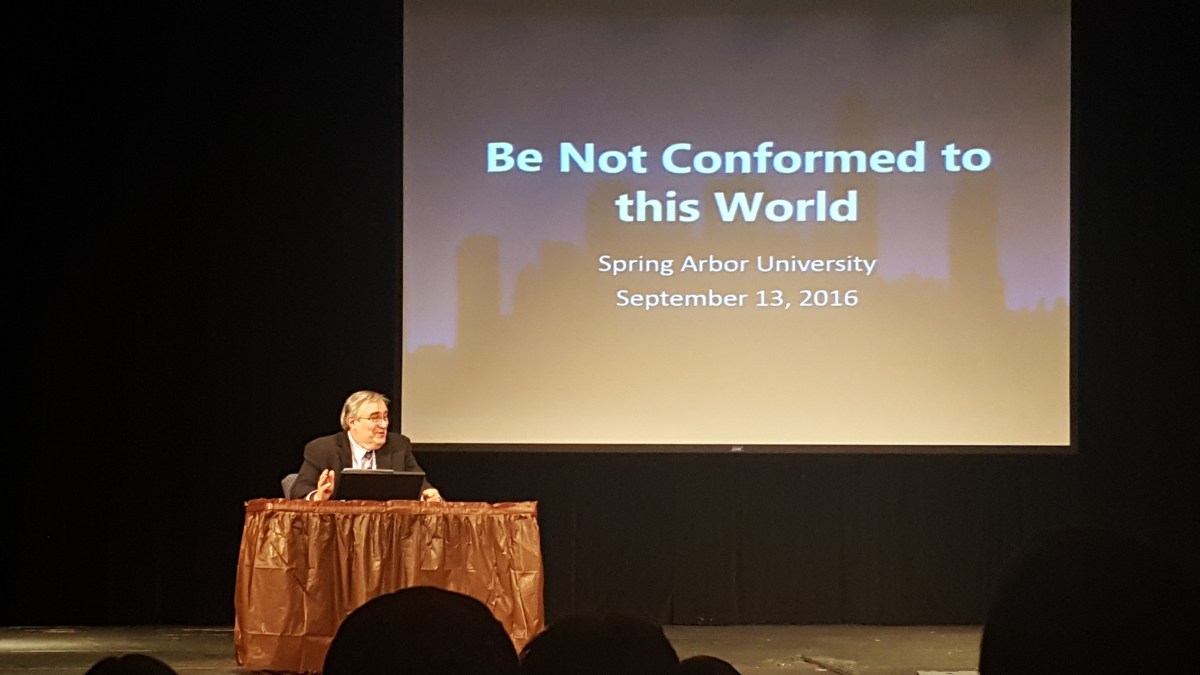
This was the foundational question Catholic radio program host and apologist Al Kresta asked at his lecture Sept. 13 at Spring Arbor University (SAU).

Kresta, whose daily program has an audience of nearly three-hundred radio stations, including the local Catholic station “Good Shepherd Radio,” has been a colleague and friend of SAU’s Professor of Communication Paul Patton for almost 40 years. The two have worked on theatrical productions and radio broadcasts together. Kresta was invited by the department of communication to speak and participate in a post-lecture reception.

For his audience of nearly one-hundred-fifty people, Kresta expounded on the dilemma Christians face in modern society. He cited seemingly conflicting Biblical messages that advise against loving the “world” but then tell us that God loves the world he created.

“Pleasure becomes hedonism, and enjoying food becomes gluttony. Kresta made me realize that one can worship through these things without worshiping the things themselves,” sophomore Trevor Tarantowski said.

Cameron Moore, assistant professor in English, said he hoped his literature students who attended the lecture would see parts of their own studies reflected.

“Loving rightly, ordering our desires, it’s very much like Dante [‘s Divine Comedy],” Moore said.

Many modern Christians, according to Kresta, rationalize their involvement and consumption of the world’s value system.

“They say, ‘God loves the world,’ so shouldn’t we imitate him?'” Kresta said.

This, Kresta said, indicates a failure to realize that the “world” spoken of in scripture has the dual meaning of the created order and also of the secular value system. There is an important distinction there that renders the seemingly conflicted passages understandable.

Kresta went on to illustrate his topic of remaining un-conformed through examples of three “illusion generators” that he said cause people to desire “the contradictory and the impossible,”. The illusion generators Kresta cited were the unattainable beauty standards set for women, media manipulation of “news” and ubiquitous advertising and marketing competing for attention.

Leah Rose, a junior advertising and public relations major, found Kresta’s talk very applicable to her own studies.

“I enjoyed Kresta’s talk because it was thought provoking; his statement about Jesus’ earthly “competition” being brands and materialistic objects changed my perspective on what and how I consume,” Rose said.

kresta2

Kresta said for the church to remain ‘relevant’ in society, it must not succumb to the devices of modern culture but rise above them by remaining distinctive.

Junior pre-engineering major Abigail Owens remembered the following quote from Kresta’s lecture: “What you lure them with is what you lure them to.”

“As he pointed out,” Owens said, “the church was not meant to be just another economical good.”

“Brands need to make us feel good. They exist to distract people,” Kresta said. His vision of the church is a place that does not dismiss the uncomfortable and painful realities of life, but rather “Bear[s] witness in the midst of suffering to joy that goes beyond.” The community and belonging offered by the church, he said, is real, not an advertising gimmick to lure consumers, and should be the reason people decide to attend a church.

Phil Webster, senior Biblical Studies major, said the advice Kresta gave will change how he reacts to the information he finds in popular media.

“Advertisers focus on our wants of happiness, fulfillment and pleasure, but that’s only because we’re so carnally minded. I’m going to keep better inventory of my wants and see to it that they are both God pleasing and beneficial for the kingdom,” Webster said.

“His question, ‘what do you want’, is really key to your soul,” Charles White ,prrofessor of Christian thought and history, said.

Kresta, in a reworking of 1 John 4:4, summed up his statements of the church’s relevance in society:  “Greater is He that is in us…than he who is over there at Starbucks or Nike or Google.”

SAU Sticker Shock

By Carly Thompson
Director of Campus Safety Scott Krebill announced a new $50 fee for parking permits this year.

Director of Campus Safety Scott Krebill announced a new $50 fee for parking permits this year.

Prior to this semester, parking permits were free for all students. Krebill made this change in order to provide better service to campus.

“We have been aware that other schools charge a permit fee, and we could no longer afford to provide quality services while issuing the permits for free,” Krebill said.

Krebill researched other Council for Christian Colleges and Universities (CCCU) and found that most schools charged more than what Spring Arbor University (SAU) settled on.

“Parking permits at other schools range from free to up to $300 per year,” Krebill said.

Although parking permits have a cost, the price of parking tickets will remain the same. According to Krebill, SAU has some of the lowest fines for parking tickets, and a 50 percent break is given if paid within the first three days.

“I understand that we have a cheaper fee than most schools. What is frustrating and upsetting to me is that we were not informed until two weeks before school. There was no way to make appropriate plans for the year,” senior Emily Wilcox said.

According to junior Campus Safety officer, Lexi Horn, it was time for this change to occur, in order to continue providing necessary services. Campus Safety has needed more funds to update their equipment.

Funds from the permit charge are designated for Campus Safety use, not the general budget. Campus Safety plans to use these funds for improving some parking signage, replacing worn out equipment used to keep parking lots safe and every vehicle running smoothly.

This year, Campus Safety is able to add service hours on weekend mornings and replace their worn out patrol vehicle.

According to Horn, this new cost has nothing to do with the demolition of the tennis court parking lot, but more to do with a change in funding for Campus Safety.

Another parking lot is already in the works adjacent to the freshman lot. Juniors and seniors are being asked to park in the Gainey, Ogle and sophomore lots, as well as in the overflow lot behind the Fieldhouse.

All students are welcome to attend the “Know Parking” education blitz plan advertised the first two weeks of school. Posters and flyers will explain the changes and educate people on where to park and how to obtain the proper permit.

“Our goal is compliance, not enforcement, but this is how we have to manage a parking system with very limited space. It works if everybody does their part,” said Krebill.

Students are asked to take any complaints, questions, and concerns to Krebill at scott.krebill@arbor.edu. Campus Safety can also be contacted through the SAU mobile app.

SAU App Centralizes Information

By Katie Shotts

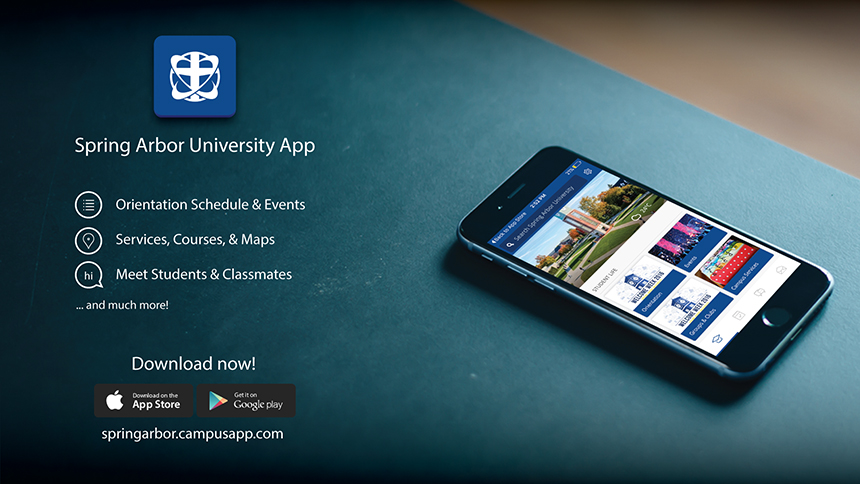
Spring Arbor University (SAU) launched a self-titled app this summer featuring information on all campus activities.

The iOS and Android app is free and available for download for students, staff, and guests alike, so parents or friends can stay connected to campus life. Its many features will improve communication and safety between students and campus groups.

Assistant Dean of Students Bobby Pratt was largely responsible for the development of the app. He said the goal behind its creation is taking information and “putting it in students’ hands.”

With the app, students can find schedules and locations of all campus events. A master calendar is also available from sports events to chapel speakers to club meetings. There is also an option to buy tickets for events such as Homecoming or shows.

Clubs and groups have their own page on the app and can keep students informed about meetings, practices and announcements through notifications by email or straight to a phone. A campus wide feed, similar to Facebook, also includes categories like “Buy & Sell,” “Lost + Found,” “Housing” and “Ride Sharing.”

Under “Campus Services,” students can find office times and locations including the Dining Commons, Cougar Den and Holton Health Center.

sau-app

In the past, Pratt said, communication to the entire campus during potential emergency situations could be difficult and possibly ineffective. Now, the app can send out campus wide notifications at a moment’s notice. The app also allows students to call Campus Safety with a touch of a button.

“It’ll be handy,” says Campus Safety Officer, Alexis Horn. “You can call us straight from the app. It’s a lot easier.”

The app is a continual work in progress, with a plan in place to add coupons from local businesses.

The administration hopes the app will be valuable to students, according to Pratt, they, “hope that it is another element to add to the community.”

Save