“A Meeting in Munich” Review

By Elise Emmert

I went to “Meeting in Munich” by Paul Patton knowing only that it was a discussion between church members about whether or not they should listen to the Fuhrer and reform their youth groups to Hitler Youth. But it was so much more than that.

liz
Elizabeth Pence and Logan Thorne. Photo by Alexis Hall.

There was more at stake in the church in Munich than the fate of their youth group. It’s a boiling point where congregants on both sides of the issue come together and clash, fighting each other on which outlook, which way of living, is objectively right.


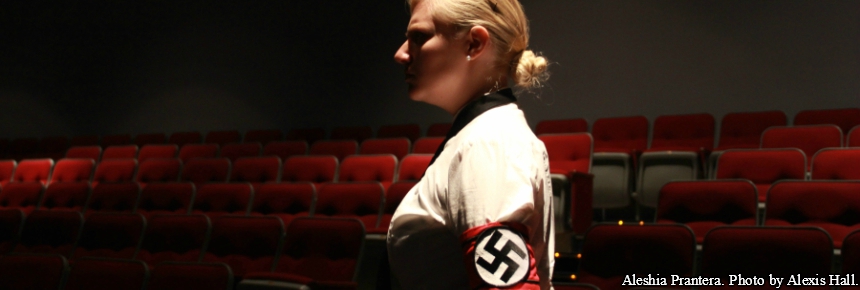
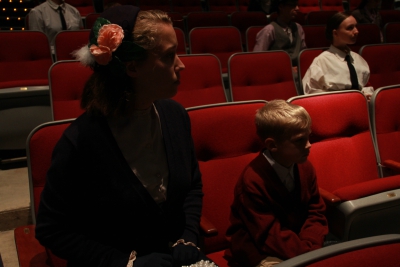
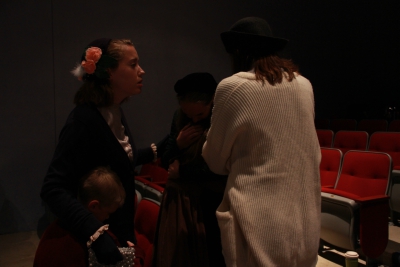
I watched friends in period clothing, some pleading with others for the right to raise their children in the church without the state as their watchdog, and others in SS uniforms with swastika bands around their arms raising their hands to perform the Hitler salute and commending the Fuhrer for his dedication to building Germany up on the church.

These actors sat among the audience members, and it made the conflict and history feel so much more present than it does when reading a textbook about what led to the second world war and the horrors that happened in Germany. The actors walked beside my chair and cried out their beliefs at each other, dealing with core values that would make or break Germany’s future in WWII. They have no idea what’s coming.

And it made me sob.

old lady and austin
Faith Dever and Austin Slater. Photo by Alexis Hall.

I cried for the fact that this happened – that anti-Semitic sentiments were rationalized, that a country was so torn and desperate that something like Nazism could rear its ugly head, that so many people lost their lives in such horrible ways because of hate and the belief that Hitler had the plan to make everything right again, to bring the country back to its former glory.

It’s difficult to identify the most heart-wrenching moment in the play, but one in particular rises above the many: when Margaret Lubosch (played by Erin Couch) says the hate being spread will put rocks in the hands of the children. In response to the Hitler supporters’ laughter, she asks her young daughter, Eva (played by Emma Brugger), to tell the congregation what has been happening at school. And Eva, in a trembling voice, rattles off the names of children in the class who aren’t allowed to talk to the others, who are pulled to the front of class and ridiculed for their mistakes, and who are afraid to go to recess because they are being spit on.

Does any of this sound familiar?

Confederate flag posters with cotton buds were posted around the American University campus last week. The “Unite the Right” rally in Charlottesville, which many state leaders condemned as a “white supremacist” meeting, ended with one civilian killed and many others injured. An improvised explosive device was set off at the Dar Al-Farooq Islamic Center in Minnesota.

tearful goodbye
A tearful goodbye. Photo by Alexis Hall.

Hate is festering, and people are acting on it. It could lead us down a very dangerous path if we choose to forget how situations can escalate from a small spark to an engulfing blaze if they are not stopped before they run beyond control.


It’s easy for us to look back on history and say we would have been on the right side; we would have stood for justice even in the face of death. But history is not simply the past. It is our present. Every second that passes becomes the history that our children and grandchildren will read about. If we do not do something about this hate, future generations may have the opportunity to ask of us: Why didn’t they do something? Didn’t they know that was wrong?

I have heard it said that theater is not done to make us forget or escape the world outside, but to help us remember it. In “Meeting in Munich,” we remember the past – we remember the hatred and divisiveness that tore apart this church and its country – but we also remember the present. And I weep for both.

Diversity, the Indigenous and the Limits of Being Human

By Taylor Reed

It’s impossible to say how many cultures there are on Earth. Lines of division blur, the sheer number of people groups make accuracy impossible and the dynamic nature of societies presents a moving target. What can be said, however, is that distinct social systems are disappearing as trends in globalization indicate shifts toward homogenization.

Which is progress, right? A simpler world is easier to handle. It’s especially helpful if cultures have much to offerpolitical and religious freedom, career opportunities for economic security,civil infrastructure to protect the safety and rights of humans, so on and so forth. These are conceptions often thought to be inherent in Western societies.
The prolific and enigmatic 20th century environmentalist, David Brower, compressed four and a half billion years of Earth’s history and that of its inhabitants into Genesis’ six-day creation.When that time frame is considered, it isn’t until 4:00 p.m. on the last day that dinosaurs walk the Earth. By 9:00 p.m., these dinosaurs are extinct. At 11:57 p.m., humans appear on the scene.Jesus is born forty-five seconds later. The Industrial Revolution occurs 1/40th of a second before midnight. Since this moment of innovation, more resources have been extracted and consumed than by the rest of the people who’ve ever lived combined. 
Brower states, “There are people who think what we’ve been doing for the last fraction of a second can continue indefinitely. They are considered reasonable people, but they are stark raving mad!
Humans have existed for a long time, yet it wasn’t until recently they began to alter the planet and its ecological balances as significantly and seriously as they do now. It’s no coincidence that 95 percent of the areas identified by the World Wildlife Fund Global 200 as harboring exceptional biodiversity are home to indigenous peoples. This isn’t to paint pre-industrial societies as utopian. Survival entails struggle, and bouts of starvation and disease aren’t to be considered lightly. Today, we think we have answers for these. We think we have answers for everything. We’ve essentially circumvented natural selection. But despite—or perhaps due tothis feat, creation groans.
Lack of clean water, food, medicine and decent sanitation threaten many today. This is well understood. The solution cannot, however, be to bring all into the same conditions that we as Westerners live in today. This “flourishing” is literally impossible, as it would require four Earths to support the world’s population living as Americans, as according to the Global Footprint Network. Developing technology is often brought up as an answer, but gambling on things that do not, and may not exist, may not be the wisest or most responsible choice,especially as it is in our collective power now to make changes with positive repercussions among humanity and creation.
We must lower our conception of ourselves to the point where we can consider that necessary changes, developments and the shaping of lives very well might ask the transformation of ourselves as much as it does others. How do we use technology responsibly? How do we love,interact with and learn from those who live differently than us? And, most importantly, and possibly all encompassing, how do we humble ourselves before God, and find ourselves back in the correct order of creation? We have been given much. We are responsible for much. And for the many cultures, perspectives and ideologies, we are thankful. We have a lot to learn.  

De Graaf, J. (2015). Black Friday is Buy Nothing Day. Retrieved February 29, 2016, fromhttps://www.prforpeople.com/news/black-friday-buy-nothing-day
Indigenous and Traditional Peoples of the World and Ecoregion Conservation (p. 28,Publication). (2000). Gland, Switzerland: WWF International- Terralingua.
United States of America. (n.d.). Retrieved February 29, 2016, from http://www.footprintnetwork.org/en/index.php/GFN/page/trends/united_states_of_america/

Stamina, Sanity and Spirituality: Extended Version

There is a meme floating around the Internet that presents three choices to the college student: good grades, a social life and enough sleep. It gives the reader instructions to “choose two.” Similar in nature, it seems, are the aspects of college students’ health: from spiritual, physical, mental and social health, it is as if we have to “choose two.” But is this really a choice we should have to make?

I recently had the opportunity to speak with a few faculty members who had some practical advice on how busy students can stay healthy without having to “choose two.” Here’s what they had to say:

Spiritual Health

Deb Varland, assistant professor of health, human performance and recreation at Spring Arbor University (SAU), believes that physical, mental, social and spiritual health are all interconnected, but that Christ is the most important part of a healthy life.

“A lot of wellness models will have physical fitness in the middle, but for me, having the cross at the center is really important,” said Varland.

To Mary Rick, nurse practitioner at SAU’s Holton Health and Wellness Center, a person’s spiritual life is paramount, as well. “A healthy life begins with a healthy spiritual life,” said Rick.

Ron Kopicko, SAU’s chaplain, emphasized the importance of a commitment to four different things in order for a person to grow spiritually: time management, people, the spiritual disciplines and fellowship. He also explained his definition of spiritual growth: “Spiritual growth is not just [about] what I believe, but it’s also understanding God’s relationship with me, my relationship with him and being consistent with those two things,” as well as “seeing myself the way God sees me and wanting him to see me as being faithful regardless of what I feel.”

Kopicko said that time management is also important, because spiritual growth does not simply happen on its own. Whether or not a person feels like it, it is essential to work at growing spiritually. “Success is predicated upon the cost that you pay when you do something when you don’t feel like it,” said Kopicko.

Furthermore, relationships with others are part of a healthy spiritual life. Jesus instructed his followers to “love one another even as I have loved you” (John 13:14, NASB). Kopicko suggested a person ask him or herself, “How can I contribute to what God is doing in this person’s life?”

Additionally, Kopicko recommended consistency in the spiritual disciplines of prayer and reading the Bible.

Rick explained that what motivates her to meditate and read the Bible is the idea that “God delights in us.”

Finally, Kopicko used an example from Acts 2 to demonstrate what Christian fellowship should look like: the 3,000 people who put their faith in Christ “committed themselves to the apostles’ teaching and to prayer and to the breaking of bread and to sharing with anyone who was in need.”

Physical Health

Getting seven to nine hours of sleep per night—as Terry Darling, professor of psychology, recommended—is both desirable for virtually all college students and beneficial to their physical health.

Rick’s suggestion to help students fall asleep is practicing “good sleep hygiene,” or having a routine that consists of “gentle things,” like prayer, meditation, reading, listening to music and taking a hot shower.

Varland said that students should go to bed and get up at about the same time every day so as not to interfere with their bodies’ natural rhythms. In addition, she explained that, on top of a good night’s sleep, resting during the day is important. “We don’t often take time for Sabbath or even for daily rest, daily reflection and time spent with God,” said Varland.

In terms of diet, Rick recommended one that is rich in protein, fruits and vegetables, adding that students need to eat a good breakfast—such as eggs or a high-protein bar, perhaps with milk. Furthermore, students should always carry a snack—carrot or celery sticks work well, along with a source of protein, like peanuts or cheese—to keep their blood sugar stable.

According to Rick, we should exercise for at least 30 minutes a day, five days per week. Ideally, this exercise will include both aerobics and weight training.

Varland recommended that students try new forms of exercise, such as intramural sports, walking the P-Loop by campus or using the indoor track or weight room and the cardio equipment in the gym.

“No one should leave Spring Arbor University without having a complete physical,” said Rick, noting that the health center offers physicals, including lab work, to both insured and uninsured students. She additionally emphasized the importance of students seeking medical attention when they need it.

Students can visit the health center for reasons other than physicals, too. For instance, the health center offers flu shots during the fall. Ultimately, in visiting the health center, students need not be afraid of getting in trouble; everything is confidential.

“Come to the health center for anything,” said Rick. “It is the best deal in health care you’ll get.

Mental Health

“The freshman year of college can create a lot of anxiety and stress for the new student,” said Carrie Dashner, director of counseling services.

Dashner and Varland both recommended getting acquainted with other people. Varland explained that talking with someone helps with stress. “It’s really important to develop relationships with someone that we feel secure with,” said Varland. Then, a “sharing of ideas” can occur that can help a person work through his or her problems.

Dashner suggested Core instructors, peer advisers, resident assistants/directors and Ron Kopicko as people that freshman students can feel comfortable talking to. “It is really important for the freshman student to feel connected and supported,” said Dashner.

Incoming students should know that confidential counseling—for any reason—is available to them through the health center. Rick noted that there can be a “stigma” attached to counseling, but added, “There should not be a stigma. It’s health-seeking behavior.”

Dashner said that, in seeking out counseling, “you are actually being proactive in dealing with your struggles, issues and feelings before they become unmanageable.”

Dashner also explained that students can stress less by practicing organizational skills. “I would recommend that all assignments, projects and exams be entered into a planner to stay organized,” she said. “Often, students find it helpful to color code their classes to distinguish between them. Staying organized, prioritizing, making lists and following a schedule will all help reduce anxiety and stress.”

Social Health

Bonnie Holiday, assistant professor of social work, provided some suggestions for practicing good social health.

First and foremost, “get involved in something.” It may be uncomfortable, but “it’s awkward and weird for everybody,” said Holiday, noting that it may take a while to really make friends, but that that’s okay and normal.

More important than being best friends with our roommates, said Holiday, “is that you can live together in harmony.”

For homesick students, Holiday recommended doing something nice for another person: “It usually makes us feel better when we do something nice for somebody else, which of course is biblical.”

“Do one thing every day that you enjoy,” Holiday advises students, “and do one thing every day that’s outside your comfort zone,” such as being intentional about meeting a new person.

“There’s no perfect freshman,” said Holiday, encouraging students to keep in mind that our experiences will be a little different from everyone else’s.

In the end, the components of spiritual, physical, mental and social health connect and overlap with each other. So, instead of asking whether we have to “pick two,” or even whether we can be healthy in all four areas simultaneously, perhaps the question should be, is it possible to have one type of health without the others?

By Dana Van-Doren

What is kombucha and should I be drinking it?

I met up with Spring Arbor University senior Autumn Freeman, biology major and daughter of a “health nut,”  to discover what kombucha is, what it does, and why she drinks it.

ca pic
Autumn Freeman and Professor Jen Letherer

Kombucha is a fermented tea drink with a probiotic nature, which is what makes it so appealing to the “health nuts.” Autumn explained the complicated biology part to me like this:

There are twice as many bacterial cells in your body as your own cells. These cells help break down your food and protect you against things you touch. Everyone’s bacteria is unique. The kombucha supplements the good bacteria, which helps keep you healthy.

Where you can buy it

1) Walt’s Health Food 

This health food store is across from local favorite Chilangos. Autumn says that their kombucha is “the good stuff” and suggested pitching in with a few friends to get a bottle, since drinking a whole bottle during your first time might “shock your system.”

2) Target / Meijer 

Target
Target

These two chains have a pretty similar selection. Personally, I tried Mamma Chia’s Guava Mamma and, once I got used to drinking the chia seeds, I loved it. I also enjoyed the first few sips of Live Kombucha Soda’s Living Limon, but I found that 15 minutes later it tasted flat.

How can I make it?

Making Kombucha is a lengthy process, but it is worth it. It order to start you need a “mother liquid” from a different kombucha and its scoby  (symbiotic culture of bacteria and yeast). Autumn suggested either buying kombucha from the store or getting this from a friend who already brews.

Equipment

  • 1 large Glass or ceramic jar (avoid using plastic or metal)
  • A few smaller glass or ceramic jars
  • Cloth

Ingredients

  • Tea – black or green
  • Sugar
  • Starter liquid
  • Scoby
  • Extras:
    • big chunks of fruit
    • fruit juices
    • chia seeds

Step 1

Take the scoby and the starter liquid and put it in your jar. Then mix the tea and sugar together and add it in. Seal the top with a cloth so your mixture can breathe. During this stage the scoby ferments the sweet tea. Leave this alone for a week to two weeks, occasionally taste-testing until your mixture makes the perfect tang-to-sweet ratio.

Step 2

Now take your mixture and add your extras! Autumn mentioned that the chia seeds are really fun, since “they’re dry and really tiny when you put them in…the mixture, then they expand and get really gelatinous and wonderful.” She also said blueberries and mangos work really well, but apples do not.

Tip: The more sugar that the fruit juice has, the more carbonated it will be in a shorter period of time, since the bacteria will have more to work with.

Step 3

Take your mixture and put it in separate sealed glass containers for a week. After that is done, refrigerate, and enjoy!

Buy it before you try it!

It is really important to pay attention while making your kombucha. If you leave the lid off while making it, you risk mold and dust getting in. Additionally, there recently was a food poisoning bacteria strain was going around the world and ended up in Autumn’s brew. (If your kombucha turns green, throw it out!)

FAQ: Is kombucha alcoholic?

Technically, yes! It is a fermented drink, which means that a sugar source was turned into alcohol. However, the alcohol content is so low that is nearly impossible to get buzzed off of the tea.

By Courtney Applebee

http://www.waltshealthfoods.com/

http://www.culturesforhealth.com/kombucha-tea-starter-kit.html

Standardized Protests

THE INTRO

In school there was nothing I hated more than standardized testing. They took up a bunch of time, were boring and stressed me out. I always figured standardized tests were just a part of school life and colleges needed the scores to properly judge where people were at academically, so I just went along with it and only complained to my friends at lunch.

THE WHAT

The Washington Post reported on a new phenomenon growing among parents of grade schoolers: opting out of standardized testing. Parents are becoming more and more upset with the current academic system and the importance of standardized tests in America. To show their distain they simply don’t take their children to school for test days. The tests are only effective if everyone takes them, so this really throws a wrench into the system.

THE WHY

If this reaction seems a bit drastic, it’s because it is. With the current education system, children are required to take standardized tests to assess if they should pass on to the next grade or if a school is properly educating kids. But this wasn’t the first step. Bianca Tanis, the founder of New York’s opt-out group, told CNN reporters they’ve been lobbying to the governor for years and feel the need to do this because instead of simply ignoring them, the governor has actually passed laws to make teacher evaluations more heavily governed by the test results.

THE WHO

Opt-out groups have been sprouting up all over the United States, with meet ups in every state. All of them have the common goal of evicting standardized testing, created by the No Child Left Behind Act, from the educational system. Many parents, like Tanis, feel the current system is flawed and they need to “take back the classrooms.”

THE GOOD

Standardized tests aren’t all doom and gloom as they’re so often portrayed. In many ways they do some real good for the education system. Their main benefit is their most obvious: they create a standard system for judging levels of education and intelligence. With standardized tests, educators can see which school districts are doing worse than others at teaching their students, then send people to find out why and fix it. The tests also make sure teachers in low-income school districts are held to the same base standard as others in high-income school districts.

THE BAD

The tests aren’t all good either, though that much can be seen just by the protests. Standardized testing can cause many problems, not the least of which is stress. It causes stress for students, who feel as if the tests will dictate their future and if they fail then they won’t be able to succeed out in the real world. It also causes stress for the teachers, who need to cover specific sets of material in order to prepare their students. In some cases their jobs may even depend on their students scoring well. Another major issue is that teachers need to teach specific things, they’re not free to teach other topics that the class might find interesting. They’re not free to spend another week diving deeper into a topic that the class needs more work on because many surface-level topics have to be covered.

THE CONCLUSION

Whether you’re for or against standardized testing, this is becoming more of an issue in the US every year. According to CNN, in New York, an estimated 14% of all students will opt out of standardized tests this year, and the number continues to grow.

By Evan Roberts

Is TIDAL the Answer to Music Streaming?


from tidal.com
from tidal.com

You may have heard about the star-studded press conference held by Jay-Z on Monday. It was all in support of his recently acquired music streaming service, TIDAL.

Artists such as Alicia Keys, Arcade Fire, Daft Punk, Jack White Kanye West, Rihanna, Usher and Deadmau5 have been locked in as direct supporters and were even given a small piece of the company in return.

TIDAL’s claim to superiority in the streaming world is that it will stream CD-quality audio as opposed to the MP3 quality that platforms like Spotify and Beats Music use. These “CD-quality” files come in FLAC, WAV, AIFF and Apple Lossless files and take up significant more space than an MP3 or AAC file.

Jay-Z has come out strongly against the current music-streaming system which has seen much backlash for supposedly ripping off artists. Spotify has said that artists receive $0.007 per play and that it has paid more than $1bn in royalties since it’s launch in 2008.

Artists such as Thom Yorke and Taylor Swift alongside others have pulled their music from Spotify in protest. Spotify has responded by saying they believe their service is a valid alternative to piracy and they continue to pay out nearly 70% of all revenues in royalties.

However, this money rarely makes it too the artists before being thinned out. BBC news said, “This 70% is usually paid direct to record labels, who take their cut before it reaches managers and artists.”

Dave Johnson of TIME released an article outlining what artists earned from streams based on Spotify’s current payout rate and the amount of streams the artist received. At roughly 30 million (M) plays in October 2014, Stay With Me would’ve earned Sam Smith $170k-240k. At 20M plays, Cool Kids would’ve earned Echosmith $120k-170k. Although this amount is perhaps not as large as it would be if the albums were downloaded in full from iTunes or bought in a store, it’s certainly not chump change.

I’ll admit, I love Spotify. I pay the $9.99 per-month fee for their premium subscription. Aside from the ability to access nearly any album or song at anytime for one flat rate I enjoy the usability and format of their app. Everything is no more than a couple easy clicks away and the app is appealing to the eye in a streamlined sort of way.

I also, however, will go out to a store and buy a hard copy of an album if I like it. In fact, I bought two albums in Best Buy this week after listening to them on Spotify and enjoying them. I want to support the artists as much as I can.

Online music streaming doesn’t have to be a bad thing. Hopefully all of this conversation leads to improvement in all areas of the industry. In the meantime, do what you can to support the artists you love. Spare the $8-10 to buy an album in a store, every purchase matters.

By Jesse Gentry

Top 10 Music Videos from 2012-2015

What is the first music video you can remember watching?  The first I remember watching was “Wrong Way” from Sublime. I remember the video being super goofy and weird, however, what else can one expect from a music video made in the 90’s?

The 2015 YouTube music awards took place last week, so in light of that, I have compiled a list of the top 10 videos from 2012-2015 having particular visual, artistic, and narrative interest. Each video has unique qualities either from how they were filmed, edited, and performed. On especially important quality to acknowledge is the visual narrative each song delivers.

Just like films, novels and music albums, great music videos impact and bring awareness to the viewer. Some say an artist’s potential lies in their ability to write, perform, create and sell music. This is accurate, however, an artist’s ability to synthesize multiple art mediums separates performers from artists. In America, modern pop culture is the societal collective of our beliefs, values, interest, and traditions. Hence, when a valued and largely followed artist has a music video, in essence they’re demonstrating the visual narrative of our pop culture. The music videos that comprise this list demonstrate significant artifacts in pop culture trends.

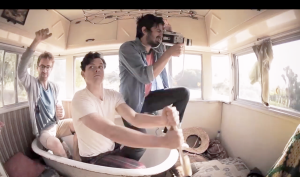
1. Alvvays-Next of kin. The effects and artfulness, enhances the mood and vibe of this melodic gem.
Connor Gilhooly
Connor Gilhooly
2. TV on the Radio- Happy Idiot, Paul Reuben (Pee-wee- Herman) and Karen Gillian (Doctor Who, and Guardians of the Galaxy) star in the video. 
Danny Jellnek
Danny Jellnek
3. Mogwai-Teenage Exorcist, The unique use of practical and digital effects that is seen in the video. 
Craig Murray
Craig Murray
4. Young the Giant- Apartment, the narrative and plot uniquely integrates the story of a man having an adventurous birthday and the lead singer dreaming about the events that took place. 
Marcus Haney
Marcus Haney
5. Phantogram-Fall in love, the use of special effects and performance displayed by the group that shows the intensity and emotion of the song.
Joshua Davis and Timothy Saccenti
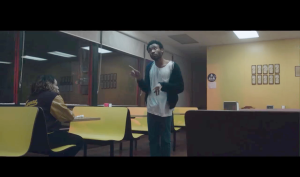
6. Childish Gambino –Sober, the 80’s R&B pop vibe the song has, also the dance moves that Donald Glover throws down, and the various technical changes in the video. 
Hiro Murai
Hiro Murai
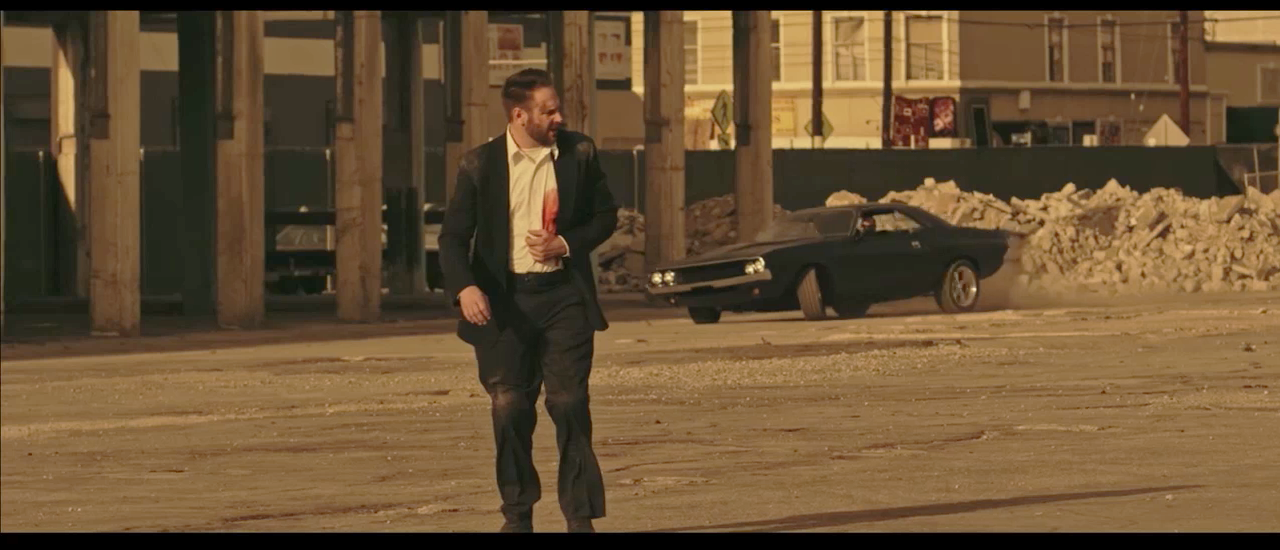
7. Foster the People- Best Friend, the intense and trippy effects of this dark twisted narrative depicting how the idea of beauty can be an addiction and lead to one’s downfall. 
Brewer
Brewer
8. Vampire Weekend- Diane Young, the cameos of indie/pop artist such as Sky Ferreira, Santigold, Chromeo, Despot, Dave Longstreth of the Dirty Projectors, and Hamilton Leithauser from The Walkmen and their all having a party. 
Primo Kahn
Primo Kahn
9. Death cab for cutie- Black Sun, the Music video is about death cab for cutie making a music video, the irony.
Robert Hales
Robert Hales
10. Joey Bad$$- Like me, the emotional content and story of the main characters struggles of being a black minority facing street life, police, love affairs and grudges. Near the end of the video Joey Bada$$ pays respect to fallen minorities, as they’re being resurrected from the after life.
Nathan R. Smith and Joey Badda$$

Seven Micro-Adventures to have in Jackson County


Photo by Alexandra
Photo by Alexandra Harper

Stop saying there’s nothing to do on the weekends. I repeat: stop saying there’s nothing to do on the weekends. Now, I grant you, if you have no car, no friends with access to car, and no one to beg, borrow, or steal a car from; your choices are indeed limited. However, the majority of students here have a car, and the majority of those who do not can con a ride occasionally.

I’m sorry, you say, but there’s nothing to do: I’ve been to Aka, to JCo, City Crepes, and Target…there really is nowhere else to go. It’s a lie, don’t buy it. And on that note, how can you afford all that? I’ve spent four years in this county looking for its wildest and least expensive parts and though I’m no native, I’ll reveal a few Jackson micro-adventures that I’ve particularly enjoyed.

A man with the impressive name of Alastair Humphreys recently coined the term “micro-adventure,” the premise is easy: hypothetically you work a 9 to 5 job (with even a little more lenience on a college schedule), so what are you doing with the other 16 hours? The 5 to 9? Why aren’t you filling it with a myriad of memorable and spontaneous adventures that celebrate where you live and the fact that you are alive? Humphreys advocates taking these micro-adventures wherever you can and whenever you’re willing. Camp in your nearest woods. Sleep in a bivvy bag by the expressway. Go discover all you can. (If you’re hesitant of the legality of any of this, read his post here.)

So where can you micro-adventure in Jackson. Well thank you for asking, please let me give you a few options and as you adventure, feel free and tell me your own. After all, I still have a few 5 to 9’s and weekends before I graduate.

A LIST OF EXCITING, RIVETING & COMPLETELY UNDERRATED MICRO-ADVENTURES IN JACKSON COUNTY, MICHIGAN

  • 5 a.m. Hinkley’s run.

    Everyone loves hot doughnuts in the morning. However, few are brave enough to have hot Hinkley’s doughnuts in the very early morning. This is a fun one to kidnap a friend or partner for. In fact, the day I did it, I drove up to my boyfriend’s house, called him at 5 a.m. said to come outside and get in the car, handed him hot tea and then we drove to Hinkleys right when they opened (through a minor blizzard) to get Michigan’s best doughnuts at their best time.

  • The Dahlem Conservancy.

    Located just between Jackson and Horton, this nearby ecological non-profit has trails perfect for spontaneous walks, bird-watching, or just general nature-doings. Or look at their schedule for chances to take a bee-keeping class, go moonlight skiing, or an evening woodcock walk.

  • Geocache Jackson. Geocaching is treasure-hunting where the treasure is a little notebooks and trinkets like plastic army men and your iphone is your map. Download the Geocache app and you will find a plethora of tiny dots telling you where little surprises  are hidden (even on campus) it’s an underground network you never knew existed.
  • Ella Sharp Sites.

    Ella Sharp was a pretty impressive gal. Learn what all the hubbub was by going to one of the many sites that are named after her, whether you are sledding on Ella Sharp hill, looking at a nationally-acclaimed art exhibit in the Ella Sharp museum (all donation) or learning about her life in the Ella Sharp historical house. (Bonus: the Ella Sharp museum does inexpensive art classes, such as pottery throwing and figure drawing for those who want to flex an artistic muscle.)

  • Visit the nuns.

    A half-hour away in Rives Junction is the Dormition Romanian Orthodox Monastery—if you’re interested in experiencing both a different culture (Romanian) and denomination (Eastern Orthodoxy) attend Divine Liturgy (Saturday 9 a.m. Sunday 10 a.m.) if you feel out of you comfort zone, know it’s good for you, also know the only thing you’re expected to do is sit or stand without causing a ruckus. (Pro tip: stay after liturgy for a complimentary meal put on by the nuns—it’s worth it.)

  • Explore the fitness trail.

    If you think this is too close to home to be an adventure, then you’re missing out. Going off-road on the fitness trail is fantastic fun—there are great climbing trees behind Mt. Beebe, deer trails through the thickets, and people have even been known to camp out there. Is it allowed? I have no idea, but they’ve done it.

  • Do it Humphrey’s way.

    What is Alastair Humphrey’s suggestion on finding a great place to have a micro-adventure? Pack a sleeping bag/bivvy bag, find a map (preferably with topography), find the most remote and topographically interesting area. Go there. Sleep there outside. Say sorry if you’re caught on someone’s land. Never leave trash.

“I have a choice, the same choice that faces every man. I can live a frivolous life, trying to impress others with the house I live in, the clothes I wear, the car I drive. I can strive to be a success in the way of the world, seeking the admiration of others, reveling in their jealousy…I can complain about boredom, as if it were up to those around me to inject excitement into my day. These are the patterns of the living dead, people who have forsaken life, who are willing to squander their most precious gift, because they refuse to face up to the reality of death. If they wanted to live, truly wanted to live, they would rise up in a resurrection of their own making and commit themselves to the life they have.”
– Richard Bode.
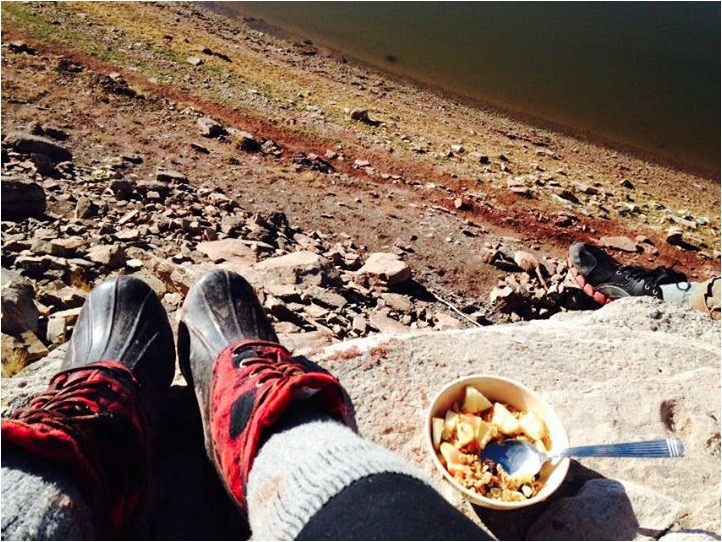
Beachcombing at Miramar 

By Alexandra Harper

Pebble Time


apple-event-0909-28[1]
from wired.com

Many people are aware of the famous (or infamous) device: the Apple Watch. It is designed to be the equivalent of a tiny iPhone attached to straps and can be worn as a watch. Many criticize its small screen, low battery life and high costs. But people still want to buy the miniscule timepiece. This fact caught the attention of Eric Migicovsky, CEO of the company Pebble.

Three years ago, Pebble created their first smartwatch, and crowd-sourced the funds to create it. They managed to raise a whopping $10 million, with 69,000 people backing it. But now, Pebble has outdone even that amount with their new efforts to crowd-source the second model of their watch, Pebble Time.

The company set their initial goal at a humble $500,000. But on the very first day they set a new record for the fastest record for any crowd-sourced item has reached $1 million. Within only 49 minutes they had shattered the record, and by the end of the week had raised more money than any other Kickstarter campaign to date. The Pebble Time is currently being backed with over $20.3 million, with 78,463 people pitching in.Kickstarter-featured_image[1]

The second highest-funded Kickstarter, the Coolest Cooler came in at only $13.3 million, and Pebble’s first Pebble Time creation still holds third place at $10.2 million. Those are even higher than the efforts to fund wireless ear buds and bringing back the popular children’s tv program Reading Rainbow. In fact, the amount of money going into the funding of Pebble Time is slightly over 1% of America’s total gross domestic product.

To put that into perspective, with the amount of money pledged to the creation of this smartwatch, a single person could buy:

1. 2 million and 30 thousand slices of Marino’s pizza.

2. 50 decent-sized houses in a nice neighborhood (official estimate terms used)

3. LeBron James’ mansion in Miami, and still have a nice $3.3 million left over

4. Or 1,194 of the most expensive versions of the new Apple Watch

But why are people going nuts over Pebble? To look at that, you need to look into why the original Pebble sold so well, as well as what is promised with the new Pebble Time.

Pebble 

The original Pebble has a wide variety of features. It can synch up to almost any smartphone device, unlike the Apple Watch which is only compatible with iPhones and other Apple devices. It is also water resistant, has access to thousands of apps and most importantly has a massive battery life of around 7 days. The Apple Watch’s biggest complaint is its small battery life, needing to be charged up about every day.

from the verge.com
from the verge.com

The Pebble Time, the new second edition product, boasts a more improved version of the already popular previous model. It will have a color screen, even better battery life, a thinner model than the original Pebble and even a microphone.

Needless to say, whatever Pebble is doing, it is doing it right. With 78 ,000 backers and over $20 million in pledges, people want this new gadget and they want it badly. Watch out Apple, you’ve got competition and its name is Pebble.

By Evan Roberts

Long boarding 101


from imgur.com
from imgur.com

As the weather warms, we’re all looking for excuses to be outside, one great one is long boarding. Now, I’m going to be honest with you: I didn’t learn how to long board until last summer and it was not an easy thing to do, but if an uncoordinated nerd like me can learn, I have faith that you can too!

Learning to long board feels a lot like learning how to fall on your face. Don’t worry though, if you fall on a long board people will assume you are cool simply because you have a long board. A very basic formula you can always go by is: long board = cool, even if that means you wipe out on one. With that being said here are a couple tips on how to fall on your face with style.

Learn to push the board

Many people who start learning to long board are terrified to start pushing the board. This is most likely because of Newton’s first law, “an object in motion stays in motion.” This means that if you wipe out while moving it will probably hurt pretty bad, but the one formula Newton never discovered was that long board = cool, so that clearly trumps Newton’s law.

While learning to push the board, many people will start by standing on the board and quickly fall on their face. For beginners it is much harder to simply stand on the board than it is to push the board. This may sound backwards since growing up you need to learn how to stand before you can walk, but think about it like a bike. You can’t sit on the bike with your feet up if it is not moving; it requires motion to stay balanced. Long boarding is very similar. After you are comfortable with learning how to push then see if you can stand on it. This will greatly reduce the amount of times you fall on your face.

Find your footing

In long boarding one foot will always be positioned on the long board and that foot should point in the direction that the long board is headed. The other foot will be your push foot and will be used to push the board to get it going and once it is in motion the push foot will gently sit behind your lead foot.

Find out if you like pushing with your left foot or your right foot. You may ask “well how am I supposed to know?” There are many tips online telling you things like “Have your friend push you and the foot you catch yourself with is the foot that should be in the front.” But this trick may make you fall on your face which is what we are trying to reduce.

Another tip suggests you “walk up a set of stairs and use the foot you start with as your lead foot.” However when I tested this trick it didn’t work for me. Feel free to try these tips if you want, but just know that I used the opposite foot that was suggested, which means you may as well. Realize that the best way to learn is through experience. Try a couple times with pushing with your left foot, and then a couple times pushing with your right foot. If neither one feels more comfortable than the other just choose one of them to practice with. It will become comfortable in no time.

Know basic board physics

A majority of falling on my face was because I didn’t know basic board physics. I wasn’t aware that riding into grass with your long board doesn’t work like a bike. A bike you slowly bumble your way through the grass, a long board will force you into an immediate halt, and launch you off your long board (Apparently this is common knowledge for many people, but it wasn’t for me.)

Don’t turn too sharp. When you get comfortable on your board you will want to start to learn how to turn. Just know that if you turn too hard your board will fly out from underneath you. Starting up you probably will not turn so hard that you lose your footing, but its something you will want to keep in mind for the future.

Don’t jump on your board. Don’t get me wrong, when you are comfortable with your board you can jump on it all that you want, but do not jump on a board if you are new to long boarding. It will launch from underneath you and it will hurt pretty badly.

Have fun

Falling on your face doesn’t sound like fun, but after hard work and determination it will all be worth it. Just keep practicing and when you get to riding you will realize how great of a feeling it is. Just remember that even experts fall on their face so don’t expect to be an exception. Have fun as you learn to fall on your face with style.

By Joel Bradley

Save