I am currently one of the DJs at Home.fm and I am required to do a three-hour show every day of the week except for weekends. This means that I am responsible for coming up with 15 breaks that all have interesting, engaging content each day. In order to find this content I cycle through news stories and what I’ve learned through this experience is that news outlets love to focus specifically on bad news. Often times it is quite discouraging to sift through stories on drugs, violence, sex and crime on a daily basis.
For this reason I like to dig as deep as I can to find all the good news in the world so that I can share it with others to help them realize the world is a little bit better than they make think. This is not as easy as it may sound, and often I like to imagine that all of the bad news stories are one giant monster that I have to fight with my legendary sword of good news. I provided an extremely detailed and well-illustrated diagram below so you can see the epic battle first hand.
At the end of the day I want to believe I caused one person to smile or realize that there is good in the world. This is not an easy feat as the bad news monster lives to crush the people who fight it, but if good news continues to spread, the beast is not too hard to overcome. See illustration below.
I have had many people tell me that talking about nothing but good news makes people ignorant. They believe this because I am not telling my listeners the reality of how dark the world is. While this may be true, I believe if someone wants to have a glimpse at the bad news monster they can find it pretty easily. I want people to see the other side of the news world. If others can spread good news then the bad news monster will not be so intimidating and step-by-step we will learn how to conquer the beast.
P.S. Some people may be frightened to see I killed a living animal. First, remember that the creature is hypothetical. Second, for the sake of calming everyone’s nerves we will just assume the creature passed out from my shiny sword. That’s what most things do around shiny objects after all.
Well, sort of. Even though the great state of Michigan can’t make up its mind about which season it should participate in, spring is still in action. Besides the fact that it’s 60 degrees one day and 32 degrees the next, it’s time to start thinking about what you’ll be participating in when the warm weather starts kicking in. In a town like Spring Arbor, where it’s winter for 80% of the time you attend school, it may become a bit overwhelming when the sun starts bringing the heat because you don’t really know what to do now that it’s nice outside. Don’t you fret, because Spring Arbor and it’s friendly neighbor Jackson have a lot to offer when the weather heats up. Some cost money, and some don’t, but here are a couple of things to look forward to before this semester comes to an end.
Volley that ball.
For all of you sporty students who love the beach but can’t afford to drive to one, Spring Arbor has got you covered. Grab a couple of water bottles and head out to the volleyball court and it will start to feel like you’re actually hanging out on Lake Michigan. Grab a couple of your greatest pals, prepare a couple of sandwiches, and throw some sand in each other’s faces for the full effect of a day at the beach. It’s some great competition and a great way for you to have fun in the sun before you throw your deuces up at Spring Arbor.
Mini Golf Rocks.
Not to far from Spring Arbor is Ella Sharp Park which includes a wickedly sweet 18-hole mini golf course. The drive only takes about 15 minutes tops and the price is unbeatable. You can play a full game for $5 dollars, or bring a whole bunch of friends and you only have to spend $4 dollars! Keep wearing that same t-shirt and “forget” to change your pants so you can use all of your laundry money on a sweet game of mini golf. It’s a great spot for some sweet Instagram shots and you can update your Twitter when you score a hole-in-one!
Pizza in the Plaza.
Pizza! Isn’t it nice to attend a school that is surrounded by God’s gift to mankind? Spring Arbor has not only Marino’s, which is right across the street, but Amy’s Pizza and Slice of Spice all within walking distance. Grab some super gnarly friends, grab a slice, and chill out in the SAU plaza before the school year comes to an end! You can fly a couple of kites, play an intense game of Battleship, set up your Wii U on the concept, and enjoy some pizza with your friends. It’s a cheap, sharable meal that will fill you with memories for years to come.
Spring Arbor is meant to have community, and it’s nice to see everyone hanging out and enjoying the great weather this state can sometimes have. Go out and enjoy spring, Spring Arbor.
It happened back in November the same way Title IX’s controversy got rolling: with a small wording change.
On November 3, President Ellis addressed the SAU staff and faculty at the fall community meeting. Partway through the talk (28:50 on the video) Ellis said the next topic partly hearkened back to the request for Title IX exemptions.
When SAU requested exemptions, both of the lawyers consulted urged the school to keep the language of SAU’s Community Standards as in-line with the Free Methodist discipline as possible to ensure SAU’s foundation for religious-affiliated claims.
“We’ve had a change in Community Covenant language” said Ellis during the meeting. “Previously, the staff and faculty handbooks, as well as the board of trustee policy, had stated ‘The university community expects all its members to abstain from gambling, profanity, the illegal use of drugs, the use of tobacco and alcoholic beverages.’”
The Covenant for staff now reads, “The university advocates abstinence from gambling, profanity, the illegal use of drugs, the use of tobacco and alcoholic beverages.”
This new language is almost identical to the Free Methodist Book of Discipline, which says “Because Christ admonishes us to love God with all our being and our neighbor as ourselves, we advocate abstaining from the use of alcoholic beverages.” (page 61, ¶3213)
In the community meeting, Ellis said this change was prompted by a “need” for correlation with the board of trustees and the Title IX exemption.
“We’ve had board members from more diverse backgrounds where abstinence is not something that is expected,” said Ellis.
Some potential board members were hesitant of joining because of the abstinence rule. There were also board members who ignored the policy.
Ellis said the issue was that SAU “became vulnerable to a question of inconsistency of how we would deal with board members, because it would never be addressed.”
“We found ourselves in a place where we knew we had board members not abiding by the expectations of the community standards, clearly articulated, and therefore, we were not treating faculty staff and students equitability,” said Ellis.
In the meeting, Ellis stressed that the policy for students would remain completely the same: no drinking. He then said for board members, the new wording allowed some leniency; if a board member wanted a glass of wine after dinner at home, they could exercise their personal freedom to do so.
However, he said, with faculty and staff things “get a bit more complicated.”
No one— board members, faculty, or staff—would be able to drink while acting under official capacity for SAU or while in the presence of students. Ellis said his ability would not change, he would not drink, as he lives on campus and is constantly representing SAU.
He also said a faculty member could not go to Slice of Spice and get a drink where they could be seen by students. Additionally, if a faculty member was in Traverse City and wearing an SAU sweatshirt, they should not drink because they are representing the SAU community.
Ellis said he had been asked by a faculty or staff member if they would be fired if someone saw them buying beer, and was offended. “No,” said Ellis, “but let’s think about this. If you’re a faculty member and you walk into Hutches and you buy a case of beer, what’s the likelihood of someone seeing the role you play? Let’s be wise about living out the freedom that you have in this.”
“Say we have a faculty member in California,” said Ellis, “they’re having a glass of wine with their dinner. His whole family knows they’re a professor at Spring Arbor. I’m going to put that upon the faculty member.”
“People have asked, and I’m not going to give a list of where you can and where you cannot…we as an institution advocate abstinence,” said Ellis.
When asked if this policy could be understood as a kind of ‘don’t ask don’t tell’ in which the ability to drink was dependent on the physical proximity and visibility of your connection to the university. Ellis responded, “Our community has a certain view of what Spring Arbor is and what they aren’t, that’s what we’re going to present to the community.”
“We prefer that everyone abstain,” said Ellis. “We also understand that having a drink of alcohol isn’t a sin, isn’t a rebellion against God, it’s something that we say as a community can be destructive…we do not want it to have an impact on our community and if you want to make an individual choice, it’s your prerogative.”
When asked if he thought of-age students would ever have the ability to drink off-campus, Ellis answered, “Will there ever be a day? Maybe. It would be quite a while from now. And probably not during my tenure. Within certain communities, alcohol is a destructive presence…I don’t want it be a part of this community at all.”
Ellis has the unpleasant task of being both mediator and messenger of this small change with big repercussions. He said that if any faculty or staff had questions or wanted advice in regards to the policy, they can contact him.
Michigan is known for its Great Lakes, unpredictable weather, and, to the film community, its film incentives.
Since 2008, the film incentives have been helping production companies get tax breaks. These tax breaks encourage filmmakers to produce their entertainment in Michigan. This also applies to television and digital media (video games).
In order to get these tax breaks, the productions must spend a set amount of money in Michigan. They are then reward with a certain percentage of the spent money back.
A recent bill is hoping to cut these incentives altogether, in order to save money. However, $50 million is only a 1/10 of 1% of Michigan’s budget. In return, many job opportunities have been created.
What you should know:
In December 2014 the Michigan legislature voted to extend film incentives to 2021.
However, on October 21, 2015 a bill passed in the House, 58-51, to cut these incentives.
Now the Senate must vote to kill or keep these incentives.
The incentives have caused movies like 30 Minutes or Less (Jesse Eisenberg), Oz: The Great and Powerful (James Franco), and the upcoming Batman vs. Superman: Dawn of Justice to be filmed in our state.
“As a young filmmaker and someone who has grown up in Michigan, I have always been a big supporter of the state. However without film incentives, once I graduate I will most likely be forced to go elsewhere to look for jobs. With so many colleges and universities in Michigan offering majors in film, the state’s choice makes me wonder how many taxpayers and citizens it may lose in the coming years because of a few politicians choices to damage an industry that is viable for many young professionals.” said film major Jacob Fisher.
Associate professor Dorie Shelby said
“Without film incentives, films won’t be made in Michigan. That’s just reality. All but a dozen or so states offer varying degrees of tax breaks to filmmakers. What I fear people lose sight of, is the fact that Michigan’s incentive package was never designed solely to attract Hollywood Fat Cat. It was designed, and is still intended, to make production a viable industry in this state by giving tax breaks to local industry professionals who work in production that’s outside of the blockbuster feature film. The incentives were meant to kickstart the industry that also produces local programming, television commercials, content for the web, video games, and a host of other production related businesses. In my view, cutting the incentives is short sighted and a blow to what could be a thriving and prosperous industry in Michigan.”
No dates have been released for the Senate’s opportunity to weigh in on the matter.
“Ever since the end of Jennifer Granholm’s term as governor, the film incentives have become an arguing point between republicans and democrats, with few exceptions. Hopefully in the weeks to come Michigan taxpayers will be able to see their politicians put aside party differences in order to come to an honest and viable decision regarding the future of Michigan’s film incentives and ultimately the film industry that currently exists in Michigan.” Fisher said.
Our choice of dining areas here at SAU are pretty limited. There’s the DC, Ada’s Kitchen, and the Cougar Den on campus, along with Marino’s Pizza nearby. If people are willing to make a bit of a drive and spend some money, then there are restaurants in Jackson but that’s an entire trip. So where do people go if they want a quick, relatively cheap bite to eat? McDonalds.
The golden arches can be hard to resist when you’ve got a case of the late night munchies, but it’s not up for debate that a lot of the options aren’t particularly healthy. So what would you do if you wanted to get a snack, but not clog up your arteries with a Big Mac meal? Here are a few suggestions.
Order grilled
Most of the chicken-based items on the menu have two options. You can get the chicken “crispy,” which is easily translated to breaded and fried, or you could get it grilled. The default for most people is the crispy version, although if you’re trying to watch what you eat it’s not a good default. The breading adds unnecessary carbs and fat, when you could just as easily enjoy the same meal without it.
Get Protein
It’s no secret that protein is something that helps keep us full. If you’re grabbing a snack, or even a full meal at McDonalds, make sure to get some protein in you. It’ll make you stay full longer, saving you another trip to the golden arches. Both your stomach and your wallet will be thanking you.
Fruits and Veggies
It should come as no surprise that ordering a salad will be healthier for you than a deep fried meal deluxe. Making sure that what you’re ordering includes some fruits and vegetables is a definite way to have a healthier meal. You’ll feel better having eaten it too. And who knows, you might end up with strawberry-based super powers!
Soda So-don’t
Unless you’re dying of thirst in the Sahara Desert, you will never actually need a large soda. The extra sugar and caffeine isn’t a nice combo for your body, and as tempting as it is it’s not the best option. Ask for a water, or if you want some flavor get an iced tea.
The fun part is that these rules work for any kind of eating place. Even in the DC, if you want to try turning over a new leaf for spring or already try to eat healthy, these rules can help keep you on track. Eating filling, balanced meals is a key part of staying healthy, and your body will definitely appreciate the good nutrients you’re giving it.
Of course, if you’re really trying to be healthy it’s probably best to avoid fast food altogether. But the location is very prime, especially for Ormston guys and Muffit girls. But if you really need something to eat and there’s no other place open, keep these rules in mind.
Join Spring Arbor University’s Department of Communication and Media for the fifth annual film showcase of “Forget Me Never,” at 2 p.m. on Sunday, April 12 at the Michigan Theatre, 124 N. Mechanic St., Jackson.
“Forget Me Never” is a red carpet premiere, filmed and organized by SAU students, honoring the lives of local senior citizen residents of Arbor North, a semi-assisted living center in Jackson.
The event captures and preserves the residents’ lives and stories in video and book forms, hence the title, “Forget Me Never.” Students interview each resident, creating hours of raw footage, which is then edited down to approximately four minutes on each senior and combined for the final film. The audio file is edited to create the stories found in the pages of the accompanying book.
This experience not only gives residents the opportunity to share their stories with a younger generation, but it gives students the chance to learn something about the past.
Becky Veydt, administrator of Agency, the capstone experience for selected Comm. Department students, describes “Forget Me Never” as a “rich, creative, hands-on experience on a multigenerational level. It places students at the feet of senior citizens with opportunity to learn their stories and life perspectives. These students then have opportunity to turn around and share their experiences via film, writing and event planning, all while keeping the residents’ narratives alive.”
The event is free and open to the public. Semi-formal attire is encouraged.
Wir laden Sie ein, Deutsch zu entdecken! (We invite you to discover German!)
A recent addition to Spring Arbor University’s World Languages Department is Deutsch club (or German club) led by Prof. Kim Bowen, which was officially recognized last semester. Students can look for the German flag outside Ada’s Kitchen (in Poling Lobby) on Tuesdays at 11:30 a.m. to practice their conversational German and discover more about the culture.
Events
In April, the club will be putting on a German festival. There will be opportunities to eat German food, study a bit of the language, practice some German dances, and practice Scherenschnitte, an art form similar to making paper snowflakes.
“We are excited to see the campus get involved.” says Bowen.
On April 25, students will be traveling to Ann Arbor based German restaurant Metzgers for lunch. There students will receive an entree and drink, have the opportunity to taste a variety of side dishes and eat dessert for only $13.95, including tax and tip. At 3 p.m. they will be back on campus to watch the award winning Das Wunder von Bern, which tells the story of Germany’s soccer team after World War Two. History professor Dr. Correll will be guest speaking.
Events are open to all students and everyone is encouraged to attend.
Past events included visiting the Christkindlmarket, an outdoor German Christmas market, in Chicago. There students had the opportunity to practice conversational German with the vendors and sight-see in the Windy City.
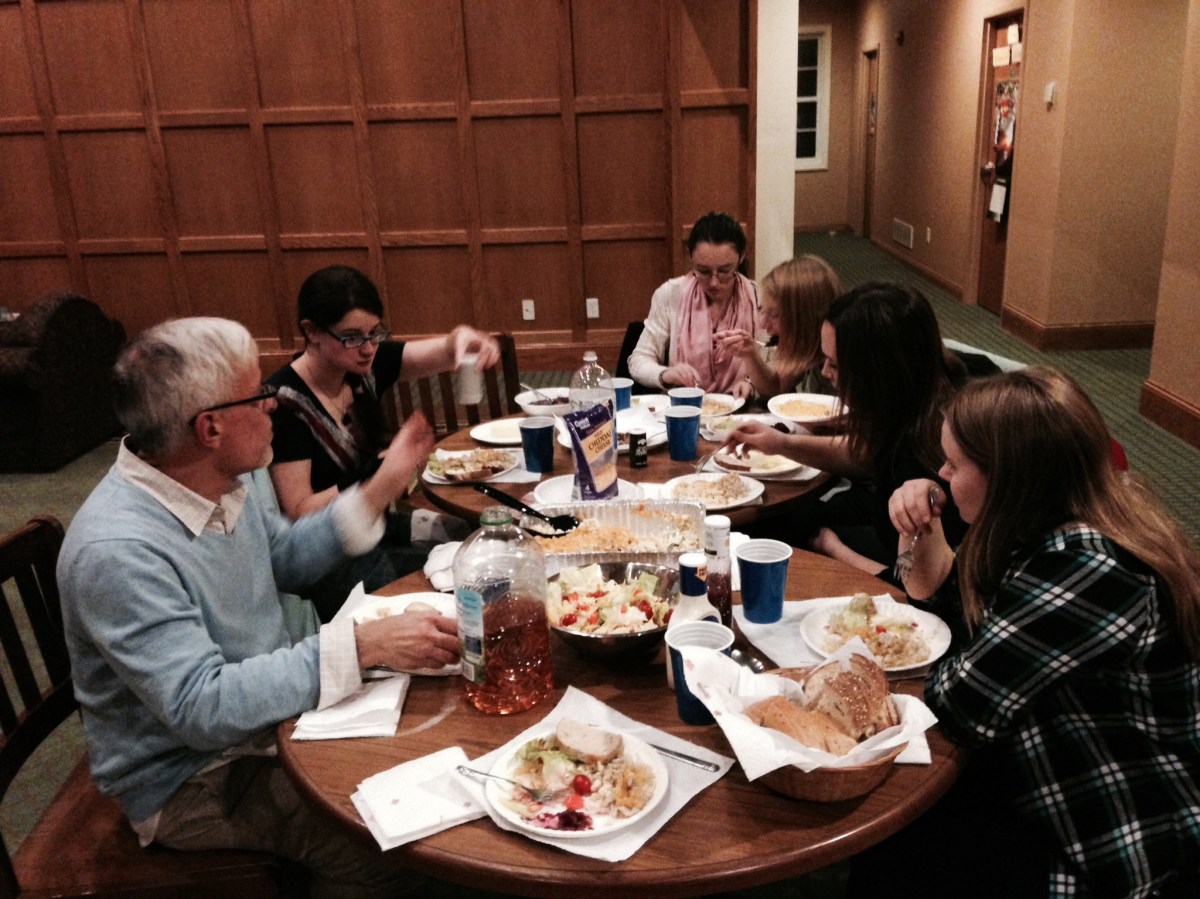
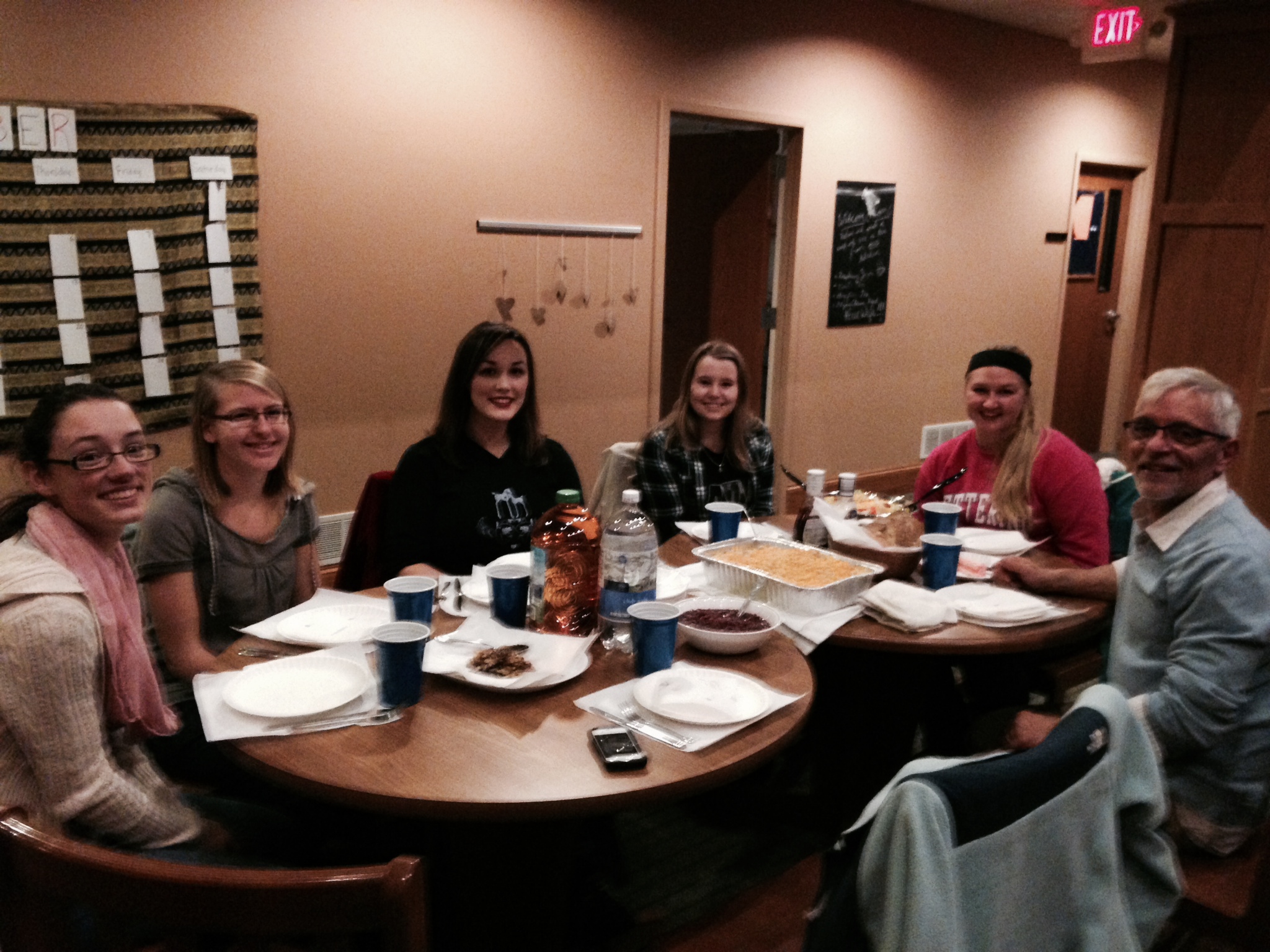
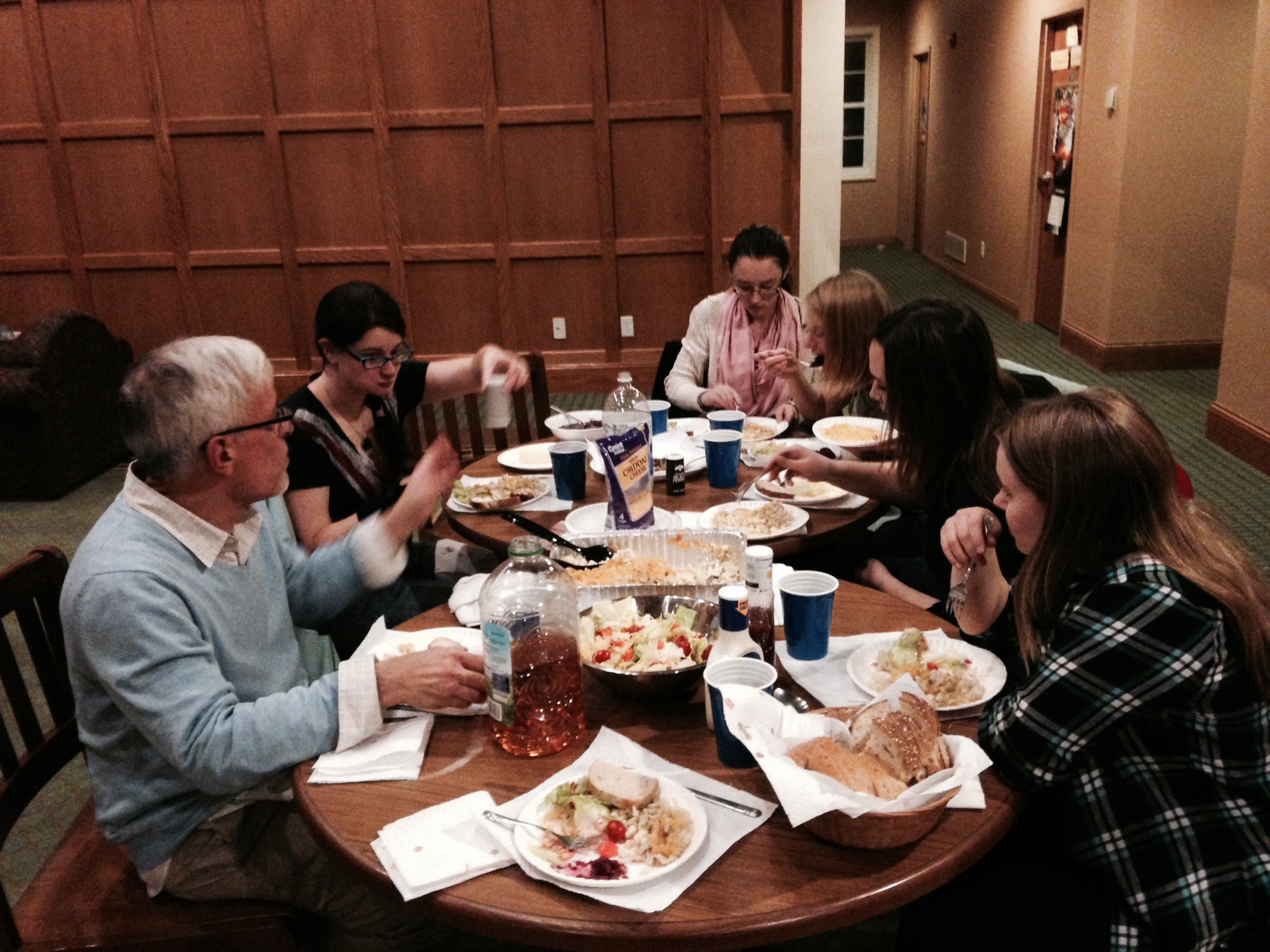
Additionally, last semester students spent a night taste-testing different German foods, including Spätzle (macaroni and cheese), Bauernbrot (German bread), and Apfelschorle (sparkling apple soda). They then watched Lilo and Stitch in German with English subtitles.
“Generally Germany doesn’t get a lot of attention. This club is just bringing more to the World Languages Program.” says Allie Herkenroder, president of Deutsch club.
Education
Spring Arbor University students have the option to take two years of German classes. During this time students learn about the basics of the language and culture. Prof. Bowen begins every class with a German scripture.
Games are often played to keep the students engaged. “I want my classes to be interactive.” Bowen explained.
A German business class is also available for students who want to be able to use the language in their careers. Half of the class is devoted to German business language, while the other half focuses on the culture. This is beneficial, since there are over 200 German companies in Michigan and over 1000 German companies in the midwest.
Finally, both a study abroad and cross cultural experience is available in Germany. Both of these opportunities are available to students who do not speak the language. The University of Regensburg will be hosting their first Spring Arbor University student next fall, with two more planning to attend in the spring. There the students will have an opportunity to travel throughout Germany and the rest of Europe, including studying art in Rome and politics in London. The program is designed for Christian universities. Students will also have opportunities to do mission work.
“So much of American culture comes from Germany,” says Herkenroder “there is so much going on in the world and it is important to see how other cultures play with each other. Being able to see other country’s perspectives and the relationships between countries can help in a time of crisis.”
During the months of March and April, many Christian denominations have entered this time called Lent. The word Lent means “springtide” and also “March,” the month which the majority of Lent falls in. Lent is where we remember the death, burial, and resurrection of Jesus Christ. Starting on Ash Wednesday, this time of remembrance last about six weeks, ending on Easter Sunday. Christians who practice Lent go through the process of prayer, penance, and repentance of sins, almsgiving, atonement, and self-denial. In order to do this, believers commit to fasting or giving up certain luxuries as a form of penitence. Now this article is not about what luxuries people are giving up, but on what Lent means to them.
Lindsey, a Catholic, gave me her view on what Lent means to her. “Lent is a time of sacrifice that represents the 40 days Jesus spent in the desert, so we give up something important to us to draw closer to him. It’s important to my faith because it makes it stronger and we can do something for 40 days to honor what Jesus did for our life.”
Sophomore David, a Free Methodist, gave his opinion on Lent. “Lent means giving up something that causes distractions in your life. We live with these distractions every day of our lives when we should be focusing on God. So this period where we give up something that takes up a huge portion of our life, we can then focus on what is really important in our life, God.”
Lent has been around for a long time, but back in the early years no one really had the actual practices and duration of Lent set in stone. Church authorities worked together and concluded around the 4th century that there was going to be a 40-day period of Easter preparation known as Lent and its main spiritual exercises would include prayer and fasting. This 40-day practice is meant to be fasting for six days a week over the course of six weeks. The Constitution on the Sacred Liturgy of Vatican Council II stated, “The two elements which are especially characteristic of Lent – the recalling of baptism or the preparation for it, and penance – should be given greater emphasis in the liturgy and in liturgical catechesis. It is by means of the celebration of Easter, while they hear God’s word more frequently and devote more time to prayer.”
For as long as I can remember, I’ve been disabled. My leg was partially paralyzed by a virus when I was nine months old. As a student at Spring Arbor University (SAU) for the past three and a half years, I’ve had the chance to experience some amazing things. For the most part, my disability hasn’t held me back while I’ve been a student here. However, there are still a few things that SAU could change to make their campus not only more accessible but also safer for all students.
1. Sidewalk on the east side of Cottage Street
I know there’s a sidewalk on the west side of Cottage Street, but students coming from Gainey Hall or Andrews Hall will agree, walking down Cottage Street itself is easier than crossing the street, then crossing back over because your class is in Smith Music Center or Sayre-Decan Hall. This puts students in danger of vehicles. Additionally, in the winter months, treatment of Cottage Street is neither as rapid nor as complete as the snow removal and deicing of sidewalks on campus. Additionally, there is no crossing area marked on the road for people to cross near Gainey Hall or Deitzman Hall’s ground floor access.
2. Card access to the South Wing end door of Gainey Hall
SAU’s ground maintenance crews do an excellent job of trying to clear student parking lots over the winter with student cooperation. However, parking lots cover a lot of ground and they don’t need the same sort of salting that sidewalks do. They can remain icy when there are melting-refreezing periods in the winter. While I’m not arguing for the treatment of all student lots, Gainey Hall is especially difficult to enter from the parking lot in the winter. To enter via the back door, one can go up the sidewalk that leads to the south wing, then through the snow to the circle drive at the back of the building. The circle is typically maintained, though not as well as streets or sidewalks. Following the circle to the back door, one can walk up the short sidewalk and then swipe in. To enter via the front door, one must follow the sidewalk that leads to the Resident Director’s apartment. It has a semi-permanent ice patch, crossing the entirety of the path, next to the parking lot due to the slant of the sidewalk. Additionally, one must step through the rock garden across the paving stones, attempting not to catch anything on the bushes or trip over bikes remaining on the bike rack. This paving stone area is difficult to maintain in the winter because it isn’t sidewalk. Snow sometimes freezes into the shape of bootprints that you have to fit your foot in in order to get through. If the snow does melt down to the point of the stones, it can freeze and leave the paving stones icy. Try to get into Gainey Hall from the parking lot with your arms full of groceries in winter could easily lead to slip-and-falls. The sidewalk leading to the door of the South Wing of Gainey Hall is always maintained in the winter, making it the best door to get in.
Implementing these recommendations could make students, especially those living in Gainey and Andrews Halls safer.
One of Nashville’s biggest up and coming artists has a lot more to him than people may realize. The chart-topping Sam Hunt once was a highly touted high school football player who went on to play quarterback at Middle Tennessee State before transferring to play at UAB. His talents on the field were enough to warrant him an invitation to an NFL training camp but his NFL career never took off. That may not be a bad thing, especially for us.
After making the move to Nashville to pursue music, Hunt wrote songs with the likes of Kenny Chesney, Keith Urban and Billy Currington. Chesney’s “Come Over,” Urban’s “Cop Car,” and Currington’s “We Are Tonight,” are a few of the well known songs he has written.
Hunt’s style is also unique, traversing genres to bring a blend of R & B, Country, Pop and even some EDM influences. In an October 2014 article interview with Marissa R. Moss of the Rolling Stone he explains his unique sound saying, “I am from the country, and I grew up mostly influenced by country music,so by the definition I have, these are country songs, not pop songs. Even though there may be a pop element, pop is an ambiguous word and can mean a lot of different things. I’m not trying to become a pop artist, and I’m not trying to make sure I stay a country artist. I’m just trying to make sure I make the best music I can, according to my way.”
His debut full-length album “Montevallo” reached #1 on the country charts and the top 3 in nearly every other. The first single off of the album, “Leave the Night On,” went platinum (at least one million sold). No matter what kind of music you’re into, you’re bound to find a song on it that you enjoy.
In an article written by Dacey Orr of Wondering Sound, Hunt gave his opinions about the direction country music is headed and the changes in the overall sound of country music. He said, “I do believe that it’s breaking down some of the stereotypes that have prevented people historically from giving country a chance. So I think that’s a good thing.”
Hunt has recently embarked on his first major headlining nationwide tour, of which many shows have sold out. This summer he will be touring with the likes of Lady Antebellum and playing some of the country’s biggest festivals.
Though he has only released one full-length album to date, Hunt has found great success in a hurry. Look for him to build on this momentum and release new music in the coming year.


 P.S. Some people may be frightened to see I killed a living animal. First, remember that the creature is hypothetical. Second, for the sake of calming everyone’s nerves we will just assume the creature passed out from my shiny sword. That’s what most things do around shiny objects after all.

 Pizza! Isn’t it nice to attend a school that is surrounded by God’s gift to mankind? Spring Arbor has not only Marino’s, which is right across the street, but Amy’s Pizza and Slice of Spice all within walking distance. Grab some super gnarly friends, grab a slice, and chill out in the SAU plaza before the school year comes to an end! You can fly a couple of kites, play an intense game of Battleship, set up your Wii U on the concept, and enjoy some pizza with your friends. It’s a cheap, sharable meal that will fill you with memories for years to come.

![mcdon[1]](https://thesaupulse.com/wp-content/uploads/2015/03/mcdon1.jpg)

![Lent-2014[1]](https://thesaupulse.com/wp-content/uploads/2015/03/lent-20141.jpg)
![IMG_8002[1]](https://thesaupulse.com/wp-content/uploads/2015/03/img_80021.jpg)