Roommates Choose Each Others Outfits

Recently, a Buzzfeed video was posted where a couple chose the others outfits for an entire week. The outfit, shoes, makeup and hairstyle were all decided by one half of the couple, the other didn’t get a say.

A group of Spring Arbor University (SAU) students decided to try the experiment for themselves and “The Pulse” will be following their journey. We’ll post an update at the end of every day so you can follow along as well!


Meet the students!

This is Bekah.

12661827_1157392490945090_5180302920141860605_n

“I love jeans, boots or sandals and cardigans. I like to keep things fairly simple with an emphasis on staying warm.”

Meet Bri.

12792302_1167490519971140_2119954026235981151_o

According to Bri, her style is “black jeans and lots of blazers. Occasionally, I’ll mix things up with a dress or skirt. To quote Jess, “You dress librarian-chic.””

And last but not least, Jess.

12439429_10207704328597910_1336330476128711576_n

“Usually you can find me in an oversized sweater and leggings. I keep my style pretty simple and most of my clothes are very neutral.”

By Bekah Kinney, Bri Loomis and Jessica Tower

Edited by Amber Cekander


What happens when you relinquish ownership of your wardrobe? We’ll be posting every day to let you know!

*all photos are provided by the participants and used with permission*

Save

Diversity, the Indigenous and the Limits of Being Human

By Taylor Reed

It’s impossible to say how many cultures there are on Earth. Lines of division blur, the sheer number of people groups make accuracy impossible and the dynamic nature of societies presents a moving target. What can be said, however, is that distinct social systems are disappearing as trends in globalization indicate shifts toward homogenization.

Which is progress, right? A simpler world is easier to handle. It’s especially helpful if cultures have much to offerpolitical and religious freedom, career opportunities for economic security,civil infrastructure to protect the safety and rights of humans, so on and so forth. These are conceptions often thought to be inherent in Western societies.
The prolific and enigmatic 20th century environmentalist, David Brower, compressed four and a half billion years of Earth’s history and that of its inhabitants into Genesis’ six-day creation.When that time frame is considered, it isn’t until 4:00 p.m. on the last day that dinosaurs walk the Earth. By 9:00 p.m., these dinosaurs are extinct. At 11:57 p.m., humans appear on the scene.Jesus is born forty-five seconds later. The Industrial Revolution occurs 1/40th of a second before midnight. Since this moment of innovation, more resources have been extracted and consumed than by the rest of the people who’ve ever lived combined. 
Brower states, “There are people who think what we’ve been doing for the last fraction of a second can continue indefinitely. They are considered reasonable people, but they are stark raving mad!
Humans have existed for a long time, yet it wasn’t until recently they began to alter the planet and its ecological balances as significantly and seriously as they do now. It’s no coincidence that 95 percent of the areas identified by the World Wildlife Fund Global 200 as harboring exceptional biodiversity are home to indigenous peoples. This isn’t to paint pre-industrial societies as utopian. Survival entails struggle, and bouts of starvation and disease aren’t to be considered lightly. Today, we think we have answers for these. We think we have answers for everything. We’ve essentially circumvented natural selection. But despite—or perhaps due tothis feat, creation groans.
Lack of clean water, food, medicine and decent sanitation threaten many today. This is well understood. The solution cannot, however, be to bring all into the same conditions that we as Westerners live in today. This “flourishing” is literally impossible, as it would require four Earths to support the world’s population living as Americans, as according to the Global Footprint Network. Developing technology is often brought up as an answer, but gambling on things that do not, and may not exist, may not be the wisest or most responsible choice,especially as it is in our collective power now to make changes with positive repercussions among humanity and creation.
We must lower our conception of ourselves to the point where we can consider that necessary changes, developments and the shaping of lives very well might ask the transformation of ourselves as much as it does others. How do we use technology responsibly? How do we love,interact with and learn from those who live differently than us? And, most importantly, and possibly all encompassing, how do we humble ourselves before God, and find ourselves back in the correct order of creation? We have been given much. We are responsible for much. And for the many cultures, perspectives and ideologies, we are thankful. We have a lot to learn.  

De Graaf, J. (2015). Black Friday is Buy Nothing Day. Retrieved February 29, 2016, fromhttps://www.prforpeople.com/news/black-friday-buy-nothing-day
Indigenous and Traditional Peoples of the World and Ecoregion Conservation (p. 28,Publication). (2000). Gland, Switzerland: WWF International- Terralingua.
United States of America. (n.d.). Retrieved February 29, 2016, from http://www.footprintnetwork.org/en/index.php/GFN/page/trends/united_states_of_america/

Student created petition against trafficking gains support

You might not have noticed it, or ever thought anything of it. But when driving on Interstate 94 heading towards Spring Arbor, it’s almost impossible to miss certain billboards that advertise peculiar services.

Bold yellow and pink letters over a solid black background promote an Oriental Health Massage parlor. While seemingly innocent enough, the strange part comes further down the billboard where it says they are conveniently open seven days a week…until 1 am. Many people in the Jackson and Spring Arbor area know this as blatantly promoting human trafficking.

Currently, a petition with over a thousand signatures on it is being enforced through Change.org. When enough people have signed the petition, Michigan Representative Tim Walberg will receive a letter asking him for the removal of these billboards in Jackson.

“Every time I drive on I-94 I’m reminded that Jackson is a safe place for human trafficking,” said Dr. Matthew Hill, Spring Arbor University (SAU) professor of philosophy. “That sign is a physical reminder that the political leaders in the city of Jackson and Jackson county (many of whom claim to be Christian) are too scared or impotent to do anything about such depravity.” Opinions like these were expressed during one of Dr. Hill’s Ethics classes, which actually sparked the idea for the petition in the first place.

Josh Riddick, Lindsey Fluharty, Caleb Smith, Quinn D’Ascenzo, and Nikki Bonnema pursued the idea in Dr. John Hawthorne’s Spirituality, Faith, and Justice course as an “action” project. According to Riddick, his group was struggling to get things done with their other project ideas until the subject of the billboards came up in Ethics class and they decided to do something about it.

While there is currently no lawful proof that human trafficking takes place in these parlors, there has been questionable activity. Senior Lindsey Fluharty, as part of the action project, tried calling the phone number on the billboard to make an appointment, but reported that they wouldn’t let her do it and insisted she should make an appointment “for her husband” instead.

During further research of the subject, it was also discovered that the massage parlor has a profile on “Naughty Reviews.com.” A website who’s tagline is “Find naughty girls near you.” 

o[1]
A picture of the parlor’s entrance
In past interviews, SAU sociology professor Jeremy Norwood has said “There is no reason that a massage parlor should be open at 1 a.m.; nobody wants to purchase a massage at 1 a.m.”

At the time of this writing, the student-led petition currently has 1,157 out of the 1,500 signatures needed to continue the petition process. Dr. Hawthorne said he has started introducing the action projects to his class because his students said they “wanted to actually do something.” This is exactly what this group of students is doing, and if others continue to sign the petition, they will be too.

To look at and sign the petition, visit this link

By Nate Bortz

Save

Bubble Soccer

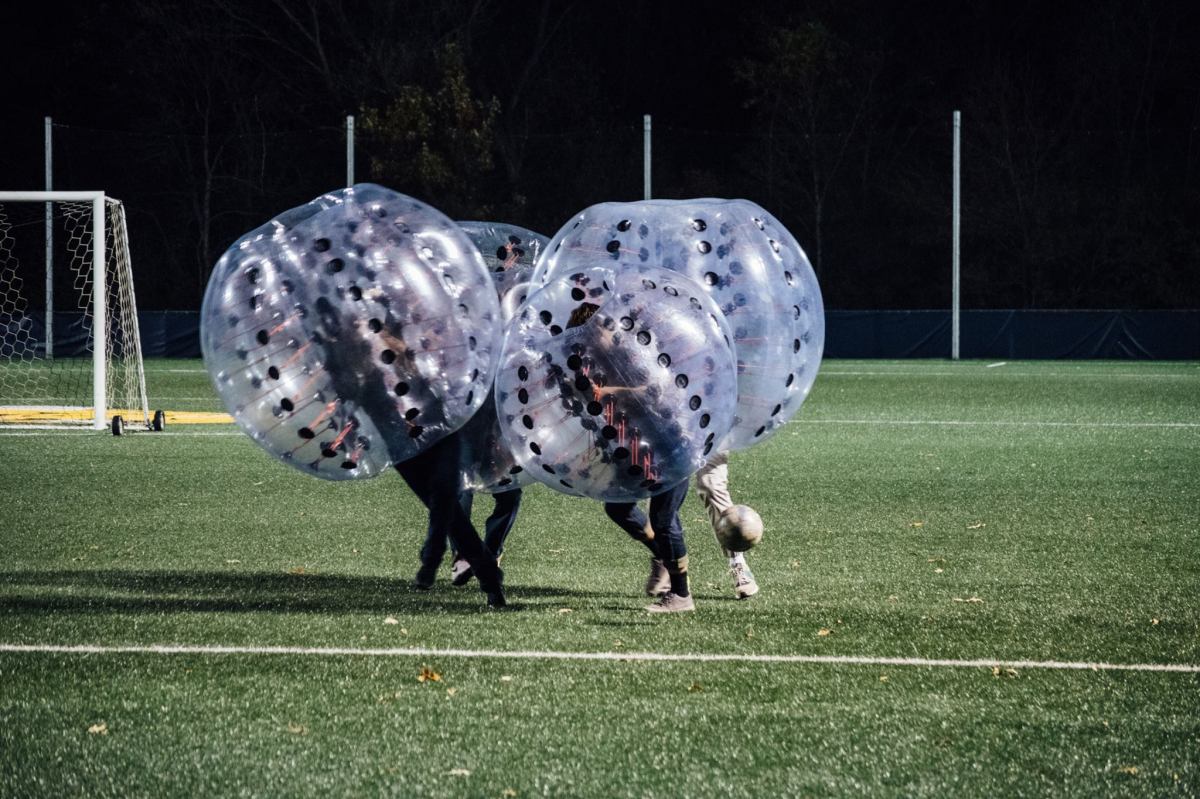
Eight people, inside giant inflatable balls, chasing a soccer ball around and more often than not, knocking each other over and sending the other person bouncing across the floor. Sound amusing? That’s Bubble Soccer, which took place in Dunkel Gym on the 14th. Teams of students who had signed up for the event in the previous weeks faced off in several games during the tournament, which was set up as a double elimination play. Even Student Government president Ty Davis joined the fun, along with several Peer Advisors and other students.

According to Student Government Association Intramural Sports Coordinator Austin Gatza, this is how the game workes:

There are 4 players on a team, and each has his or her own bubble, which is basically a large inflatable ball with an open center tube that the player stands inside, with straps and handholds to keep the bubble from being bounced off if the player is knocked over. The games were timed in two six-minute halves, and teams alternated play in order to give the others a chance to rest.

There were no out of bounds. Balls could be played off the walls and then if it went completely out of play, staff members or spectators just kicked the ball back into the game. I quickly noticed that this rule meant that even sitting on the sidelines was no guarantee of staying out of the action. Stray soccer balls and sometimes even players often bounced in the direction of spectators, and ducking was certainly a common thing to see when a the soccer balls were kicked more wildly than usual.

While the supposed object of the game was to kick the soccer ball into the goal, the game sometimes became more of a human bumper car tournament, as students attempted to bounce into each other hard enough to knock their opponent over. Getting up after being knocked down seemed to be quite a challenge. Players bounced and rolled across the floor trying to find good footing only to be slammed into again seconds after getting up. Some even became wedged in the goals when their bubble was knocked into the net.

Bubble soccer was certainly a very amusing event, both to watch and to be a participant in. This event gave students a fun and more protected way to participate in a sport that they normally do not play.

By Heather Clark

Student uses “reply all” to propose to girlfriend

During a mostly quiet afternoon, the most interesting thing to happen on campus since the silverware incident intruded its way into the lives of students and alumni alike.

Students who don’t check their emails will probably never bother again due to a flaw in the new email system. It is now possible to use “Reply All” on emails sent to the entire campus. Phones buzzing and notification ringtones were heard round the plaza as the entire student and faculty mailing list was set ablaze with tired memes and fabricated “campus news” twitter sources.

From what started as an innocent plea stating,

“This is an advisory email to please avoid hitting “Reply All” to campus-wide emails.”

eventually turned into cries for help including,

“PLEASE REMOVE ME FROM THIS EMAIL STRING!!!”

and

“This has veered wildly from ‘moderately amusing’ into ‘STAHP. PLEASE STAHP.’”

The most powerful words spoken in this email onslaught were

“Why am I getting this?”

In a truly unsurprising turn of events, someone took the liberty of using this newfound platform to propose to his girlfriend using. Getting ahead of #RBS (ring by spring) and hoping the wide audience will lower his chances of rejection, the email said

“Ever since I saw you cut the head off that chicken at Cedar Bend, I knew you were the one I want to pursue life with. (Name withheld), will you marry me?”

The email, soon deleted, was both moving and pathetic in the eyes of the SAU campus.

This incident has undoubtedly inspired people working at IT to get off Reddit and see what they can do to fix this, but until then, the epidemic shall continue.

#SAUFlatline

By Nate Bortz

Stamina, Sanity and Spirituality: Extended Version

There is a meme floating around the Internet that presents three choices to the college student: good grades, a social life and enough sleep. It gives the reader instructions to “choose two.” Similar in nature, it seems, are the aspects of college students’ health: from spiritual, physical, mental and social health, it is as if we have to “choose two.” But is this really a choice we should have to make?

I recently had the opportunity to speak with a few faculty members who had some practical advice on how busy students can stay healthy without having to “choose two.” Here’s what they had to say:

Spiritual Health

Deb Varland, assistant professor of health, human performance and recreation at Spring Arbor University (SAU), believes that physical, mental, social and spiritual health are all interconnected, but that Christ is the most important part of a healthy life.

“A lot of wellness models will have physical fitness in the middle, but for me, having the cross at the center is really important,” said Varland.

To Mary Rick, nurse practitioner at SAU’s Holton Health and Wellness Center, a person’s spiritual life is paramount, as well. “A healthy life begins with a healthy spiritual life,” said Rick.

Ron Kopicko, SAU’s chaplain, emphasized the importance of a commitment to four different things in order for a person to grow spiritually: time management, people, the spiritual disciplines and fellowship. He also explained his definition of spiritual growth: “Spiritual growth is not just [about] what I believe, but it’s also understanding God’s relationship with me, my relationship with him and being consistent with those two things,” as well as “seeing myself the way God sees me and wanting him to see me as being faithful regardless of what I feel.”

Kopicko said that time management is also important, because spiritual growth does not simply happen on its own. Whether or not a person feels like it, it is essential to work at growing spiritually. “Success is predicated upon the cost that you pay when you do something when you don’t feel like it,” said Kopicko.

Furthermore, relationships with others are part of a healthy spiritual life. Jesus instructed his followers to “love one another even as I have loved you” (John 13:14, NASB). Kopicko suggested a person ask him or herself, “How can I contribute to what God is doing in this person’s life?”

Additionally, Kopicko recommended consistency in the spiritual disciplines of prayer and reading the Bible.

Rick explained that what motivates her to meditate and read the Bible is the idea that “God delights in us.”

Finally, Kopicko used an example from Acts 2 to demonstrate what Christian fellowship should look like: the 3,000 people who put their faith in Christ “committed themselves to the apostles’ teaching and to prayer and to the breaking of bread and to sharing with anyone who was in need.”

Physical Health

Getting seven to nine hours of sleep per night—as Terry Darling, professor of psychology, recommended—is both desirable for virtually all college students and beneficial to their physical health.

Rick’s suggestion to help students fall asleep is practicing “good sleep hygiene,” or having a routine that consists of “gentle things,” like prayer, meditation, reading, listening to music and taking a hot shower.

Varland said that students should go to bed and get up at about the same time every day so as not to interfere with their bodies’ natural rhythms. In addition, she explained that, on top of a good night’s sleep, resting during the day is important. “We don’t often take time for Sabbath or even for daily rest, daily reflection and time spent with God,” said Varland.

In terms of diet, Rick recommended one that is rich in protein, fruits and vegetables, adding that students need to eat a good breakfast—such as eggs or a high-protein bar, perhaps with milk. Furthermore, students should always carry a snack—carrot or celery sticks work well, along with a source of protein, like peanuts or cheese—to keep their blood sugar stable.

According to Rick, we should exercise for at least 30 minutes a day, five days per week. Ideally, this exercise will include both aerobics and weight training.

Varland recommended that students try new forms of exercise, such as intramural sports, walking the P-Loop by campus or using the indoor track or weight room and the cardio equipment in the gym.

“No one should leave Spring Arbor University without having a complete physical,” said Rick, noting that the health center offers physicals, including lab work, to both insured and uninsured students. She additionally emphasized the importance of students seeking medical attention when they need it.

Students can visit the health center for reasons other than physicals, too. For instance, the health center offers flu shots during the fall. Ultimately, in visiting the health center, students need not be afraid of getting in trouble; everything is confidential.

“Come to the health center for anything,” said Rick. “It is the best deal in health care you’ll get.

Mental Health

“The freshman year of college can create a lot of anxiety and stress for the new student,” said Carrie Dashner, director of counseling services.

Dashner and Varland both recommended getting acquainted with other people. Varland explained that talking with someone helps with stress. “It’s really important to develop relationships with someone that we feel secure with,” said Varland. Then, a “sharing of ideas” can occur that can help a person work through his or her problems.

Dashner suggested Core instructors, peer advisers, resident assistants/directors and Ron Kopicko as people that freshman students can feel comfortable talking to. “It is really important for the freshman student to feel connected and supported,” said Dashner.

Incoming students should know that confidential counseling—for any reason—is available to them through the health center. Rick noted that there can be a “stigma” attached to counseling, but added, “There should not be a stigma. It’s health-seeking behavior.”

Dashner said that, in seeking out counseling, “you are actually being proactive in dealing with your struggles, issues and feelings before they become unmanageable.”

Dashner also explained that students can stress less by practicing organizational skills. “I would recommend that all assignments, projects and exams be entered into a planner to stay organized,” she said. “Often, students find it helpful to color code their classes to distinguish between them. Staying organized, prioritizing, making lists and following a schedule will all help reduce anxiety and stress.”

Social Health

Bonnie Holiday, assistant professor of social work, provided some suggestions for practicing good social health.

First and foremost, “get involved in something.” It may be uncomfortable, but “it’s awkward and weird for everybody,” said Holiday, noting that it may take a while to really make friends, but that that’s okay and normal.

More important than being best friends with our roommates, said Holiday, “is that you can live together in harmony.”

For homesick students, Holiday recommended doing something nice for another person: “It usually makes us feel better when we do something nice for somebody else, which of course is biblical.”

“Do one thing every day that you enjoy,” Holiday advises students, “and do one thing every day that’s outside your comfort zone,” such as being intentional about meeting a new person.

“There’s no perfect freshman,” said Holiday, encouraging students to keep in mind that our experiences will be a little different from everyone else’s.

In the end, the components of spiritual, physical, mental and social health connect and overlap with each other. So, instead of asking whether we have to “pick two,” or even whether we can be healthy in all four areas simultaneously, perhaps the question should be, is it possible to have one type of health without the others?

By Dana Van-Doren

What is kombucha and should I be drinking it?

I met up with Spring Arbor University senior Autumn Freeman, biology major and daughter of a “health nut,”  to discover what kombucha is, what it does, and why she drinks it.

ca pic
Autumn Freeman and Professor Jen Letherer

Kombucha is a fermented tea drink with a probiotic nature, which is what makes it so appealing to the “health nuts.” Autumn explained the complicated biology part to me like this:

There are twice as many bacterial cells in your body as your own cells. These cells help break down your food and protect you against things you touch. Everyone’s bacteria is unique. The kombucha supplements the good bacteria, which helps keep you healthy.

Where you can buy it

1) Walt’s Health Food 

This health food store is across from local favorite Chilangos. Autumn says that their kombucha is “the good stuff” and suggested pitching in with a few friends to get a bottle, since drinking a whole bottle during your first time might “shock your system.”

2) Target / Meijer 

Target
Target

These two chains have a pretty similar selection. Personally, I tried Mamma Chia’s Guava Mamma and, once I got used to drinking the chia seeds, I loved it. I also enjoyed the first few sips of Live Kombucha Soda’s Living Limon, but I found that 15 minutes later it tasted flat.

How can I make it?

Making Kombucha is a lengthy process, but it is worth it. It order to start you need a “mother liquid” from a different kombucha and its scoby  (symbiotic culture of bacteria and yeast). Autumn suggested either buying kombucha from the store or getting this from a friend who already brews.

Equipment

  • 1 large Glass or ceramic jar (avoid using plastic or metal)
  • A few smaller glass or ceramic jars
  • Cloth

Ingredients

  • Tea – black or green
  • Sugar
  • Starter liquid
  • Scoby
  • Extras:
    • big chunks of fruit
    • fruit juices
    • chia seeds

Step 1

Take the scoby and the starter liquid and put it in your jar. Then mix the tea and sugar together and add it in. Seal the top with a cloth so your mixture can breathe. During this stage the scoby ferments the sweet tea. Leave this alone for a week to two weeks, occasionally taste-testing until your mixture makes the perfect tang-to-sweet ratio.

Step 2

Now take your mixture and add your extras! Autumn mentioned that the chia seeds are really fun, since “they’re dry and really tiny when you put them in…the mixture, then they expand and get really gelatinous and wonderful.” She also said blueberries and mangos work really well, but apples do not.

Tip: The more sugar that the fruit juice has, the more carbonated it will be in a shorter period of time, since the bacteria will have more to work with.

Step 3

Take your mixture and put it in separate sealed glass containers for a week. After that is done, refrigerate, and enjoy!

Buy it before you try it!

It is really important to pay attention while making your kombucha. If you leave the lid off while making it, you risk mold and dust getting in. Additionally, there recently was a food poisoning bacteria strain was going around the world and ended up in Autumn’s brew. (If your kombucha turns green, throw it out!)

FAQ: Is kombucha alcoholic?

Technically, yes! It is a fermented drink, which means that a sugar source was turned into alcohol. However, the alcohol content is so low that is nearly impossible to get buzzed off of the tea.

By Courtney Applebee

http://www.waltshealthfoods.com/

http://www.culturesforhealth.com/kombucha-tea-starter-kit.html

Top 5 weirdest video games

This is a list of the strangest games I have ever personally played. I realize there may be weirder games out there, and please share them in the comments below!

Toribash screen1[1]

The concept of Toribash is one that does not sound too strange. Essentially Toribash is a game where you are trying to fight your enemy in a martial arts battle to victory. The catch is that you have to choose what muscles you want to move, and you have access to every muscle in your body. This means in order to fight you must choose if you want to extend, contract or hold a muscle and things get really weird really fast. For example I could start by choosing to contract my hip and extend my knee and that would essentially more or less be a kicking action. The problem is more often than not you can’t figure out how to get things to work. Instead you make your character flail around like an idiot trying to hit your opponent. It typically ends with you falling on your face and simultaneously kicking the back of your head. It’s a lot of fun and is free so you should definitely try it out. But be warned: if you play online, get ready to lose because there are some weirdos in this world who actually know how to work this impossible game. Hint: Adding jetpacks to the game makes it infinitely more fun.

 Earthbound (Mother 2) ytvnp9clnahbjgt5of76[1]

In all fairness this game is a work of art and fans everywhere can’t stop talking about it. However, this doesn’t mean it isn’t absolutely out of this world in its levels of weirdness. You start on a journey as a kid named Ness and you have to fight a super-powered fly, erase giant pencil statues, defeat an evil cult that wants to paint the entire world blue, and even fight an evil pile of puke. (which sounds gross, but to be quite honest while playing the game you don’t even think that much about it.) And these are only the beginning. It sounds crazy and nonsensical, but everyone who finishes the game is in awe of its beauty.

 Noby Noby Boy noby_noby_boy_1[1]

I don’t really know how I stumbled across this hidden gem. The whole point of the game is to eat everything on the screen, and that’s pretty much the extent of it. You start off as a small worm that is only big enough to eat things such as small plants and then once you eat enough small plants you grow big enough to eat things like skateboards, and then you can move on to people and you finally grow large enough that you can eat entire skyscrapers. That’s pretty much the extent of the game, there’s no real purpose. After you quit the game, your score is uploaded online and it helps grow the entire noby noby boys community worm as a whole. The goal is to play everyday as a new worm so that you can continue to grow the community worm so large that it reaches new planets. When I stopped playing about 3 years ago the entire community had reached the planet mars. I did a quick google search and found out that the community has currently reached the planet Uranus. This game has been going on since 2009, so players from all over the world have spent the last 6 years trying to reach every planet. Will they ever reach the final planet Neptune? I can only hope so.

Goat Simulator 2548622-2057333842-24887[1]

Chances are you have heard of the game goat simulator. It’s received quite a bit of attention since its release last year, and yes, it is exactly what it sounds like. I have never felt more like a goat then when I have played this game. The whole game was made essentially as a joke. There are numerous bugs and glitches in it and that’s okay because the developers didn’t want to make a nice polished game. The whole point of the game is to be buggy. Essentially you run around as a goat and grab stuff with your tongue. You can do many different things such as call aliens and go to space. Make it rain goats. Get a cool goat jetpack and many other strange things. The coolest part are the variety of characters in the game. You can be a giraffe goat, an ostrich goat and as of recently, you can even be a microwave goat–just a microwave with 2 legs. Seriously this game’s weird, but I love it.

 .Detuned detuned-psn_1241461673[1]

Alright we made it to the top weirdest game that I have ever played. Almost no one I’ve talked to has ever heard of this game and I really wish I could say that I don’t know it either. I originally got it because the title description made it sound like I could make my own music. Instead I sat staring at a screen with the most confused look I have ever had in my life. I also couldn’t get rid of that confused look for the next 3 weeks. I went to school and people were like “Joel what’s wrong with your face?” I couldn’t answer them though because the game had broken my ability to do anything.

Essentially in .Detuned you play your favorite songs in the background and control a man who sits in a chair. You can make the man do things like walk around the chair, cough and adjust his sleeves. Sorry was that too normal for you? Well you can also do things like turn your head into a balloon, an elephant or various other things. And all the while weird smiley square people are staring at you and cheering you on. You don’t have the option to move away from the chair, you must stay in its vicinity the whole time. As you play more and more you discover different buttons perform different actions. Why do I want to preform all these actions you may ask? That’s the best part. The whole point of the game is actually to make a music video based around your character sitting in the chair. There’s no way to beat the game, you just experiment until you don’t want to experiment anymore. You quickly find out all the cool creative ways to make a music video of a man and a chair. Still confused? You can watch the video below if it helps, but chances are it will confuse you even more.

https://www.youtube.com/watch?v=MLDanQvMw04

By Joel Bradley