After 34 years of teaching, Dr. Jonathan Bruce Brown, Spring Arbor University’s (SAU) music department chair, is set to retire.
His first encounter with SAU was 44 years ago on March 31, 1973, when his sister was married on campus. Ten years later, he heard about a job opening, “and the rest is history,” he said with a smile.
Dr. Brown. From SAU’s website.
Dr. Brown has taught several classes at SAU, with some of his favorites being Intro to Fine Arts and Music Theory. He also started and directed the string orchestra, helped set up the computer music lab, and composed a brass piece for the kick-off dedication of the campus library in 2002.
“It is a real blessing to be here [at SAU],” he said. “I just hope people feel like I tried to be helpful.”
According to sophomore Rachel Lawrence, “Dr. Brown is just a really great guy to talk to… and he does such a good job laying down the basics and making complex concepts easy to understand.”
Dr. Brown is not only an accomplished professor at SAU, but he is also a nationally-recognized composer. His performances have been showcased from Washington D.C. to Honolulu, Hawaii, garnering annual awards from the American Society for Composers, Authors and Publishers (ASCAP) since 1992.
34 years later, Dr. Brown’s career at SAU comes full-circle as he plans his farewell concert. The concert is on April 27th, 7:00p.m., in the Spring Arbor Free Methodist Church chapel.
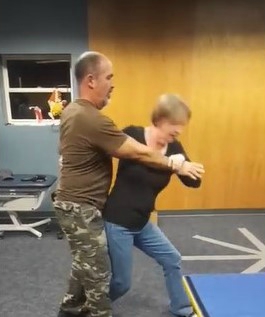
On Thursday, February 1, 10 students dodged punches and blocked kicks as they attended the newly emerging kickboxing club at Spring Arbor University (SAU) for an hour-long session of fight training.
The club started in the fall of 2016 when two students in associate professor of physical therapy Mitch Zigler’s HPR101 class expressed interest in learning techniques he taught one day in class.
Now that school is back in session for the spring, this new club is “kicking” it into action for the year with the hopes that the new semester will bring in some new recruits to help the group come out of the shadows.
The group meets every Thursday night from 5:30 to 6:30 and is led by Zigler in the Physical Therapy clinic. Zigler said that he instructs by his history of Krav Maga and Filipino fight training.
Mitch Zigler and Bethany Ulrich, assistant professor of HHPR. Photo by Rachel Merchant.
“Just training in Krav Maga offers your body cardiovascular exercise,” Zigler said. “It is also mainstream combative, so we get to have fun all while working on these very direct techniques, making it the most effective way to defend yourself.”
Zigler also said he would like to focus on Krav Maga techniques.
“It’s the most movement-efficient, and is proven combatively effective because it’s used by the Israeli army and is taught in our police and army systems as well,” Zigler said. “I think that all SAU students should learn how to handle any combat situation.”
Student Conner Williams attended for the first time this past Thursday.
“My favorite part of the class was being there with my friends and learning something new together,” Williams said. “We’re constantly learning new information in an academic sense, but it’s nice to learn a new way to use our bodies, too.”
Regular attendee Celeste Fendt said, “it’s a casual, fun way to get some cardio in and learn important self-defense skills.”
The class is free, welcomes beginners, and is for anyone looking to have some fun and learn how to protect themselves.
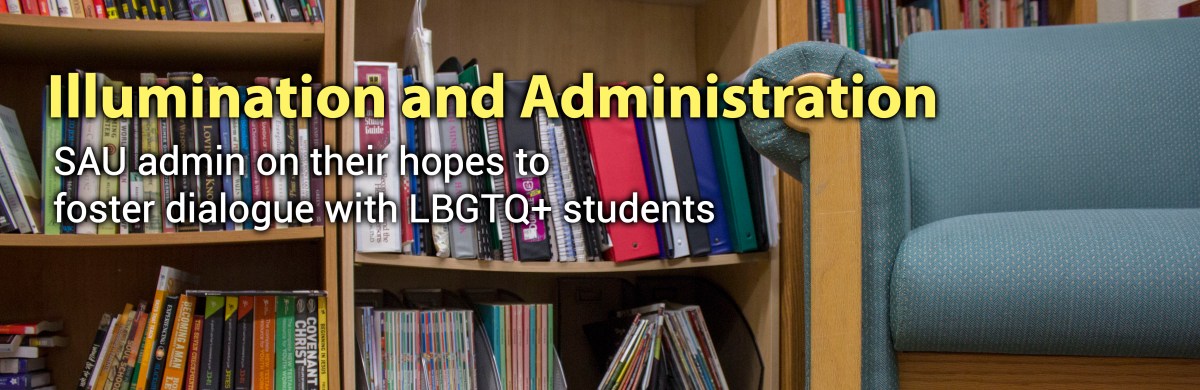
A worn green armchair sits in the corner surrounded by shelves of encyclopedias, devotionals and Biblical commentaries. Papers, reading glasses, three used mugs and a ping pong ball are scattered on a desk across from it.
By Kayla Williamson
A worn green armchair sits in the corner surrounded by shelves of encyclopedias, devotionals and Biblical commentaries. Papers, reading glasses, three used mugs and a ping pong ball are scattered on a desk across from it.
Some consider it a safe space to talk about their sexual identity.
“I don’t know how, but some [students] have chosen to come talk to me about it,” University Chaplain Brian Kono said. “As they sit in that chair and talk, I try to never make my opinion or my belief stand above the person or my relationship with them.”
The bulk of their conversation is not about what the Bible says about sexuality, but how they are processing this with their family, what shapes their identity, why they think God made them this way.
It is a conversation full of questions and listening.
It is a conversation an estimated 9.5 million Americans have had, according to a study by the Williams Institute in 2014.
It is conversation the Spring Arbor University (SAU) administration is trying to cultivate.
Living on a school campus that prohibits homosexual behavior creates a student perceived barrier to cultivating an environment of welcome conversation and loving support. Bridging that gap while maintaining student handbook rules is a challenge administrators like Kono are trying to overcome.
[It] was very revealing to me that a student didn’t think they could come out to me or an administrator without there being some sort of response from us. – Kim Hayworth, VP for Student Success and Calling
Whether the attempts land successfully or not depends on the level of trust at an individual level.
“I hope that it’s because they trust me,” Kono said. “They know my heart. It’s not unique to me. You know those that you trust because of the good conversations you have with them.”
The role of community standards
In a meeting with students, a girl asked Vice President for Student Success and Calling Kim Hayworth if someone has ever come out to her.
Her answer: absolutely.
“She was shocked, and her shock shocked me,” Hayworth said. “That was very revealing to me that a student didn’t think they could come out to me or an administrator without there being some sort of response from us.”
For Hayworth, the challenge was realizing student perception of administration—that if someone came out to an administrator, unknown concequences await. She realized the effort she and other administrators will have to do to overcome urban legends or the label of “administration.”
Both she and Associate Vice President for Student Development and Learning Dan Vanderhill emphasize the difference between identifying as LGBTQ+ and participating in LGBTQ+ behavior.
The Student Handbook states, “All students, regardless of age, residency or status, are required to abstain from cohabitation, any involvement in premarital or extramarital sexual activity, or homosexual activity (including same-sex dating behaviors). This includes the promotion, advocacy, and defense of the aforementioned activities.”
“I hope people understand that it’s not against the rules to be LGBTQ any more than it be against the rules for someone to want to have sex outside of marriage,” Vanderhill said. “It’s against behaviors which are clearly stated in the handbook. I think they’re fair expectations even if there’s room for disagreement on them.”
I don’t believe we should interact with, like this calculus in my mind of how I should interact or approach you. To me that is very unhealthy. It’s like a false reality that we create when we affiliate with each other in that manner. – Kim Hayworth, VP for Student Success and Calling
How will we engage with the other?
A group of administrators and faculty started meeting at the beginning of fall to brainstorm how to be intentional with conversations.
It is both the school and an individual’s responsibility to create safe spaces where students can feel comfortable approaching someone, Hayworth said.
“I don’t believe we should interact with, like this calculus in my mind of how I should interact or approach you,” Hayworth said. “To me that is very unhealthy. It’s like a false reality that we create when we affiliate with each other in that manner.”
This “thinktank” as they call themselves, has met with students to tell their own stories and the stories of others. By listening to these students, they hope to create more events and opportunities to cultivate community engagement with each other. Next Monday’s chapel speaker, Adam Mearse, and the following dorm talks that night are efforts to “elevate” the conversation.
Yet there is a barrier between the LGBTQ+ community and the non-affirming. SAU is built on the Free Methodist heritage, which does not affirm the LGBTQ+ lifestyle. So how can the SAU community engage with each other without forgetting that heritage?
I see both students and staff faculty just get into this comfortable rut. When we’re in stressful day-to-day things, we just want to sit with people we know at the DC instead of meeting someone new and taking time to listen. – Anna Tabone, Career Advisor
“I don’t have a good answer because I think it can be interpreted as a very painful thing to be non-affirming, but I do believe there’s ways to be so loving and non-affirming,” Tabone said.
Kono is still wrestling with how to best advocate for the other on campus.
“This is a difficult conversation to have,” Kono said. “The weight of the tension that comes is something that I feel very greatly. It becomes a weight. Yes, it can become a negative thing, but I feel it because of the weight of importance that we, as a community called Christian, try to engage these conversations well.”
Strangers Like Me – Anna Tabone’s Story
In high school in 2002, Anna Tabone had a crush.
She and her friend Joe had agreed to go to prom together. A week before the dance, he told her he was gay.
That was the first time Tabone was challenged by what her conservative upbringing had taught her about the lifestyle of the LGBTQ+ community.
“But we went to prom together [with] one of our gay friends and one of my best friends, and it was a blast,” Tabone said. “In that sense, Joe is not an ‘other’ to me. [He’s] someone I really knew and really cared about.”
As a former Resident Director (RD), Community of Learners (COL) leader and now Career Advisor, Tabone has taught and mentored several students in the LGBTQ+ community. She has had students who came out to her as an RD, as someone who will walk with them before they are ready to come out to anyone else.
“That, I feel was maybe one of the most treasured gifts, to have a student trust you with their real self,” Tabone said. “[It] still really chokes me up.”
Engaging with the LGBTQ+ community, or anyone considered “other,” is a fundamental Christian action, not just a principle, Tabone said. They become less of a stranger if their story is told and they are in an environment where they can be themselves.
Engagement starts in small ways, Tabone said.
“I see both students and staff faculty just get into this comfortable rut,” Tabone said. “When we’re in stressful day-to-day things, we just want to sit with people we know at the DC instead of meeting someone new and taking time to listen.”
It started with a girl her son brought home. It should have ended with a Facebook post. But that was not what God had planned for Michelle Cochran.
When Cochran first saw the mLive surveillance photo of a girl at a gas station, she kept scrolling. It was not until her son came home and asked her if she had seen the Facebook post that she realized it was her son’s girlfriend, Danielle. Danielle was addicted to heroin. She had been caught on camera robbing a gas station attendant at gunpoint.
“Sadly, my first reaction was, ‘okay, at least she’ll be away from my son,'” Cochran said.
But the next day brought a different outlook. That morning, Cochran listened to Adele’s “All I Ask” on her mp3 player when the lyrics, “there is thought to my role,” made her pause. Then, “it matters how this ends.”
“All I could see was her face,” Cochran said. “And it just broke my heart. I cried over that girl for three days, and then I went to the jail.”
Cochran asked Danielle if she could walk with her through the trial. From then on, Cochran never missed a court date and visited her every week. Danielle could have been sentenced to at least seven years of prison, but instead made it out with three and a half.
“For that,” Danielle said in a blog post, “God is good.”
Danielle’s story is not over. But many girls are not given a second chance like Danielle. They do not have someone willing to build a relationship with them or guide them post-addiction or trafficking or incarceration, so they go back to their unhealthy environments or addictions. They start the process over again.
When fighting addiction, patients have a 40 to 60 percent chance of relapsing, according to the National Institute on Drug Abuse. A 2013 national study by the Illinois Criminal Justice Information Authority on residential programs for victims of human trafficking found 37 operational residential programs in the U.S. specifically for human trafficking victims. That brings a total of 682 beds for an industry with an estimated 1.5 million victims in North America alone.
The freedom to choose their ending is a luxury that not many people have. While the issue may be broad and reach across the globe, Jackson county and Spring Arbor University (SAU) students and staff are working to stop the cycle.
Restoration
A year before Cochran met Danielle, she heard about Thistle Farms in Nashville, Tenn. where girls with similar yet varying backgrounds to Danielle attended a two-year residential program of healing and support. Cochran fell in love with it, but it was put on the backburner until November 2016 when she brought it up to Danielle by mere happenstance.
While in prison, Danielle met women stuck there because they did not have a home in which to live out parole. Or once they were released, the women would go back to their unhealthy environment.
“It gets me down, knowing these women long to do better and get stuck in this cycle,” Danielle said in a blog post. “They get out and end up somewhere that’s unhealthy for them. They feel unwanted and unloved.”
That is where Cochran’s idea of a restorative home for survivors of addiction, trafficking, incarceration and exploitation would grow and come to fruition.
Cochran is the founder and president of SOAR Café and Farms, Jackson’s first home for women trying to escape “the bondages of slavery to addiction, emotional wounds, addiction and poverty,” as their vision statement states. The residency will provide mental and physical medical attention, education and personal/spiritual development to all the girls. Eventually the Café attached to the residency will be a place for the residents at SOAR to work, build their resume and gain new skills in a guided environment.
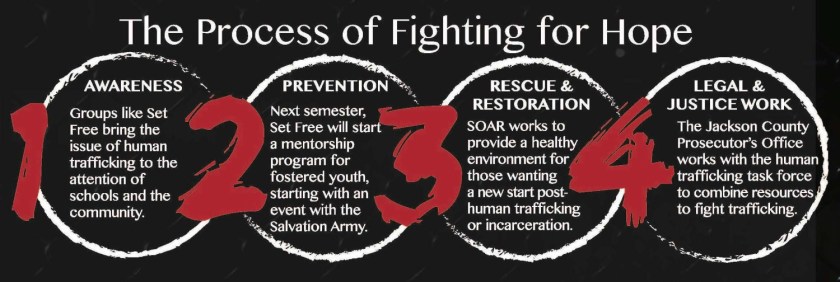
Graphic by Kayla Williamson.
The land for the program has already been identified, but until its official opening in the next year or so, SOAR is spreading the word and raising money by hosting a “mobile” café. They host house parties where guests are paired together to create a meal, and at the end all the guests and a SOAR representative share food and SOAR’s mission. SOAR representatives are also spreading the word and raising money by selling healing products and a cookbook with “items by inmates.”
Girls must apply to the program and will be evaluated by social workers to determine if they are capable of completing the program. If so, they will be entered into the program, and if not SOAR will work with community partners to make sure they are cared for.
The community of Jackson is working on all sides to fight the underground slavery in their backyards. SOAR is just one of many groups to be working on this issue.
“I think [God] wants captives free,” Cochran said. “To be a part of that is humbling. I think that as we work together as a community, each person or group or organization doing their part, at the very least we can make it highly uncomfortable for trafficking to exist in Jackson.”
Prevention
Cochran was not the only one looking at buildings for potential rescue homes. When the anti-human trafficking movement at Spring Arbor Free Methodist Church (SAFMC) called Set Free started to hone their sights on certain areas to tackle, the leader, Amber McKee, thought they were going to open a home for survivors. In fact, she was already searching for buildings.
Graphic by Kayla Williamson.
But before she could go any further, a community assessment of Jackson’s needs closed that door of helping survivors and opened it to working with kids most vulnerable to recruitment into human trafficking.
A year ago, when someone asked what Set Free did, the answer would take 10 minutes. Now they have decided to focus on a specific issue within human trafficking. A study of “The Just Church” by Jim Martin said the place where a church can have the most impact on justice work is where God’s will, gifts and talents of the group and a community’s need come together. So they held a community survey. With the help of Spring Arbor University (SAU) alumni Deja Williams, the group contacted schools, law enforcement, churches, nonprofits, government organizations and more to try and identify the gap in the community they could fill.
That gap was with vulnerable youth and teens. A study by the Polaris Project found the most common vulnerabilities in potential victims of human trafficking. Some of those vulnerabilities include kids in the foster care system, juvenile justice system or victims of abuse and neglect. Williams found that 35 percent of youth in Jackson have confirmed cases of neglect or abuse. Twenty-five percent live in poverty.
Out of that research came the idea of the Brave event. Originally sponsored by the Salvation Army in California, Brave events reach and empower teen girls in the foster care system.
“Brave is an opportunity for us to intersect with youth that are hurt and have been neglected,” McKee said, “to come into their life and tell them they are worthy. They’re created in God’s image.”
But they are not only focused on girls. Post-event, the Set Free movement is starting a mentorship program between its members and teens in the Michigan Youth Opportunities Initiative (MYOI). It is a group of foster teens that meet every other week and are trained in “leadership, media and communication skills, including how to strategically share their story and present on panels” according to MYOI’s website.
By starting this new program, McKee hopes the Set Free Movement will help prevent youth from entering human trafficking in the first place. Through partnerships with the Michigan Department of Health and Human Services, Salvation Army, public schools and more, the Set Free Movement has been able to raise awareness and educate students and other members of the community about the risk and vulnerability of those in human trafficking.
“There’s going to church and doing church things, and then there’s being the Church,” McKee said. “We’re outside of the boundaries of the church building, and we’re actually in community. It really feels like being the Church that God wants us to be.”
Justice
With a human trafficking conference at SAU, multiple programs and organizations addressing the issue and a dedicated task force connecting individuals from all of those groups, one would think Jackson County is riddled with brothels, girls on street corners and pimps ready to exploit anyone vulnerable.
Yet Jackson County has not prosecuted a single human trafficking case.
According to Jackson County’s Attorney Prosecutor Jerry Jarzynka, building a case against human trafficking requires resources local law enforcement does not have. It is a challenge to gather enough time and resources to build a case against human trafficking or enough officers to mount a surveillance operation.
That is why the county depends on community groups like SOAR, Set Free and others to start the movement. With the support of the Jackson County Human Trafficking Task Force, which connects the people fighting human trafficking in Spring Arbor and Jackson, the community is able to see, support, and fight together to help Jackson become “a community known for freedom,” as Cochran puts it.
The more diverse the backgrounds and talents of the task force, the better. A couple of FBI agents attended the last task force meeting, and Jarzynka sees the potential to start the offensive.
“With FBI agents who just attended our recent task force meeting, we are involved with discussions trying to organize a co-op effort with FBI and local law enforcement,” Jarzynka said. “So that’s encouraging. You need to do that if you want to be able to put a case together.”
Enforcing human trafficking laws by local government is also a challenge because of a lack of training and education, Jarzynka said. The laws are also so new that nobody knows about them.
Associate professor of sociology Jeremy Norwood agrees. He also sees a discrimination and corruption within the criminal justice system that prohibits the full enforcement of laws against human trafficking.
“Prostitutes are seen as perpetrators and not victims. Immigrant farm workers are seen as aliens rather than victims, and are revictimized by the system,” Norwood said.
The United States and other Westernized countries compared to the rest of the world have polarized views on this modern day slavery, Norwood said. Western countries think human trafficking is bad but are ignorant to its presence in their backyard. Other parts of the world see it as normal due to weak criminal justice systems and lack of resources.
That is why awareness and education are some of the first steps to fighting human trafficking. The Set Free Movement, Northwest High School’s Code Orange and counseling services like Flourish have those covered. Set Free is working on preventing vulnerable youth from entering the it. SOAR is the pathway to restoration. And the Jackson County Prosecuting Attorney’s office and task force work with the legal side.
“It’s really quite beautiful to watch the community come together to do something about this issue because it’s just so vial,” Cochran said.
It takes a village to work together to fight slavery in one small part of the United States. But that does not mean the fight starts and ends here. All of these groups would not be where they are today without partnering with each other and connecting with others in the community to share stories, experiences and resources.
Don’t try to contact Will Sanders, Andrew Depoy or Canyon Smith on Tuesday nights at 10 p.m., because they will be working hard to win $5,000 in scholarship money. How? A not-so-little online game called “Hearthstone.”
Based on the hit game, “World of Warcraft,” it is an online fantasy card game with minions, spells and heroes.
“You have a hero that has thirty health and your opponent has a hero…and the first one to get their opponent’s [hero] down to zero wins the game,” Sanders said, describing the basic premise of the game. Depoy and Smith were familiar with the game, having played it before, so when Sanders approached them with a proposition of them teaming up for the Hearthstone Championship Tour, they agreed.
A screenshot from the game. Photo provided by playhearthstone.com.
The basic guidelines of the tournament are as follows: there must be three people per team, and teams are randomly matched to play against each other once a week for a span of seven weeks. The teams that accumulate a minimum of five wins and two losses by the end of the seven weeks will move on to the regional playoffs, around 15 teams of the original 300, and the top teams of playoffs in each region (North, South, East, or West) will be given the opportunity to play in the finals, traveling to a yet-to-be-determined location—most likely California, since that is where the finals were held last year.
Now, five weeks in to the seven-week tournament, they have a record of four wins and one loss. They have already played matches against Purdue and Michigan that seven to eight thousand people tuned in to watch over the livestream.
“I had no idea it was this big of a tournament,” Depoy said. Although playing for thousands of people seems like it would put the pressure on, Sanders, Depoy and Smith have not let it get to them yet.
“It feels the same, but we have a webcam shot onto us,” Sanders said. “You’re just thinking about, ‘oh, the whole time they’re just talking about how bad some of our plays are,’” he said regarding the commentators of the streamed matches.
They have two more matches left, and if they win one, they will officially move forward in the tournament. Although this is an online game, there is still a lot of ways to prepare.
“Deck building is super important,” Sanders said. Each team brings four decks and is able to choose what cards are in each deck. Once a team wins with one deck, that deck cannot be used again.
“If you have one bad deck, that holds everything back,” Sanders said. “There’s a lot of…strategizing that goes into that.”
When deck building, the team has to take into account what they think their opponents will bring, so they want to pick cards that are hard to beat. It is more of a strategy game than anything else, so preparation is an important factor.
The grand prize of the tournament is $5,000 in scholarship money per team member, but there are smaller cash prizes for the other finalists, the last being $500 for eighth place.
“Going to California for free and getting five hundred bucks doesn’t sound too bad,” Depoy said.
Lowell Hall is one of three female residence halls on Spring Arbor University’s (SAU) main campus. Built in 1970, it is known for zero air conditioning and a lobby that routinely smells like burnt popcorn. Lowell houses nearly three-hundred girls every year, each of whom are learning to live in community more and more each day. As of 2017, the Hall has undergone a leadership change by gaining a new Resident Director (RD). This year, Hannah Sinkovitz has succeeded the former RD, Kelly McGraw. This is Sinkovitz’s first year being an RD and says she has big plans for Lowell Hall this year, and for the many years to come.
Sinkovitz is an SAU and Indiana Wesleyan Universtiy (IWU) alumna. She obtained her Bachelor’s Degree at Spring Arbor, majoring in Psychology and minoring in Global Missions, and then proceeded to continue her Psychology education by gaining a Masters in Clinical Health from IWU. During her time as a student at SAU, Sinkovitz played on the soccer team. At IWU, Sinkovitz continued her soccer career as a coach, which helped to pay for some of her Master’s schooling. This time is also when she and her husband, Jake, began to gain experience in the field of being an RD. During their years at IWU, Jake was an RD for a men’s dorm, so Sinkovitz got to live with and experience everyday RD life first-hand. After finishing her Master’s program, Sinkovitz moved her family back to SAU, this time to work as an RD herself.
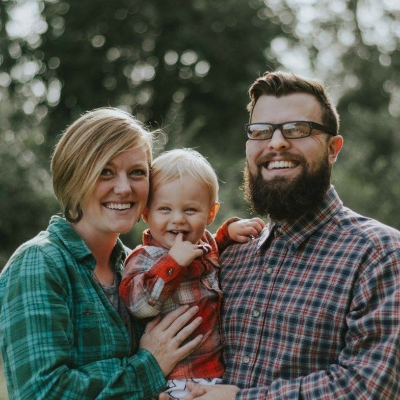
Hannah with her husband, Jake, and son Leo. From Facebook.
“It’s surreal to be back,” Sinkovitz said. “It’s definitely sooner than we thought, but it was always a dream for us to come back. We have relationships here and plan to invest here for a long time.”
Starting this year, and for the years to come, Sinkovitz hopes to make Lowell known for being a welcoming and safe place. She believes in making a residence hall somewhere students can deal with the uncertainties of life that college brings, including figuring out where one is going, learning how to live and preparing for the outside world. Sinkovitz’s main hope for her dorm is that it would be a place to belong. Part of Lowell lobby’s decorations are three painted pictures with the words, “Here We Belong.” These signs represent her hope that residence life will be a place to call home, a place to reside and grow alongside other women through these years of learning.
“College is a unique time,” Sinkovitz said. “It should be a time where we can let our guard down and give grace where it is needed the most.”
Sinkovitz has been learning alongside Lowell residence this year as students enter the new school year and as she starts her first RD job. Already, Sinkovitz says she has “learned a lot about herself and how people interact, how to deal with ‘spur-the-moment’ occasions and especially about having grace and patience.”
In the end, everyone is learning how to create his or her own “Here We Belong” space, whether it is senior year, freshman year or the first year on the job. This year, Sinkovitz wishes that, if nothing else, Lowell Hall can hold this meaning for all of its residents. A place where everyone comes as stranger, leaves as friends and knows that it is “Here We Belong.”
Stats and Facts
Harry Potter?: All the way, and she’s in Gryffindor house
Favorite TV Shows: Grey’s Anatomy, How I Met Your Mother, Parks and Rec and New Girl
Favorite movie: Currently Moana, because of her 18-month-old, Leo (go ahead and give him a highfive if you see him!)
Favorite drinks: Loves coffee with chocolate and sugar and is a fan of the Pumpkin Spice trend
Favorite memories from SAU soccer: team bonding trips to Puerto Rico and Hawaii, as well as team service projects.
Home Sweet Home: Her favorite place where she stayed on campus as a student was Delta 3
Last spring, I had the opportunity to study at the University of Oxford for a semester. While there, I was able to travel to numerous countries, and see lots of amazing things. Here, you’ll also be able to travel to the places I did, as I share some of the highlights of my trip!
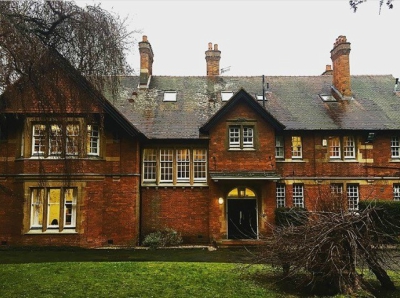
Home Sweet Home
Photo by Cathryn Lien
This is the Vines. I lived here for the three-and-a-half months at I was in Oxford, along with 33 other students from the United States.
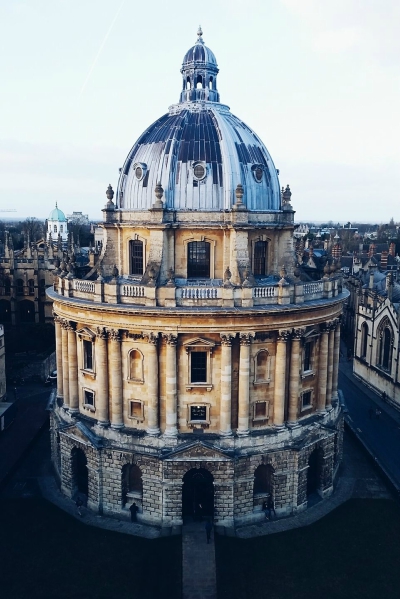
An Oxford Library
Photo by Natalie Seale
This beautiful building is the Radcliffe Camera, one of the many libraries that grace the city of Oxford. I spent many hours in this library reading historical texts and working on essays.
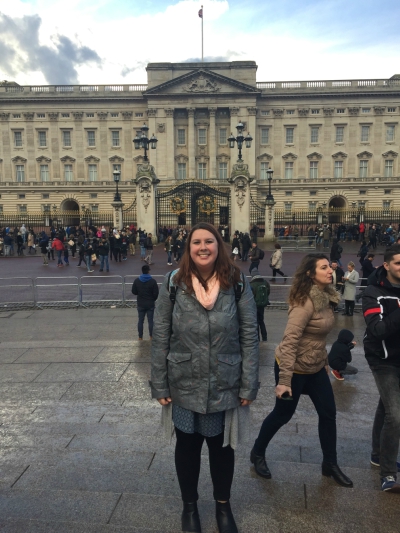
Buckingham Palace
Photo by Cathryn Lien
Here we see the official residence of the queen: Buckingham Palace. It’s always been a dream of mine to see this place, so I was thrilled when I got to go not once, but twice! Unfortunately, I was unable to go inside, but there’s always next time.
A Day Trip to Wales
Photo by Lily O’Connor
One of the places I got to visit was Cardiff, Wales. We took a train from Oxford and spend the day exploring city centre, Cardiff Castle and the bay area. I loved getting to see the history of this place, and experience a culture that was similar to England but still quite different as well.
Stonehenge
Photo by Lily O’Connor
I was also thrilled that we got to go to Stonehenge. Even though I was told not to get too excited, since it was just a “pile of rocks,” it was so cool to see and to imagine how people over 1,000 years ago managed to stack the rocks like they did. It was also fun to hear the different theories about why Stonehenge exists.
Poland
Photo by Lily O’Connor
During my Mid-Term break, some friends and I traveled to Poland for three days. We explored Warsaw and Krakow, looking at the old architecture and exploring the Jewish quarters. We also spent a day touring Auschwitz and Birkenau, which was incredibly emotional, but I learned so much about the people who died there and the impact the camps had on Poland. As a history major, and even more so as a human being, I was shaken as I stood in the same place thousands of people died and tried to imagine what it must have felt like then.
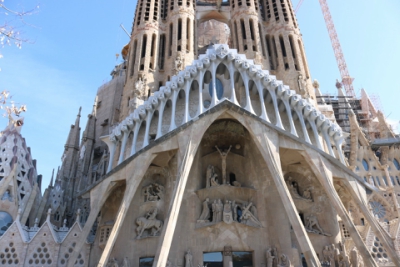
La Sagrada Família
Photo by Christine Murphy
On a lighter note, after exploring Poland, I traveled to Barcelona to finish out my Mid-Term break. While there, I got to see La Sagrada Família, which is a Gaudi-designed basilica. It has been under construction for about 100 years, but as the detail is so intricate, it is easy to understand why! We also look at some other Gaudi buildings, walked along La Rambla,and stuck our feet in the Mediterranean Sea. I definitely felt like I was in the Ed Sheeran song while here.
The City of Bath
Photo by Lily O’Connor
While studying at Oxford, we went on class field trips to different cities throughout England. One of these cities was Bath, which is appropriately named due to it being the home of the Roman Baths. While the water does not look very appealing, it was amazing to visit a place the Romans once used.
The Coventry Cathedral
Photo by Lily O’Connor
This is the Coventry Cathedral, in the city of Coventry. The city had been heavily bombed during WWII, and was mostly destroyed, including the cathedral on the left. All that remained of the original cathedral were the walls and the altar. They eventually rebuilt the cathedral, seen on the right, and host daily ceremonies to remind people about what happened in Coventry, to show the power of forgiveness and to pray that something like this never occurs somewhere else again.
Hogwarts
Photo by Meghan Hui
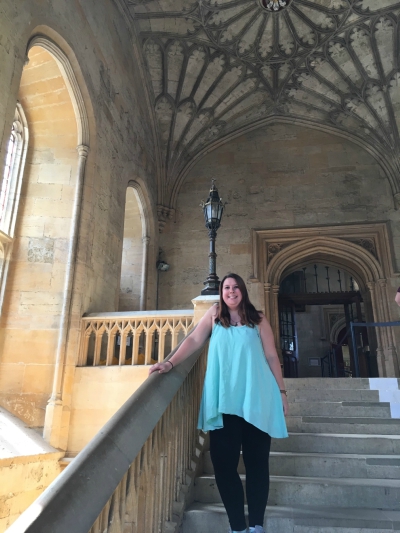
As a huge Harry Potter fan, I couldn’t not explore one of the most iconic places: Hogwarts! Now, I didn’t get to visit Warner Brothers’ Studios, but I did get to visit something just as good, Christ Church College. This is where the Great Hall is based on, and where the staircases that lead to the Great Hall are located, as seen above. These staircases are easily visible in the first movie, which always gives me a sense of happiness and nostalgia every time I watch the films.
All Things London
Photo by Lily O’Connor
Last but not least, is this photo from London. It is so quintessentially British that I would be a fool not to include it! You have Big Ben’s tower, the London Eye, a black cab, and a red double-decker bus all in one shot. I loved getting to explore London, and I had the opportunity to spend my last day in England exploring this amazing city. I spent hours inside the Tower of London, walked across Tower Bridge, saw Westminster Abbey and the Houses of Parliament, walked through Trafalgar Square and ended the night by seeing Les Misérables live on the West End. I was so sad to leave this beautiful place, but I can’t wait to go back and see everything once more! I love England so much and it will always have a very special place in my heart.
The students of Spring Arbor University (SAU) were thrown into the dark on September 23 after a fire broke out at the nearby physical plant late at night. Both Andrews and Gainey Hall lost power, and the clock tower lost power long enough to be behind by a few hours until it was fixed after a couple days.
Marty Fortress, the head of the physical plant, was able to shed light on what caused the confusion.
“Although the cause of the fire is still being determined by the insurance company, it appears as though the fire began in a transformer,” Fortress said.
Along with the power outages on campus, two generators that were burned during the fire were confirmed to be damaged beyond repair by the insurance company when they assessed the damage on Oct. 10. A few smaller pumps in different buildings also needed repairs due to the surge of power that happened during the fire.
Currently, nothing has been fixed permanently. Cables were rerouted to get power back up to the main campus, but the physical plant is still working through the next steps.
The physical plant is in the process of getting temporary generators to campus until permanent new ones are available. There is currently a 12-16 week waiting period for new generators, due to a shortage caused by the needs of the victims of the hurricanes in Houston and Florida.
In the meantime, workers are keeping things on campus going as smoothly as possible. The rerouted cables and temporary generators will provide power until permanent solutions can be made.
They walk around campus wearing proudly their blue and black uniforms with a yellow stripe across their hearts. They protect students from harm, are on call for emergencies and enforce parking regulations. They are the campus safety officers. Only a handful of souls brave this career path at Spring Arbor University (SAU), and one of them goes by the name Peter Breckner.
Breckner joined the SAU force this year as a Campus Safety Specialist. He is the head over parking regulations, students of Campus Safety and reporting information directly to the Director of Campus Safety.
Peter Breckner and his wife, Laura. From Facebook.
Before coming to SAU, Breckner worked at Davenport University. Davenport is about two hours away from SAU, where his wife Laura Breckner works in the Student Success and Calling Center on campus. The position at SAU offered him better hours and an administrative role and higher position than his previous job. It also allowed him to be closer to his wife. Now, the couple’s offices are across the hall from each other, which allows them to enjoy lunch together.
Breckner said he is excited about is the opportunity to incorporate his faith into his new career as a Campus Safety Specialist. He said his faith was not encouraged in his past positions, and SAU has provided for him a unique platform to share his beliefs with faculty and students alike. Now that Breckner works on a campus where his faith is encouraged, he says he is awaiting the opportunity to share his testimony to better the lives of those he encounters.
Stats and Facts:
Hobbies: swimming, biking, relaxing on the lake
Off the job: He volunteers as a Reserve Sheriff Deputy for his local county over summers and weekends
Over the summer, several Spring Arbor University (SAU) professors traveled abroad to reconnect with old acquaintances, enhance their knowledge of foreign cultures and prepare for future cross-cultural trips for students. Here are a few of their stories.
Russia and Kyrgyzstan
Tears welled in her dark brown eyes as she recalled reuniting with the friends she had not seen in over 30 years.
“I was so pleased, so surprised by the fact that they were so happy to host me,” Inna Molitoris, lecturer for the Gainey School of Business, said.
Molitoris was born in Kyrgyzstan and grew up in Ukraine. But when the Soviet Union collapsed in 1991, her family was forced to immigrate to Russia. This summer, after receiving a grant from the International Initiatives Committee of Spring Arbor University, she spent three weeks returning to the countries where she was raised.
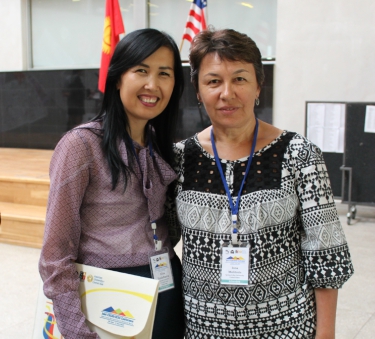
Inna Molitoris (right) at the conference in Kyrgyzstan. Photo provided by Molitoris.
The Kyrgyz, Russian and Ukrainian cultures changed significantly after the fall of the Soviet Union. From diversity to new technologies, Molitoris was curious to see how these countries have evolved in the nearly 30 years since the collapse. She came up with two goals to guide her research: to explore the local business culture and see if it could be productive for American people to develop relationships there and to explore how Christians in Kyrgyzstan are perceived by Muslims.
“I found that [in Kyrgyzstan] there is a very welcoming culture,” Molitoris said. “I spoke to Christians about how they feel in this country and they said ‘wonderful.’”
Looking back on the Soviet Union’s anti-religious campaigns in the 1920s-40s, this reflects a significant change.
Molitoris attended a three-day international conference in Bishkek, Kyrgyzstan’s capital, that addressed some of these issues regarding globalization. One of her favorite memories from the trip was realizing that her college roommate was a key speaker at the conference.
Cuba
Randy Lewis, Professor of Finance, traveled to Cuba this summer along with two other SAU faculty and 18 students. Lewis will be the lead faculty for the Cuba cross-cultural trip beginning in January of 2019. Professors Paul Nemecek and Terry Darling mentored Lewis during the trip in order to train him for the new position.
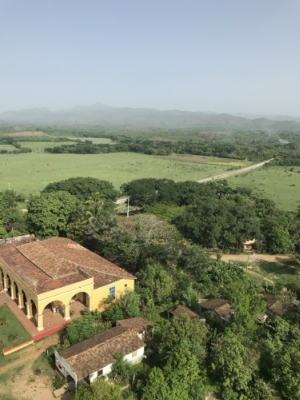
A view in Cuba. Photo provided by Randy Lewis.
Cuba is a communist country that was closed to travel from the United States from January 1961 until July 2015. Despite this, Lewis said the group always felt safe there and the people were friendly and hospitable. During their three-week trip, they stayed in homes with families designated by the government.
During their stay, the cross-cultural group traveled to five different cities, including Havana, Cuba’s capital. They visited museums, beaches and the United States Embassy and got a first-hand experience of what the culture there is like.
“The nature was just gorgeous there,” Lewis said. “There were a lot of beautiful flowers and beaches.”
He recommends the trip to students of any major, since the country’s openness to U.S. travel provides what might be a short-lived window. A knowledge of the Spanish language is not necessary to participate.
“It’s a fantastic trip… and it could be a once in a lifetime opportunity,” Lewis said.
Guatemala
SAU’s Guatemala cross cultural and semester abroad programs take place at what is known as “Cambio,” an SAU location where students take the classes required for their trips. Professor Kim Bowen visited the Cambio site this summer for a few different reasons.
On his first trip to Guatemala, Bowen’s goal was to learn about the program and how students are taught there. His second trip focused on establishing relationships with the Spanish instructors working there. This year, on his third visit, Bowen went to train the instructors and interact with them through workshops.
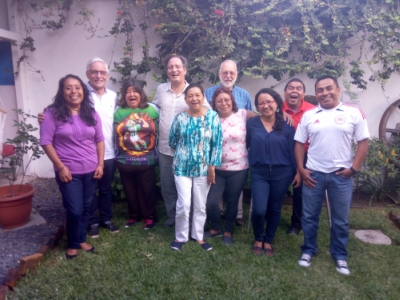
Kim Bowen (second from left) in Guatemala with a group. Photo provided by Bowen.
Spanish majors and minors are required to take certain classes abroad, so the staff received updated syllabi for each of the courses offered. They also worked with Bowen on different workshops regarding teaching.
Because the Michigan Department of Education (MDE) recently updated their requirements for the preparation of world language teachers, Bowen also brought details of new policies. The staff at Cambio needed to be informed of these changes before the next group of students arrived to study there.
Bowen said that the Guatemala trip is a must for Spanish majors and minors at SAU, because studying abroad provides students with an “intensive immersion” that cannot be replicated anyplace where the native language is not Spanish.
While in Guatemala, students also have the chance to volunteer at local elementary schools and clinics in the area. Similarly to the Cuba trip and other cross-culturals, students stay in the homes of host families while in country.
“[This trip] will open students’ eyes and hearts to the Latin cultures and the Latin people,” Bowen said. “It’s a wonderful experience.”