Grace is something that we can give to those that might not deserve it, but it can help us from keeping all of those feelings of frustration from destroying us.
Grace is something that I really want to work on for myself and I want to talk about it here first. So, what is confident grace? I would describe this as showing grace in a confident manner. This can be shown in two ways: giving grace without substituting your confidence and exhibiting confidence without substituting grace.
In this post, I want to share the words that I hope to implement more into my everyday life. I love the idea of starting fresh and making some important and necessary changes when needed.
GENEROUS GRACE
What is generous grace? One of the areas that I hope to work on this year is giving the grace that I want to receive. I oftentimes find myself being quick to anger or frustrated with others when they act in a way that I don’t understand. Even when they are in the wrong, I am aiming to adjust my reactions so that I can improve my own life. I won’t have to answer for anyone else’s actions but my own, so I want to act accordingly.
Grace is something that we can give to those that might not deserve it, but it can help us from keeping all of those feelings of frustration from destroying us. There will always be people and things that frustrate us, but we don’t have to let them dictate our lives.
I hope this post was beneficial in giving you encouragement to overcome your own frustrations as well. Choose grace, kindness, and love whenever possible.
You should join the Pulse if you are interested in journalism, writing, or just broadening your experiences. As a writer on the Pulse, you will have opportunities to interview peers and faculty, write engaging stories, and get to know other like-minded writers. If any of this interests you, it may be worth your while to join our team.
How has the Pulse helped you to use your voice?
The Pulse has helped me use my voice by encouraging the broadening of my worldview. I am able to write about topics and events that I am interested in and can use my voice to help others.
Feeling heard is so important. How does working on the Pulse make you feel heard?
Working on the Pulse makes me feel heard in that I feel like I am able to speak my mind. While no one will agree with everything that is said, I have the ability to feel heard because I am encouraged to write and share. I feel as if my stance on a topic truly matters and that everyone should be able to speak up when needed.
What opportunities has the Pulse given you that you might not have had otherwise?
One of the opportunities that the Pulse has given me is getting out of my comfort zone. Without the Pulse, I wouldn’t necessarily talk to the different professors that I have interviewed. It is also growing my leadership skills as I work as the editor and lead short meetings every week. There are dozens of opportunities at the Pulse, from learning to be a better writer to broadening your worldview.
Speak with kindness, share love, and remember to keep your words beautiful.
What does it mean to keep our words beautiful? Is it just a pretty saying to write out and never talk about? It it just something we say so that it seems like we care? No. It is so much more than that. Words are so extremely important and they do in fact affect us deeply. Words are a direct reflection of what is on our heart. There are two parts to this conversation: what our words say about us as individuals and how our words affect others. I will be breaking these discussions down below.
WHAT DO OUR WORDS SAY ABOUT US AS INDIVIDUALS?
Words are more important than most people might think. Words make up our languages and our thought processes. Words are how we communicate to others, how we speak up for ourselves, and how we share what’s on our mind. When we lash out and say things that are not kind, it affects us inside more than we know. Have you heard the saying “hurt people hurt people?”
That is so true. When something upsets us and our first response is to get angry and attack somebody else, our words convey that that is how we are feeling on the inside. Our words can either help or hinder our attitudes. Depending on which choice you choose, that is how you will be affected.
When we get defensive and attack other people, our insecurities are showing. When we respond with kindness and love, our confidence is showing. Which one will you choose to show?
Defensiveness is an interesting and complex facet of this discussion, partly because we all get defensive when we feel attacked or threatened. When we lash out with our insecurities, it is quite obvious and makes it very clear to the people around you what is going on. When we express kindness, it makes us appear confident in who we are. Our words have a profound effect on us and how we come across to other people.
Below are some ways to see what our words say about us and how they can affect us.
Words define our thoughts.
Words define what we feel on the inside.
Words can make us look like the bigger person, or the smaller person.
Words can convey specific messages.
Words can affect how we feel after we say them.
HOW DO OUR WORDS AFFECT OTHERS?
This seems to be quite obvious. Hurtful words not only affect ourselves, but also the people that we say them to. Watch your words and make sure that you aren’t reacting out of anger, because that off-handed statement that you made when you were upset can stick with someone for a lifetime. I know this all too well. I’ve done it before and I’ve had it done to me. It doesn’t feel good, from either party.
Instead of just blaming the other person, use it as a time to reflect on yourself as well and how you can do better in your own statements that were unkind. After all, we don’t have to answer for other people’s words. Only our own.
IN CONCLUSION…
I truly hope this post helped you if you find yourself struggling with wanting to lash out when someone has hurt you, or if you have lashed out and hurt people with words as well. Our words are so important and it is necessary to pay attention to them. Speak with kindness, share love, and remember to keep your words beautiful.
Erin Scroggs, the SGA Director of Events, shares what students can expect.
SGA is working hard planning events for the student body. They are curating new events and bringing back some fan favorites. Erin Scroggs, the SGA Director of Events, shares what students can expect.
Scroggs mentioned that each SGA department has different event planning responsibilities. “The Events team is hoping to have some of the fan favorites like 80s Skate Night and Glow Bowl,” said Scroggs.
The Spiritual Life department is planning other events. “They are looking to host Your Gift for His Glory where people can perform their talents that they use to glorify God,” said Scroggs.
Scroggs mentioned that the Intramural department is exploring new event ideas. “They are looking to have more tournament style events,” said Scroggs. “They plan to hopefully have a return of some of the team sports that people know and love.”
The Office of Intercultural Relations (OIR) department of SGA has been hosting movie nights that highlight different cultures and plan to continue to do so.
Scroggs hopes that these events will help students build community on campus. “The goal of all of these events is just to give students an opportunity to come together, have fun, and build community,” said Scroggs. “Our school becomes better when we are intentional to get involved and build community.”
Scroggs said these events are still being discussed and are not necessarily set in stone yet. “My recommendation for students is to keep an eye on the events tab of the SAU app and pay attention to the posters around campus,” said Scroggs.
After a year online, chapel is now available in person. SAU Chaplin, Brian Kono, explains why it’s back.
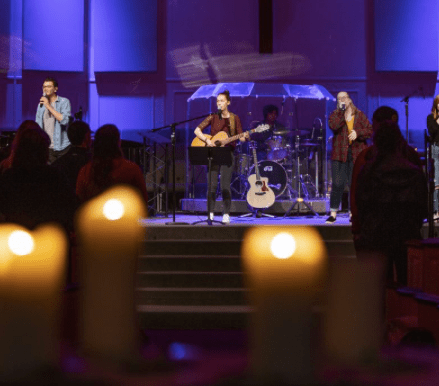
SAU chapel has moved from online to in-person and live-streamed, starting March 8th. It brings new safety regulations, a sense of community, and positive feelings from those who make chapel the great experience that it is.
Photo of Jasmine Harper
“Man, we’re so excited to spend time with you guys. I feel like we have been dreaming about this day.”
Jasmine Harper – Chapel Band Assistant/Singer
SAU Chaplin, Brian Kono, said the Committee of Corona Virus Planning Team and SAU cabinet (group of vice presidents and president) discussed having in-person chapel. They could have interpreted Michigan’s guidelines regarding gathering worship to allow in person chapel to some degree last fall. They chose to wait till the vaccine was out, numbers declined, and Michigan Health Services set new and broader guidelines for gathering.
They chose March 8th because it was after Spring Break. Kono’s original plan was to not have an in-person chapel throughout the whole semester. They had an alternative plan in case and as things got better, they decided to make the transition half way through J term.
“In regards to the support network we have with the audio, visual, and tech teams, and our chapel band, there were some things that we still needed to get in place in order to make the transition, so while we could have started at the beginning of the semester, it just happened to be the perfect storm in a good way of things coming together for us to make it happen after Spring Break, ” said Kono.
Most of the chapel speakers are willing to deliver their service in person.
“I felt like it went very well,” Kono said, regarding the chapel held on March 8th. “We didn’t fill our compacity of 250, but we certainty had a large gathering of folks who attended and worshipped together and we are encouraged by that.”
One of the chapel band assistants and singer, Jasmine Harper, prefers in-person chapel over online chapel. She said there was something special about connecting with the congregation during live service.
Kono said he prefers in-person chapel and hopes the number in attendance will rise.
A mugshot of Brian Kono.
An in-person chapel allows Kono to:
Connect with people because he can see their faces.
Respond better to community or world happening.
Provide a sense of pastoral care.
Be more flexible with live worship.
In-person chapel also allowed Kono to respond better to worship. He said worshipping while being recorded doesn’t “provide the best context for singing a worship song.”
For recording chapel, he did enjoy creating the program and recording before hand on Friday or Saturday. He didn’t have to worry about speakers being on time or not doing something well.
Recording chapel was not easier than In-Person chapel. There were moving pieces to coordinate and speakers had trouble speaking to a camera instead of a live audience. Putting all the pieces together took a long time.
Harper said she was excited to work with SAU’s video/communication department for the online chapel, but the live-streams made chapel feel like a performance, instead of communal worship. In-person chapel allowed her to receive feedback when worshiping.
“We have a great Almost Chapel production team,” Kono said. “Clayton Saren who’s an adjunct professor but also the head producer of Almost Chapel led a group of students who create the announcement segment of the video. And then, two of the production crew bring all of the pieces together. It is mostly a student team that makes that happen. They work incredible hard and I am grateful for them.”
To attend, students, staff, and faculty have to reserve a spot at signup.com. Kono sends out a link every week. Harper encourages students to sign up for chapel.
From Kono’s advice and his email, students are asked to:
Not come to in-person chapel if they are feeling unwell.
Not come if they answer ‘yes’ to any of the health screening questions on the SAU app.
Wear a mask.
Enter through the main door to the building underneath the portico.
Avoid congregating at doors and spread out to use doors throughout the foyer area.
Sit in the available rows on the main floor of the auditorium and move toward the middle of the pew.
Sit at least an arms length from your neighbor.
Exit through the closest exit door and avoid cueing.
SAU is following the Arbiter’s guidelines. SAU follows their attendance restrictions and has limited the attendance to 250 people. The Arbiter has agreed to leave their ribbons up, which provide distancing between people.
“I think there is a pretty large segment of population on campus who really enjoy chapel,” said Kono. “Having no place where we can get together, see each other, and worship together all semester through the fall has kept the university from feeling a greater sense of community. On Monday, a number of students mentioned to me how grateful they were to be able to gather in that way because it just felt like they were apart of something bigger than themselves while they were here on campus”
SAU has a chapel because they view it as a key part in creating a community of learners. It is required for students who aren’t commuters because it is a space for everyone to come together to hear a common message. Kono said that we should consider church as our lifelong place of learning.
He said it is a place where we focus on Jesus Christ as our perspective for liberal living and learning. Also, speakers from different disciplines are brought in to challenge us to think about how we can be “critical participants in the contemporary world”.
While Kono couldn’t find the exact date chapel was created, the way chapel is presently has existed since the 1980’s when Kono’s predecessor, Ron Kopeck, was in charge.
Kono hopes chapel is a place to encourage and challenge people. He said that before Covid, chapel was also the one place where you see most of the student body come together. People develop a sense of coming together to do something special at SAU.
Chapel will mostly be on Mondays. There will be some occasions of a Wednesday chapel due classes being canceled on the Easter travel day. There is also an extra all worship chapel on March 31st. SAU intends to have Monday and Wednesday chapel next fall.
Spring Arbor University is once again hosting its annual Focus Series event.
Spring Arbor University is once again hosting its annual Focus Series event. The theme this year is Liturgy and Practice with keynote speakers: Alan Noble and Jen Pollock Michel. This event is series or workshops, and seminars that run from Monday, March 15, to Friday, March 19.
Alan Noble, Ph.D.
Alan Noble, Ph.D., is the co-founder and editor-in-chief of Christ and Pop Culture, and the author of “Disruptive Witness.” Noble is an assistant professor of English at Oklahoma Baptist University.
Noble is hosting two focus sessions. First, on March 16, from 7:00 to 8:30 pm. He is hosting a session titled Why Doesn’t the Gospel Cause Riots? Acts 19. This session highlights Paul’s experience in Ephesus, considers how the practices of our society can blind us to obvious idols, and examines how this habitual idolatry might be a reason why the gospel doesn’t cause riots today.
Second, on March 18, from 4:00 to 5:30 pm, Noble is hosting a session titled The Promise of Technique: Methods for Building a Newer and Better You. This session highlights that we are addicted to methods for living better, more efficient, more pleasurable lives. It seeks to answer the questions: What conception of the human person do our efforts at self-improvement assume? And how does that anthropology square with the Christian account of human persons?
Jen Pollock Michel is the award-winning author of “Teach Us to Want,” “Keeping Place,” and “Surprised by Paradox.” Her newest book, “A Habit Called Faith,” was released in February 2021. Michel holds a B.A. in French from Wheaton College and a M.A. in Literature from Northwestern University. She is the lead editor for Imprint magazine, published by The Grace Centre for the Arts.
Michel is hosting two focus sessions. First, on March 15, from 4:00 to 5:30 pm, she is hosting a session titled Desire in a Digital Age: Examining the Liturgies of the Smartphone — and the Impossible Commands of Jesus. This session focuses on the premise that our digital habits are our most formative ones. It will examine some of the seductions of the smartphone, the desires formed by our digital technologies, and some of the counter-forming practices we must take up as those who belong to Jesus.
Second, on March, 17 from 7:00 to 8:30 pm, she is hosting a session titled Practice Makes Perfect: Discovering the Role of Habit in the Spiritual Life. This session focuses on the fact that repetition is a key to spiritual growth, which can be both good and bad for us. It will examine the principle of habit for the growth of the Christian.
Alongside the two keynote speakers, nine SAU faculty and staff will be hosting workshops on Wednesday, March 17th. These workshops will be hosted by Dr. Caleb Chan, Dr. Ken Brewer, Professor Jim Dolson, Professor Garnet Hauger, Dr. Laura Widstrom, Dr. Allen Knight, Dr. Mark Correll, Dr. Brian Kono, and Andrews Hall Resident Director David Breyette.
Students can view the full workshop schedule and access the Zoom links for each session on the SAU app under the Focus 2021: Liturgy & Practice tile.
Jenna Spek, the Resident Director of Lowell Hall, shares what Women’s History Month means to her.
March is Women’s History Month. It is a time dedicated to honoring women and their contributions to American history.
Women’s History Month originated as a week-long celebration of women in history in 1978. In 1987, Congress designated the month of March to celebrate women of history. Jenna Spek, the Resident Director of Lowell Hall, shares what Women’s History Month means to her.
“I think it’s important to celebrate everyone all the time,” said Spek. “Celebrating and advocating for all humans is important, but it’s also important to set aside time to celebrate certain groups specifically.”
“All humanity gets to celebrate each other all the time, but this month we’re focusing on women,” said Spek. “We’re getting a chance to reflect on the boldness of women in history and their ability to wholeheartedly pursue their gifts and abilities.”
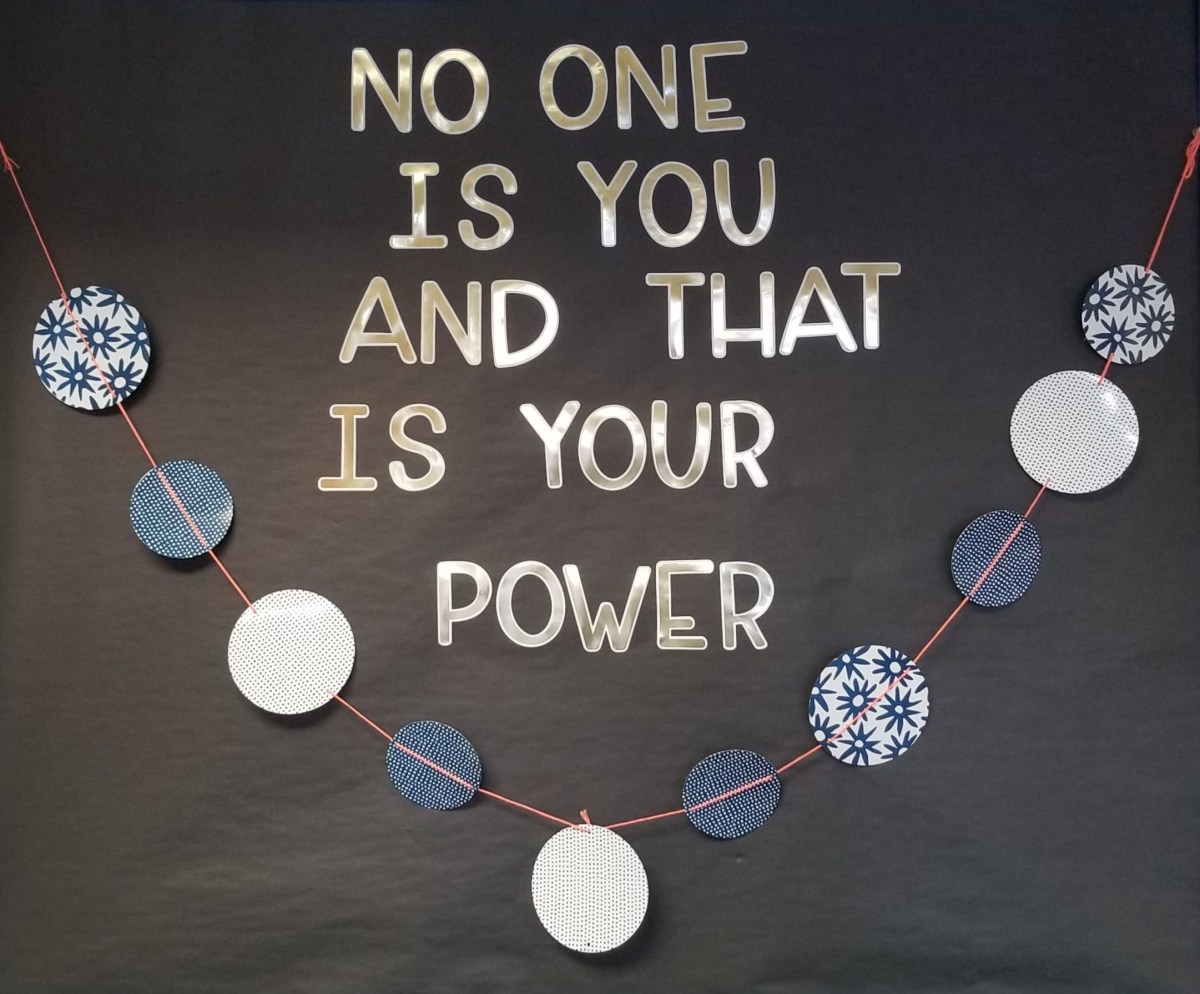
Women’s History Month ties into Spek’s overarching theme for Lowell Hall. “My theme for Lowell this year is that no one is you, and that is your power,” said Spek. “During Women’s History Month, we will focus on real women in history who embraced that no one was them and understood that it was their power.”
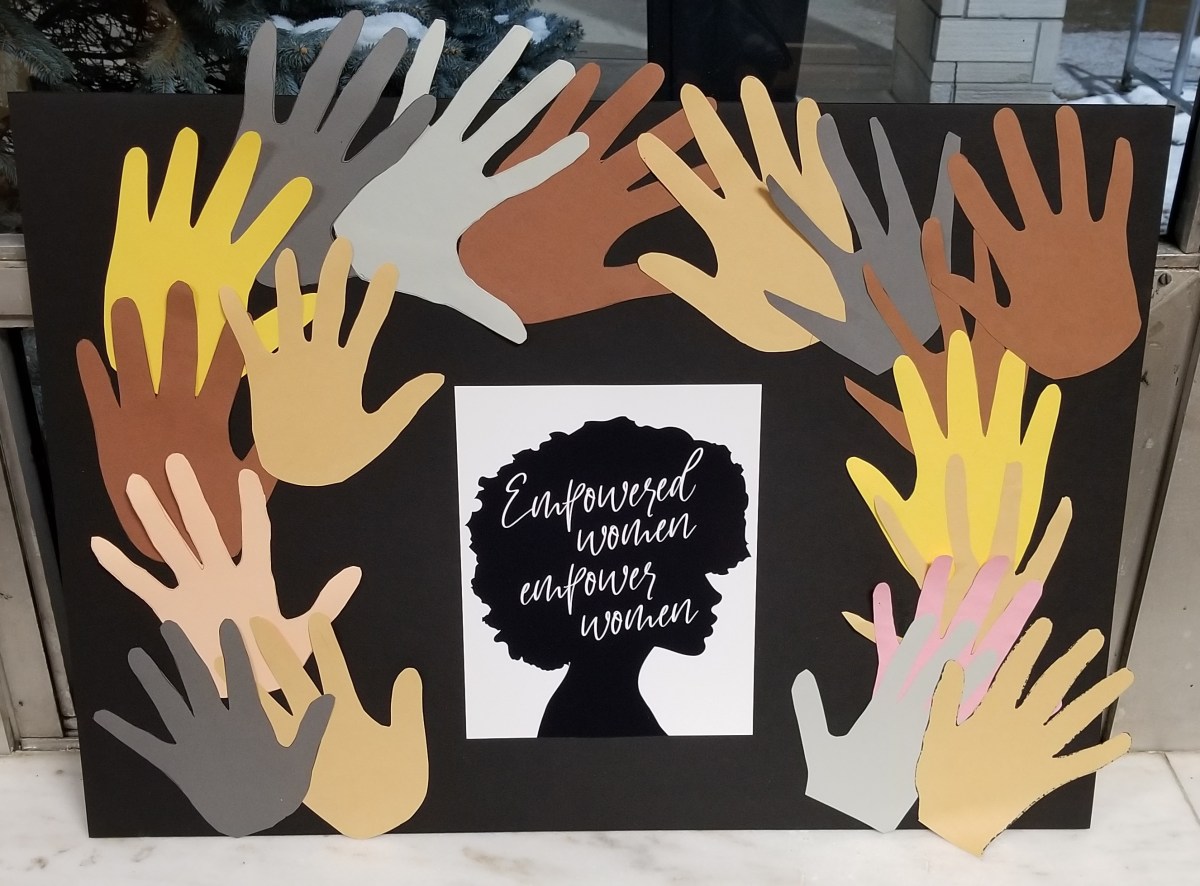
Spek believes this month is an opportunity to simultaneously empower and be empowered by women. “I believe that everyone has a unique purpose, power, and value,” said Spek. “It’s empowering to look at women in history and see how they were able to apply their unique passions and purposes.”
“This month, I hope the girls of SAU celebrate women in history and how it reflects them and their unique passions and purposes,” said Spek. “I also hope that everyone can feel empowered by looking at what humans have done, especially as we celebrate women’s accomplishments this month.”
Spek highlighted that Women’s History Month is right after Black History Month in the calendar. “It’s awesome that Women’s History Month piggybacks Black History Month,” said Spek. “It allows us to especially focus on, celebrate, and honor women of color.”
Spek also acknowledged that the COVID-19 pandemic has given her a new perspective on Women’s History Month. “We’ve gone through trying seasons and had to overcome difficult things,” said Spek. “Celebrating Women’s History Month is encouraging because we get to see how women of history have persevered, overcome hardships, and drew strength from their resiliency.”
To Spek, Women’s History Month is an opportunity to learn from the past. “It is a beautiful opportunity to reflect on the past, said Spek. “And the future is something we get to dream about.” This month is an opportunity for our campus to honor and celebrate the accomplishments of women in history, so keep an eye out for upcoming events on the SAU App.
The Human Condition and God’s Nature is returning to the Andrews Hall Lobby on March 18th.
Photo of Ryan Northup provided by him
Ryan Northup’s Bible study group is coming back to Andrews Hall after Spring Break. The first meeting will be in person on Thursday, March 18th in the Andrews Hall Lobby.
The group is called The Human Condition and God’s Nature. Unlike many other Bible groups, Northup’s club focuses on the Old Testament.
Northup said he wanted to find a book of the Old Testament because many other groups focus on the New Testament. He wanted to find a book that other people would enjoy talking about and wouldn’t be too hard to understand.
“Psalm is a really good book that has a lot of emotions and perspective in it so I thought it would be really good to make a Bible study out of it.” said Northup.
Northup said he created the group last September of 2020. He wanted to show people that even though they fall short of God’s standard, He is always going to be faithful to them. He wanted his Bible study to be a comfortable place for people who struggle with their faith and have doubts.
Northup starts his Bible group meetings with an icebreaker. He comes up with a different question that is usually tied to the passage they are reading. Then, each member will read a few verses from that chapter of the Psalm. If there is time, Northup will take prayer requests at the end.
He said leading the Bible group made him think about how he wanted to teach the Bible to others. Also, it made him think about how he could look at a passage and see how it could teach other people and not just himself.
“I think it [the Bible study] has made me and the other members of my group think about how we can worship God through everything that we do, and it has helped us appreciate who God is a lot more,” Northup said.
To create his Bible group, Northup talked to Sierra Traub who designs the posters for every Bible study. She also promotes the Bible studies on the SAU Spiritual Life Instagram page.
Usually he had 3 to 4 members at each meeting before he went on Zoom. Then, attendance decreased. He thought that the reason for the decrease in attendance was because of the change in Covid protocol. They started out in person but ended on Zoom. He felt it was difficult for people to want to go because they were tired from all the Zoom meetings or, if it was in person, they were tired of wearing their masks everywhere.
Northup thought that going to a Bible study would help people’s feelings about Covid. He said he covered Psalm 91 last semester and the chapter was about God’s protection. It mentioned God protecting people in the midst of sickness or pandemic.
“Because you’ve made the Lord my refuge, the Most High, your place of residence—no evil will happen to you; no disease will come close to your tent.” –Psalm 91:9
Common English Bible
Currently Northup and other Spiritual Life team members are greeting at Call of worship. Be sure to reach out if you are interested.
What does it mean when we go through worldly dilemmas and struggles and nothing seems to change?
What does it mean when we go through worldly dilemmas and struggles and nothing seems to change? Does God just not care? Should we just give up and never pray again? Why do we even bother pouring our heart out when that thing that we prayed so desperately for doesn’t seem to change?
The answer to this is complex and can be hard to take in during the moments of our pain. “But God’s way is best!” “Just pray and trust Him!” “Everything will all work out!” Have you heard these before? Maybe you’re going through a hard time and someone so kindly says one of these things.
While they are certainly true, they can be hard to grasp while we’re in the midst of our terrible heartache. Yes, we know God’s way is best, but I’m really hurting right now. You know what, God’s plan can HURT. His way of doing things can certainly be painful and full of consequences that we don’t always understand.
Do you know what holds true? Do you know what really helps me when I’m going through struggles where I feel like things can’t possible work out for the best? Knowing that God’s power is not limited to our human understanding.
“God’s power is not limited to our human understanding.”
We might not understand why things happen the way they do. But God sees us, hears us, and sympathizes with our pain. Our struggles do not go unnoticed.
It can be so difficult to understand why certain things happen in our life, but it is truly important to recognize that God knows what He is doing. It may be hard to practice that perspective while we are going through a trial, but it is definitely one worth analyzing.
So, what do we do when God tells us no? Trust. Even when it’s hard and we don’t want to. Trust His plan. Know that He has ways of working things out better then we could ever imagine. His timing is better than ours and His ways are better than our ways.
Take comfort in the fact that He made this world and He knows everything that is going to happen within it. Nothing will shock Him. Nothing will confuse Him. Nothing will ever throw Him off guard. Give your anxieties to Him and rest in the fact that we don’t need to stress and worry because God promises to never leave us.
We’re not going to always understand. We’re going to have doubts and think it’s the end of the world. But that’s just it, those are just our thoughts. Our human capacity for understanding doesn’t even come close to the power of God. Trust in Him and remember that He knows what He is doing.
February is Black History Month. This annual month-long observance is an opportunity for all of us to celebrate and acknowledge the achievements of African Americans. Here at SAU, Australia Smith, the Lead Intercultural Advisor for the Office of Intercultural Relations, tells us what Black History Month means to her and the ways we can celebrate it on campus.
February is Black History Month. This annual month-long observance is an opportunity for all of us to celebrate and acknowledge the achievements of African Americans. Here at SAU, Australia Smith, the Lead Intercultural Advisor for the Office of Intercultural Relations, shares what Black History Month means to her and the ways we can celebrate it on campus.
“When thinking about Black History Month, I think about how this is my time to shine,” said Smith. “For 28 days, I can unapologetically be me.”
To Smith, Black History Month is a time of celebration and education.
“I love my culture, Black culture, and being a Black woman,” said Smith. “I look at February as the time where I can embrace it to its fullest and everyone can see it, learn about it, and appreciate it.”
Black History Month is a time to celebrate Black accomplishments, but the celebration, appreciation, and education should go beyond the month of February. Smith said her Social Studies Education major causes her to view February as a time to celebrate Black achievements “with an emphasis.” She tries to make sure everyone feels welcome and represented during the month that is dedicated to their history and accomplishments. This mindset shaped how Smith coordinated events on campus for Black History Month.
“I wanted the Black students to feel represented and welcome to be open, and the rest of our friends on campus to be involved and learn,” said Smith.
There are several events on campus honoring and celebrating Black History Month. Smith coordinated two creation events in which students can participate in decorating the resident halls. On Wednesday, February 10th, they made wall decorations. The decorations were different for each residential building.
Smith ensured the event was in accordance with COVID-19 guidelines.
“It is a project that allowed separate but group collaboration to create one image to mean solidarity and unity for the building,” said Smith.
Another event was on Friday, February 12th, at 6:30 pm in each residence hall. Students painted a canvas that was hung up in the residential areas to help decorate for Black History Month.
There will also be several movie nights. Watch the movies 42 on February 17th, Black Panther on February 19th, and Just Mercy on February 26th. Each movie starts at 5:30 pm.
“These movies are all showing in the RCF and will involve active discussion afterwards,” said Smith. “We hope to see you there.”
Join us this month in observing Black History Month. It is an opportunity to educate ourselves, celebrate Black history and culture, and love our neighbors.